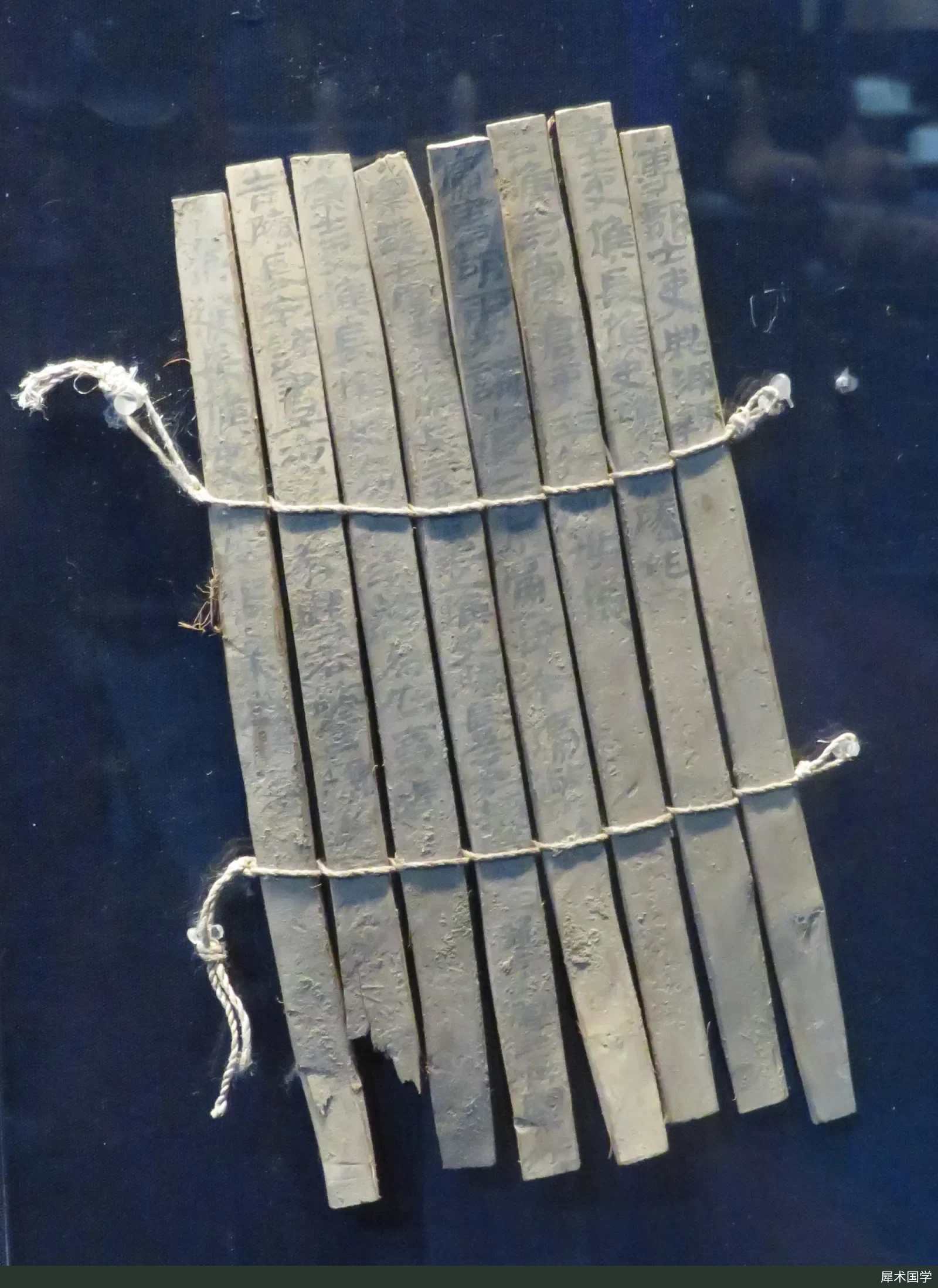
A group of Juyan Han slips, Han dynasty, held by the Inner Mongolia Museum. This image shows the physical form of Han-dynasty slips. It does not show the bamboo slips from the Han tomb at Bajiaolang, Dingzhou. All of the Dingzhou slips are carbonized, and images of the original slips appear in Dingxian Bajiaolang Han mu zhujian xuancui (Selected Bamboo Slips from the Han Tomb at Bajiaolang, Dingxian). Photo: BabelStone; source: Wikimedia Commons; license: CC BY-SA 3.0.
In 1973, a batch of carbonized bamboo slips was excavated from Han Tomb No. 40 at Bajiaolang in Dingxian (present-day Dingzhou), Hebei. Among them were 620 slips of the Analects (Lunyu). Their transcription runs to 7576 characters, less than half of the received text. The tomb occupant is generally believed to be Liu Xiu, King Huai of Zhongshan, who died in 55 BCE, so the slip text is a copy made before 55 BCE. Drawing on the official editorial reports, this article traces how the slips were excavated, damaged and published, and compares their wording and section divisions with the received text. It also introduces the scholarly disagreement over whether the slip text belongs to the Lu Analects, the Qi Analects, or a separate version.
Excavation and Two Rounds of Damage
This account draws on the excavation brief and the introduction to the bamboo slips published in Wenwu (Cultural Relics), 1981, no. 8, and on the overview of the editorial process in the “Chronology of Bamboo and Silk Discoveries” on the Bamboo and Silk Research website. According to these sources, Dingxian Tomb No. 40 lies in Bajiaolang Village, about 4 kilometers southwest of what was then the Dingxian town center. It was excavated in 1973 by the Hebei Provincial Cultural Relics Management Office and the Dingxian Museum. The tomb occupant is generally believed to be Liu Xiu (many sources write his name as 刘修), King Huai of Zhongshan in the Western Han. He died in the third year of the Wufeng era of Emperor Xuan of Han (55 BCE). The tomb was looted around the end of the Western Han, and the robbers started a large fire inside it, which charred and carbonized the slips. Carbonization kept the slips from rotting, but it also scattered and broke the bound bundles, and most of the ink became hard to read.
In June 1974, the slips were sent to Beijing for conservation and editing. In June 1976, Cultural Relics Press invited members of the Mawangdui silk manuscript editorial team to help number the slips and prepare transcriptions. In July of the same year, the Tangshan earthquake forced the work to stop. While the slips were being moved, someone who did not know what the wooden boxes held knocked one of them over, and the slips were scattered and damaged a second time. Editing resumed only from April 1980, when the Ancient Texts Research Office of the State Administrative Bureau of Cultural Relics convened the work and Li Xueqin led it. The same tomb also yielded other texts: Rujia zhe yan (Sayings of the Ru), Aigong wen wuyi (Duke Ai Asks about the Five Principles), Baofu (Tutors and Guardians), Taigong, Wenzi, and Liu'an wang chao Wufeng ernian zhengyue qijuji (Record of the King of Liu'an's Activities at Court in the First Month of the Second Year of Wufeng), as well as fragments of daybooks and divination texts. Of these, the Analects was the one whose full transcription was published as a monograph, in 1997.
Editing, Publication, and Surviving Text
The editorial results for the Analects slips were released in two stages in 1997. First, Wenwu 1997, no. 5 published three pieces by the Dingzhou Han Tomb Bamboo Slip Editorial Group of the Hebei Provincial Institute of Cultural Relics. They were “Selected Transcriptions of the Analects Bamboo Slips from the Tomb of King Huai of Zhongshan of the Western Han at Dingzhou” (transcription by Liu Laicheng, tracings by Zhang Shouzhong, pp. 49—54), a “Selected Collation and Annotation” (pp. 55—58), and an “Introduction” (written by Liu Laicheng, pp. 59—61). In July of the same year, Cultural Relics Press published Dingzhou Han mu zhujian: Lunyu (Bamboo Slips from the Han Tomb at Dingzhou: The Analects), edited by the group (ISBN 7-5010-0930-9). It presented the full transcription with collation notes and brief annotations. The editorial conventions of the “Selected Transcriptions” explain how the text was arranged. Chapter titles were supplied from the received text, and the sections within each chapter follow the order of the received text. The editors divided sections according to the slips only where the slips show clear signs of a section break. In other words, chapter names in the transcription such as “Xue er” and “Wei zheng” were added by the editors and do not necessarily appear on the original slips. The complete set of original slip images was not published at that time, so readers relied mainly on the transcription.
The editors counted 620 slips that can be confirmed as belonging to the Analects, most of them fragmentary. The slips are 16.2 cm long and 0.7 cm wide, and each holds about 19 to 21 characters. Each slip was bound with three cords, one at each end and one in the middle, and traces of the binding were still visible when the slips were excavated. The transcription totals 7576 characters, less than half of the received Analects. How much text survives varies greatly from chapter to chapter. “Xue er” retains only 20 characters, while “Wei Linggong” retains 694 characters, about 77% of that chapter in the received text.
Starting in 2019, the Research and Conservation Center for Excavated Texts at Tsinghua University worked with the Hebei Provincial Institute of Cultural Relics and Archaeology, the Chinese Academy of Cultural Heritage, and the Jingzhou Cultural Relics Conservation Center to conserve and re-edit the Dingxian slips. The first three of these institutions edited Dingxian Bajiaolang Han mu zhujian xuancui (Selected Bamboo Slips from the Han Tomb at Bajiaolang, Dingxian), and Mao Baozhong, Jia Lianxiang, and Zheng Ziliang prepared the slips for it. Zhongxi Book Company published the book (ISBN 978-7-5475-2128-1), and it was launched at Tsinghua University on November 1, 2024. It includes 175 rejoined, relatively well-preserved slips from eight texts, among them the Analects. It also provides wide-area images, images magnified 2.5 times, and the transcription cards from the first round of editing. For the first time, it showed scholars what the Dingxian slips actually look like. Because the author has not consulted the book itself, this article does not yet give the exact number of Analects slips in the Selected Slips.
Differences from the Received Text in Wording and Section Division
The editors state that the wording of the slip text differs from the received text in more than seven hundred places, and that section divisions also often differ from chapter to chapter. According to the editors' introduction, some of the more notable differences in section division are as follows:
- In “Xiang dang,” the passage from “He did not tire of finely polished rice” to “When the villagers drank wine” is divided into two, three, or five sections in different received editions, while the slip text treats it as a single section. The slip text also merges the two sections “At sudden thunder and fierce wind, his countenance would change” and “Mounting a carriage” into one.
- In “Yang huo,” the section “Zigong said: Does the gentleman also have things he hates?” stands alone in the received text. In the slip text, it is combined with the preceding “Zilu said” section.
- “Yao yue” has three sections in the received text. One slip in the slip text records the chapter's section and character counts and reads: “In all two sections, in all three hundred and twenty-two characters.” In the slip text, the received text's third section is set off from what precedes it by two small dots and copied below in two lines of smaller characters, so it looks like supplementary material.
Among the textual variants, one section in “Shu er” is frequently discussed. The received text reads: “The Master said: Give me a few more years, so that at fifty I may study the Changes (易), and then I may be without great faults (无大过).” Slip 157 preserves “…to study; then I too (亦) may be without (毋) great faults.” In other words, 易 (“the Changes”) is written as 亦 (“also”), and 无 is written as 毋. Lu Deming's Jingdian shiwen cites Zheng Xuan's annotated edition as saying, “The Lu reads 易 as 亦; I now follow the Old [text].” This means that the Lu Analects had 亦 here, while Zheng Xuan followed the Old Analects in reading 易. The slip text agrees with the Lu Analects reading, which shows that versions reading 亦 already existed in the Western Han. Scholars disagree about which reading is closer to the early form and whether this passage can be used to discuss Confucius's relationship with the Zhou Changes. This article only records the variant and draws no conclusion.
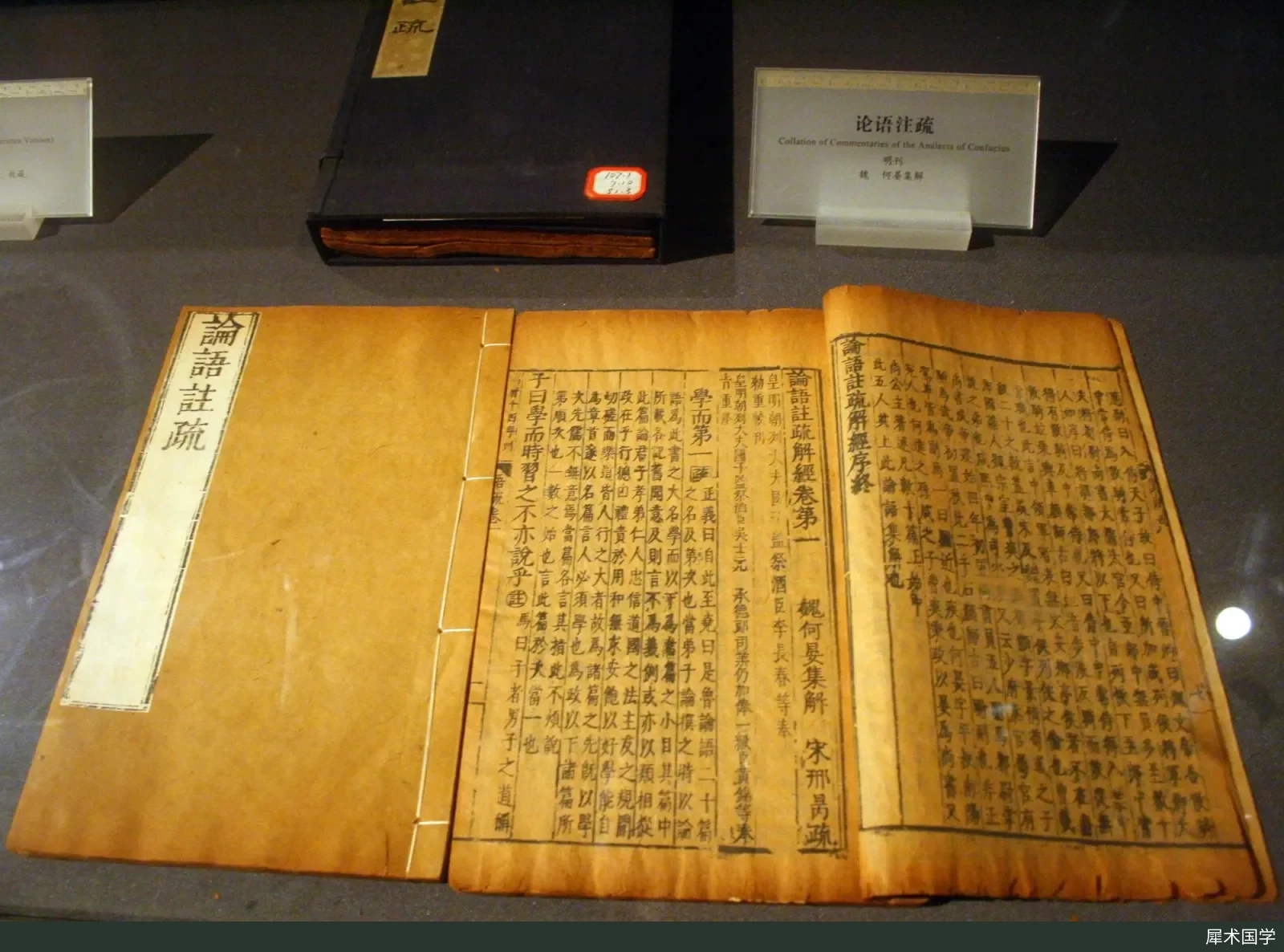
A Ming printed edition of He Yan's Lunyu jijie (Collected Explanations of the Analects), held by the Shandong Museum. The received Analects was transmitted largely through the line running from the Zhang Hou Lun through Zheng Xuan's commentary to He Yan's Collected Explanations. The image is included so readers can compare the appearance of the transmitted text with the slip text. The pages shown have not been verified and are not necessarily the “at fifty I may study the Changes” section of “Shu er.” Photo: AlexHe34; source: Wikimedia Commons; license: CC BY-SA 3.0.
The more than seven hundred variants are not all of the same kind. He Yongqin's study argues that the slip text is very close to the received text in its chapter and section structure, and that the differences lie mainly in wording. Some of these differences are scribal errors, omissions and abbreviations, and only some reflect the original state of the base text. The base text's use of loan characters and grammatical particles also shows traces of an orally transmitted text being edited. Therefore, before using a slip variant to correct the received text, one must first determine whether it is a copying problem or a genuine difference between versions.
The Debate over Lu, Qi, or Old Analects Affiliation
The “Treatise on Arts and Letters” of the Han shu records three Western Han schools of the Analects: the Old, the Qi, and the Lu. The Qi Analects had twenty-two chapters, two more than the standard twenty: “Wen wang” and “Zhi dao.” According to the “Treatise on Bibliography” of the Sui shu, Zhang Yu first taught the Lu Analects and later lectured on the Qi Analects. After comparing the two, he removed “Wen wang” and “Zhi dao” and adopted the twenty chapters of the Lu Analects as standard. This text became known as the Zhang Hou Lun (Marquis Zhang's Analects). At the end of the Eastern Han, Zheng Xuan took the Zhang Hou Lun as his base text and wrote his commentary with reference to the Qi and Old Analects. The received text largely comes from this combined and collated tradition. The Dingzhou slips were copied before 55 BCE, when all three schools still existed side by side, so the editors consider them new material for studying how versions of the Analects were transmitted. Scholars still disagree, however, about which school the slip text belongs to:
- Lu Analects: According to Li Ruohui's summary, this view is held by the editor Liu Laicheng and by Shan Chengbin. Shan Chengbin compared the slip text with the Analects quotations in the Shuowen jiezi, Zheng Xuan's annotated edition, and the Xiping Stone Classics. He found that it differs clearly both from the ancient-script text Xu Shen saw and from the Old Analects Zheng Xuan used for collation, and concluded that it belongs to the modern-script Lu Analects tradition. It also differs from the Zhang Hou Lun, perhaps because it came from a different teaching lineage.
- Qi Analects: Li Ruohui's article mentions that Li Xueqin holds this view.
- Cannot be determined on this basis: Wang Su points out that both Zheng Xuan's edition and the transmitted text are composite texts, and that no one has ever seen the genuine Qi or Lu Analects, so comparison alone cannot determine the nature of the slip text. He also rejects the Qi theory because the slip text generally divides chapters into fewer sections than the received text. Li Ruohui counters that ten surviving slips record section counts, and five of them give more than thirty sections, with the highest at forty-seven. This is more than the highest count of forty-four in the Lunyu jijie edition. He suggests that the slip text may be a separate text that circulated alongside the three schools, overlapping with them in some content and differing in other respects.
- Earlier than the division into three Analects: Chen Dong counted characters altered to avoid taboo names and concluded that the slip text is a copy from the reign of Emperor Gaozu of Han. That would place it outside the three Han Analects as traditionally described. Chen Kanli, drawing on the Haihun slips, argues that the Dingzhou slips are neither one of the three Analects nor a variant of one. Instead, he sees them as an older text from before the three versions developed their distinct features and became separate.
New finds have also changed the basis for comparison. In 1997, the editors called the Dingzhou slips “the earliest manuscript discovered so far.” In 2015, however, Analects slips were also excavated from the tomb of Liu He, Marquis of Haihun, in Nanchang, Jiangxi. Liu He died in 59 BCE. The back of one of his slips bears the chapter title “Zhi dao” (智道), which corresponds to the “Zhi dao” (知道) chapter that the Han shu “Treatise on Arts and Letters” records as unique to the Qi Analects. The excavators therefore believe that this group of Analects slips very likely belongs to the Qi Analects. Chen Kanli cautions, however, that the Haihun text does not fully match the Qi Analects recorded in that treatise. With the Haihun slips as a point of reference, the relationship between the Dingzhou slips and the Qi Analects can now be re-examined. Based on the materials published so far, the safest conclusion is this: the Dingzhou slips are an Analects manuscript copied before 55 BCE. Their chapter and section structure is close to the received text, but their wording and section divisions often differ. Which school they belong to depends on how one understands the boundaries between the Western Han “three Analects,” and that remains an open question. When citing variants from the slip text, readers should check both the 1997 transcription and the images newly published in the Selected Slips.
References
-
Dingzhou Han Tomb Bamboo Slip Editorial Group, Hebei Provincial Institute of Cultural Relics, ed. Dingzhou Han mu zhujian: Lunyu (Bamboo Slips from the Han Tomb at Dingzhou: The Analects). Beijing: Cultural Relics Press, 1st ed., July 1997. ISBN 7-5010-0930-9.
-
Dingzhou Han Tomb Bamboo Slip Editorial Group, Hebei Provincial Institute of Cultural Relics. “Selected Transcriptions of the Analects Bamboo Slips from the Tomb of King Huai of Zhongshan of the Western Han at Dingzhou” (pp. 49—54); “Selected Collation and Annotation of the Analects Bamboo Slips from the Tomb of King Huai of Zhongshan of the Western Han at Dingzhou” (pp. 55—58); “Introduction to the Analects Bamboo Slips from the Tomb of King Huai of Zhongshan of the Western Han at Dingzhou” (written by Liu Laicheng, pp. 59—61). Wenwu 1997, no. 5. CQVIP record page for the “Selected Transcriptions”
-
Hebei Provincial Institute of Cultural Relics (written by Liu Laicheng). “Brief Report on the Excavation of Han Tomb No. 40 at Dingxian, Hebei.” Wenwu 1981, no. 8, pp. 1—10. Ancient Texts Research Office of the State Administrative Bureau of Cultural Relics et al. (written by He Zhigang and Liu Shishu). “Introduction to the Bamboo Slips Excavated from Han Tomb No. 40 at Dingxian.” Same issue, pp. 11—13.
-
Hebei Provincial Institute of Cultural Relics and Archaeology, Research and Conservation Center for Excavated Texts at Tsinghua University, and Chinese Academy of Cultural Heritage, eds.; prepared by Mao Baozhong, Jia Lianxiang, and Zheng Ziliang. Dingxian Bajiaolang Han mu zhujian xuancui (Selected Bamboo Slips from the Han Tomb at Bajiaolang, Dingxian). Zhongxi Book Company. ISBN 978-7-5475-2128-1. New book introduction from the Research and Conservation Center for Excavated Texts at Tsinghua University (2024-10-30); Launch event news from the Hebei Provincial Institute of Cultural Relics and Archaeology (2024-11-07)
-
Shan Chengbin. “A Study Showing That the Dingzhou Han Tomb Bamboo-Slip Analects Is the Lu Analects.” Wenshi 2001, no. 3, pp. 47—56. Republished as “An Examination of the Nature of the Dingzhou Han Tomb Bamboo-Slip Analects.” Kongzi yanjiu (Confucius Studies) 2002, no. 2, pp. 29—38. For a summary of its views, see China Confucius Net, “Introduction to the Dingzhou Han Tomb Bamboo-Slip Analects” (2008-12-16)
-
Wang Su. “A New Exploration of the Nature of the Western Han Bamboo-Slip Analects Excavated at Dingzhou, Hebei.” Jianbo yanjiu (Bamboo and Silk Studies), vol. 3. Nanning: Guangxi Education Press, 1998, pp. 459—470.
-
Chen Dong. “Several Questions Concerning the Dingzhou Han Tomb Bamboo-Slip Analects.” Kongzi yanjiu (Confucius Studies) 2003, no. 2, pp. 4—13. CQVIP abstract
-
Li Ruohui. “A Study of the Section Divisions of the Dingzhou Analects.” Qilu xuekan (Qilu Journal) 2006, no. 2, pp. 20—23. CQVIP abstract
-
He Yongqin. “A Study of the Dingzhou Han Tomb Bamboo-Slip Analects.” Master's thesis, National Taiwan University, 2007. National Taiwan University Theses and Dissertations Repository; Airiti abstract
-
Chen Kanli. “海昏漢簡『論語』初讀 - 전한 중기 論語學의 고찰을 겸하여 -” (A First Reading of the Haihun Han-Slip Analects, with a Consideration of Analects Scholarship in the Mid-Western Han). 木簡과 文字 (Wooden Documents and Inscriptions) (year, volume, and issue to be verified). KCI record page
-
Wang Chuning. “A Brief Study of the Analects ‘Zhi dao’ Chapter Excavated from the Tomb of the Marquis of Haihun.” Website of the Center for Research on Excavated Texts and Paleography, Fudan University, August 29, 2016. Original article
-
Wang Zhenhui and Ding Sixin. “A New Study of the Classical Meaning of the First Section of the ‘Zhi dao’ Chapter of the Haihun-Slip Qi Analects” (citing the “Treatise on Arts and Letters” of the Han shu and the “Treatise on Bibliography” of the Sui shu). Reprinted by the Mencius Research Institute
-
Bamboo and Silk Research website. “Chronology of Bamboo and Silk Discoveries: 1973.” Internet Archive snapshot (2006-07-17)
-
Transcription of “Shu er” from the Dingzhou Han Tomb Bamboo-Slip Analects (slip 157; a secondhand transcription that should be checked against the original book when cited). Hanzi Guoxue Wang
-
Xishu Guoxue · Kindred minds, insight in a few words
-
Information compiled and published by Scholay One-Stop Academic Platform. If any content infringes your rights, please let us know and it will be taken down.
-
This information is also published on Enterscholar, a community for scholars in the age of intelligence.