Jing Fang of the Western Han is known for the eight palace hexagrams and the najia method, but his life is recorded mainly in the Hanshu, and the received three-juan Jingshi Yizhuan does not match the entry in the “Yiwen zhi” of the Hanshu. This article draws on the Hanshu, the Siku edition of the Jingshi Yizhuan, the Siku quanshu zongmu, and Yixing's “Gua yi” as preserved in the “Calendar Treatise” of the Xin Tangshu. It traces how the eight palaces are arranged, the rules for attaching heavenly stems and earthly branches, the relationship with Meng Xi's guaqi theory, and later uses such as the Huozhulin, along with assessments through the dynasties.
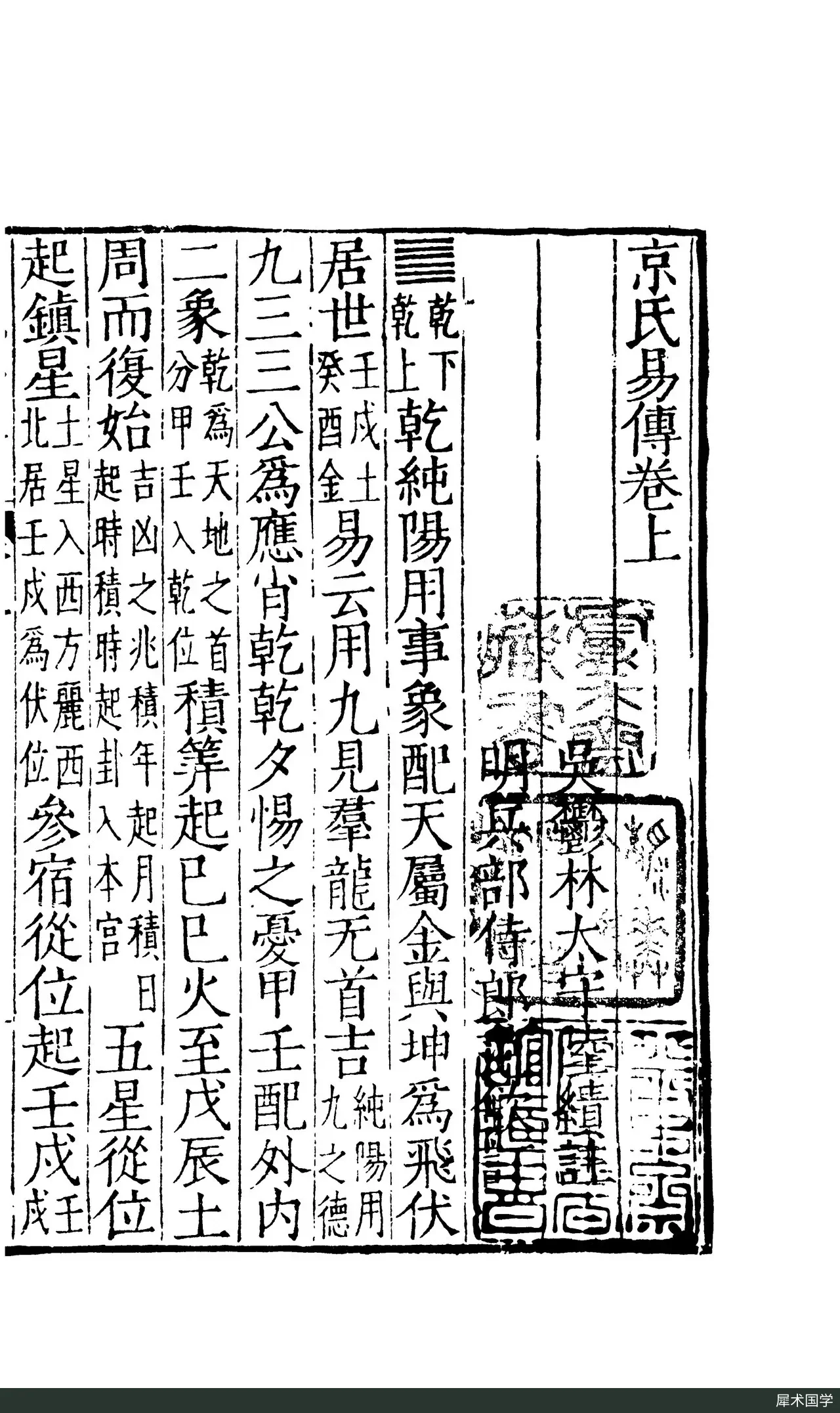
First page of the upper juan of the Jingshi Yizhuan. The opening lines read “Annotated by Lu Ji, Governor of Yulin, Wu” and “Edited by Fan Qin, Vice Minister of War, Ming.” This is the photographic reprint in the first series of the Sibu congkan of the Ming Tianyige edition held by the Hanfenlou in Shanghai. Image source: Wikimedia Commons (Sibu Congkan0043 scan, page 6), public domain.
Jing Fang's Life and the Formation of the Jingshi Yizhuan
Juan seventy-five of the Hanshu, the “Biography of Jing Fang,” records that Jing Fang, courtesy name Junming, was a native of Dunqiu in Dong Commandery, and that “his original surname was Li; by calculating with the pitch-pipes he settled on the surname Jing for himself.” He studied the Changes under Jiao Yanshou of Liang. Jiao's learning “excelled in calamities and anomalies; he divided the sixty-four hexagrams, assigning them in turn to govern the days, and took wind, rain, cold, and warmth as the signs,” and the biography says that “Fang used it with particular refinement.” In the fourth year of Chuyuan (45 BCE) Jing Fang became a gentleman (lang) as a filial and incorrupt nominee. During the Yongguang and Jianzhao eras he repeatedly submitted memorials on calamities and anomalies. He also proposed a “method for evaluating merit and assessing officials,” which made enemies of Shi Xian, Prefect of the Palace Writers, and Wulu Chongzong, Prefect of the Masters of Writing. In the second year of Jianzhao (37 BCE) he was sent out as Governor of Wei Commandery. A little more than a month after leaving the capital he was summoned back and imprisoned, and he was executed in the marketplace together with Zhang Bo. The biography closes by noting that “he was forty-one at his death.” The commonly cited dates “77 BCE–37 BCE” are worked back from this using the traditional sui reckoning of age. Note that the entry on Liangqiu He in the “Rulin zhuan” (Biographies of the Confucian Scholars) of the Hanshu mentions another “Grand Palace Grandee Jing Fang.” He was a disciple of Yang He of Zichuan, lived earlier, and is not the same person as Jing Junming.
On his lineage, the “Rulin zhuan” says that Jiao Yanshou “once asked Meng Xi about the Changes.” Jing Fang therefore treated Jiao's learning as Meng's learning, but Meng Xi's disciples Zhai Mu and Master Bai “would not accept this, both saying it was not so.” When Liu Xiang collated the texts, he judged that the various schools' accounts of the Changes “broadly agree in their main meaning; only the Jing school differs,” and that Jiao Yanshou had “alone obtained the teachings of a recluse and attributed them to Master Meng.” Despite these objections, the Jing school of the Changes was still established in the official academy under Emperor Yuan. As for writings, the Changes category in the Six Arts section of the “Yiwen zhi” of the Hanshu lists “Meng shi Jing Fang, eleven pian,” “Zaiyi Meng shi Jing Fang, sixty-six pian,” and “Jing shi Duan Jia, twelve pian.” All that can be read today is the three-juan Jingshi Yizhuan, attributed as “compiled by Jing Fang of the Han, annotated by Lu Ji of Wu.” Juan one hundred and nine of the Siku quanshu zongmu (Masters section, Techniques and Numbers category, part two) points out that this edition differs both from the eleven pian of the Han treatise and from the four juan recorded in the Wenxian tongkao. Even so, the editors held that because the divisions of ancient books were often split or merged over time, this “is not worth doubting either.” They also stressed that although the book “bears the title Yizhuan, it does not explicate the text of the classic at all.” My reading is that the editors addressed only the question of the number of juan. With the available material, it is hard to determine item by item which parts of the received text come from Jing Fang and which were added by later followers or commentators. In what follows, Jingshi Yizhuan refers to this transmitted edition and is not simply equated with Jing Fang's own writing.
The Arrangement of the Eight Palaces and the Shi and Ying Lines
The upper and middle juan of the Jingshi Yizhuan assign the sixty-four hexagrams to eight palaces. The text gives the order Qian, Zhen, Kan, Gen (“Qian generates the three sons”), followed by Kun, Xun, Li, Dui. Each palace is headed by one of the eight pure hexagrams, which is the palace's own hexagram. From there the lines are changed one at a time, starting with the first line, giving in turn the first-generation through fifth-generation hexagrams. After the fifth generation the top line is not changed. Instead the fourth line is changed back, which gives the wandering-soul hexagram. Then all three lines of the inner trigram are changed back to the palace's own trigram, which gives the returning-soul hexagram. The Qian palace, for example, runs: Qian, Gou (first generation), Dun (second generation), Pi (third generation), Guan (fourth generation), Bo (fifth generation), Jin (wandering soul), Dayou (returning soul). Under the hexagrams of the Qian palace the text says, “The eight hexagrams start from the Qian palace and reach Dayou as the returning soul.” It also says, “In all, the eight trigrams are divided into eight palaces, each palace with eight hexagrams, eight times eight making sixty-four hexagrams.”
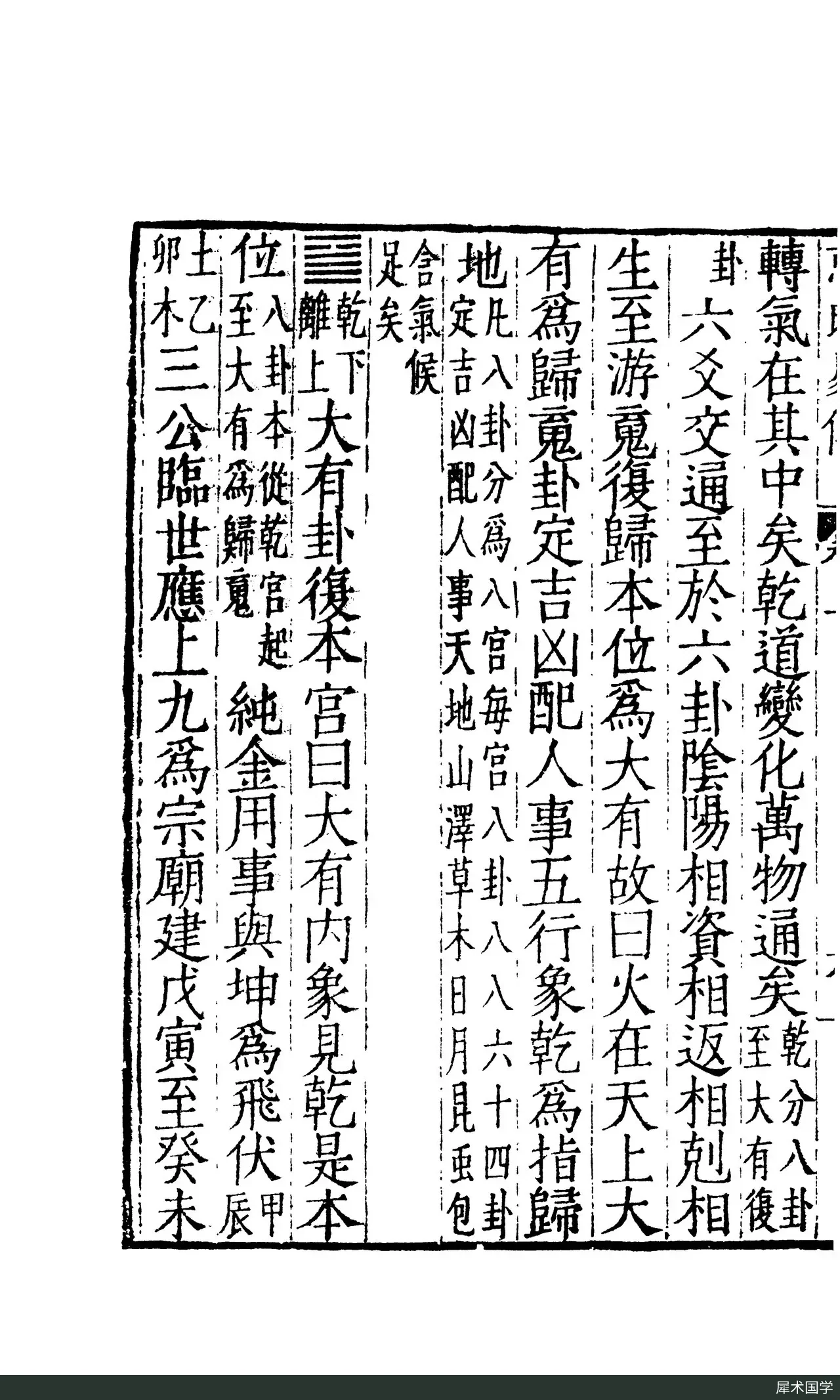
Last page of the Qian palace in the upper juan of the Jingshi Yizhuan. The main text in large characters reads “at the wandering soul it returns to its original position as Dayou…Dayou is the returning-soul hexagram,” and the double-column small note under Dayou contains “The eight hexagrams start from the Qian palace and reach Dayou as the returning soul.” This is the photographic reprint in the first series of the Sibu congkan of the Ming Tianyige edition held by the Hanfenlou in Shanghai. Image source: Wikimedia Commons (same scan as above, page 17), public domain.
Every hexagram has its shi (“generation”) line and ying (“response”) line marked. In the palace's own hexagram the shi is the top line (for Qian, “renxu is in the shi position, residing in the ancestral temple”). In the first- through fifth-generation hexagrams the shi line is whichever line was changed at that step. In the wandering-soul hexagram the shi is the fourth line, and in the returning-soul hexagram it is the third line. The ying line is paired by matching the first with the fourth, the second with the fifth, and the third with the top. The text also names the six lines by rank: for Gou, “the primary gentleman occupies the shi”; for Dun, “the grandee occupies the shi”; for Pi, “the Three Dukes occupy the shi”; for Guan, “the feudal lord approaches the shi”; for Bo, “the Son of Heaven governs the shi”; and the top line is called the “ancestral temple.” Each hexagram is also noted as forming a “flying and hidden” pair with some other hexagram, as with Qian, which “forms flying and hidden with Kun.” The lower juan further sorts the hexagrams into four classes by generation: “The first and second generations are the Changes of Earth, the third and fourth generations the Changes of Man, the fifth and sixth generations the Changes of Heaven, and the wandering soul and returning soul the Changes of Ghosts.” This arrangement has nothing in common with the Qian, Kun, Zhun, Meng sequence of the received Zhouyi. Its concern is the way yin and yang lines gradually wax and wane within a palace and then return, not the explanation of the hexagram and line statements.
The Rules of Najia and Nazhi
The general rule of najia appears in the lower juan of the Jingshi Yizhuan: “Dividing the images of heaven and earth, Qian and Kun, it adds jia, yi, ren, and gui to them…the images of Zhen and Xun are matched with geng and xin: geng, being yang, enters Zhen; xin, being yin, enters Xun. The images of Kan and Li are matched with wu and ji: wu, being yang, enters Kan; ji, being yin, enters Li. The images of Gen and Dui are matched with bing and ding: bing, being yang, enters Gen; ding, being yin, enters Dui.” In other words, Qian takes jia and ren, Kun takes yi and gui, Zhen takes geng, Xun xin, Kan wu, Li ji, Gen bing, and Dui ding, so that the ten heavenly stems are distributed among the eight trigrams. Qian and Kun each take two stems because the text regards them as “the root of yin and yang” and “the beginning and end of yin and yang,” and their two stems are assigned separately to the inner and outer trigrams. Under Qian the text says “jia and ren are matched with the outer and inner images…dividing jia and ren into the position of Qian,” meaning that the three lines of the inner trigram take jia and the three lines of the outer trigram take ren.
Nazhi assigns the twelve earthly branches line by line. The text gives no separate general rule. Instead it writes out each hexagram's lines with their stem-branch pairs directly under the hexagram. The six lines of Qian, from bottom to top, are jiazi, jiayin, jiachen, renwu, renshen, renxu, with the branches running forward and skipping one position each time. Kun, by contrast, starts from wei and runs backward, again skipping one position each time; the “yiwei” and “yimao” recorded under Yu and Pi correspond to the first and third lines of Kun respectively. Once the stems and branches are fixed, the text matches the lines with the Five Phases. For example, under Qian it says “earth approaches the inner image as father and mother,” which the commentary identifies as jiachen earth. Two levels need to be kept apart here. Matching stems and branches to lines is an organizing convention of the Jingshi Yizhuan. The practice of predicting good and ill fortune from the generating and conquering cycles of the Five Phases and from the six kin relations is something the Siku quanshu zongmu already places in the line of “the later method of coin divination,” and this article does not go into it. Separately, Wei Boyang of the Eastern Han explained najia in terms of the waxing and waning of the moon. The first volume of Zhu Bokun's Yixue zhexue shi (History of the Philosophy of Yi Studies) gives a separate entry to “Wei Boyang's theory of lunar-body najia” and discusses it apart from Jing Fang's Yizhuan, so the two should not be conflated.
Relationship with Meng Xi's Guaqi Theory and Later Assessments
The core of Meng Xi's guaqi theory is pairing hexagrams with the seasonal nodes. The Tang monk Yixing's “Gua yi” in the Dayan li yi (preserved in juan twenty-seven, part one, of the Xin Tangshu, “Calendar Treatise, Three, part one”) says: “The twelve monthly hexagrams come from Meng's commentary; his account of the Changes is rooted in qi, and only afterward is it illuminated by human affairs.” It also says that “Jing further matched hexagram lines with the days of the year.” Under this scheme the four cardinal hexagrams Kan, Li, Zhen, and Dui each receive “seventy-three eightieths of a day,” Yi, Jin, Jing, and Daxu each receive “five days and fourteen fen,” and the rest “all receive six days and seven fen.” Yixing held that Jing's “subtracting seventy-three fen to make the periods of the four cardinals is an unorthodox account, merely an attempt to fit the apocryphal text's ‘returning in seven days.’” He argued for returning to Meng's arrangement, in which “from the beginning of the winter solstice, Zhongfu governs.” The biography in the Hanshu also shows Jing Fang putting guaqi to practical use. His sealed memorials contain phrases such as “lesser yin redoubles its strength and rides upon the waxing and waning,” “murky vapor again rides upon the hexagram,” and “the Dun hexagram does not take effect,” all of which reason from the waxing and waning of hexagram qi to current affairs and calamities. The first volume of Zhu Bokun's History of the Philosophy of Yi Studies puts Jing Fang in the section “The Guaqi Theories of Meng Xi and Jing Fang,” which has three entries: “Meng Xi's Guaqi Theory,” “Jing Fang's Yizhuan,” and “The Place of the Meng–Jing Guaqi Theory in Yi Studies and Philosophy.” This shows that the book treats Jing Fang's Yizhuan within the context of the Meng–Jing guaqi tradition. As for whether Jing Fang really inherited his learning from Meng Xi, the objections of Zhai Mu, Master Bai, and Liu Xiang recorded in the “Rulin zhuan,” cited above, should be kept in view as well.
In later ages the Jingshi Yizhuan ended up mainly in the service of divination. The Siku quanshu zongmu says that what its lower juan discusses “is probably where the later method of coin divination actually came from.” It quotes the Southern Song scholar Xiang Anshi: “examined against the Jing Changes, the Huozhulin current in the world is its surviving method.” It also quotes Zhang Xingcheng: “the use of the Huozhulin takes Jing Fang as its ancestor.” The editors' own view of the Huozhulin was that “this is later people striving for shortcuts for the convenience of divination stalls, yet the original intent can still be traced.” On bringing the eight-palace terms into classical scholarship, the editors criticized Lu Deming's Jingdian shiwen for “annotating under each of the sixty-four hexagrams the names such-and-such palace first generation, second generation…wandering soul, returning soul, drawing them in to fit the meaning of the classic, which is a grave error.” An earlier assessment appears in the eulogy to juan seventy-five of the Hanshu. Ban Gu groups Jing Fang with Dong Zhongshu, Sui Meng, and others “who extrapolated from yin and yang to speak of calamities and anomalies.” He says they “borrowed the classics to set forth meanings, relied on analogies of images and categories, and perhaps could not avoid ‘guessing and often hitting the mark,’” and laments that “Jing Fang, in his small way, did not measure the depth of the waters, uttered perilous words of censure, and made enemies of powerful ministers.” Yixing, from the standpoint of calendrical science, said that Jing's guaqi, “when it comes to observing the changes of yin and yang, is confused and unclear.” Taking these materials together, I believe the assessments through the ages come down to roughly two points. As a symbol-and-number convention for arranging the sixty-four hexagrams, the eight palaces and najia have had far-reaching influence. But they do not explicate the text of the Zhouyi, and the Siku editors explicitly opposed turning them around to interpret the classic.
References
-
Ban Gu, comp., Yan Shigu, annot., Hanshu, juan seventy-five, “Biographies of Sui, the Two Xiahous, Jing, Yi, and Li” (biography of Jing Fang and eulogy), Wikisource transcription.
-
Ban Gu, comp., Yan Shigu, annot., Hanshu, juan eighty-eight, “Rulin zhuan,” Wikisource transcription.
-
Ban Gu, comp., Yan Shigu, annot., Hanshu, juan thirty, “Yiwen zhi,” Six Arts section, Changes category, Wikisource transcription.
-
Jing Fang, comp., Lu Ji, annot., Jingshi Yizhuan, three juan, Qinding Siku quanshu edition, Masters section, Techniques and Numbers category, divination subcategory, Wikisource transcription.
-
Yong Rong, Ji Yun, et al., Siku quanshu zongmu, juan one hundred and nine, Masters section, Techniques and Numbers category, part two, abstract for “Jingshi Yizhuan, three juan,” Wikisource transcription.
-
Ouyang Xiu and Song Qi, Xin Tangshu, juan twenty-seven, part one, “Calendar Treatise, Three, part one,” containing Yixing's “Gua yi” from the Dayan li yi, Wikisource transcription.
-
Zhu Bokun, Yixue zhexue shi (History of the Philosophy of Yi Studies), volume one, Beijing: Kunlun Press, 2009 (“Zhongguo wenku” edition, ISBN 9787800409516), chapter three, section one, “The Guaqi Theories of Meng Xi and Jing Fang,” from p. 126; the entry “Jing Fang's Yizhuan” from p. 140; “Wei Boyang's Theory of Lunar-Body Najia” from p. 244. This article cites the book's chapter arrangement solely from the table of contents of that edition.
-
Note: All quotations from classical texts are taken from the Wikisource transcriptions listed above and have not been checked page by page against the Zhonghua Book Company punctuated editions.
-
Xishu Guoxue · Hearts in tune; a few words reveal the art
-
Compiled and published by Scholay, the all-in-one academic platform. If this infringes any rights, please let us know and it will be taken down.
-
Also published on EnterScholar, a community of scholars for the age of intelligence.