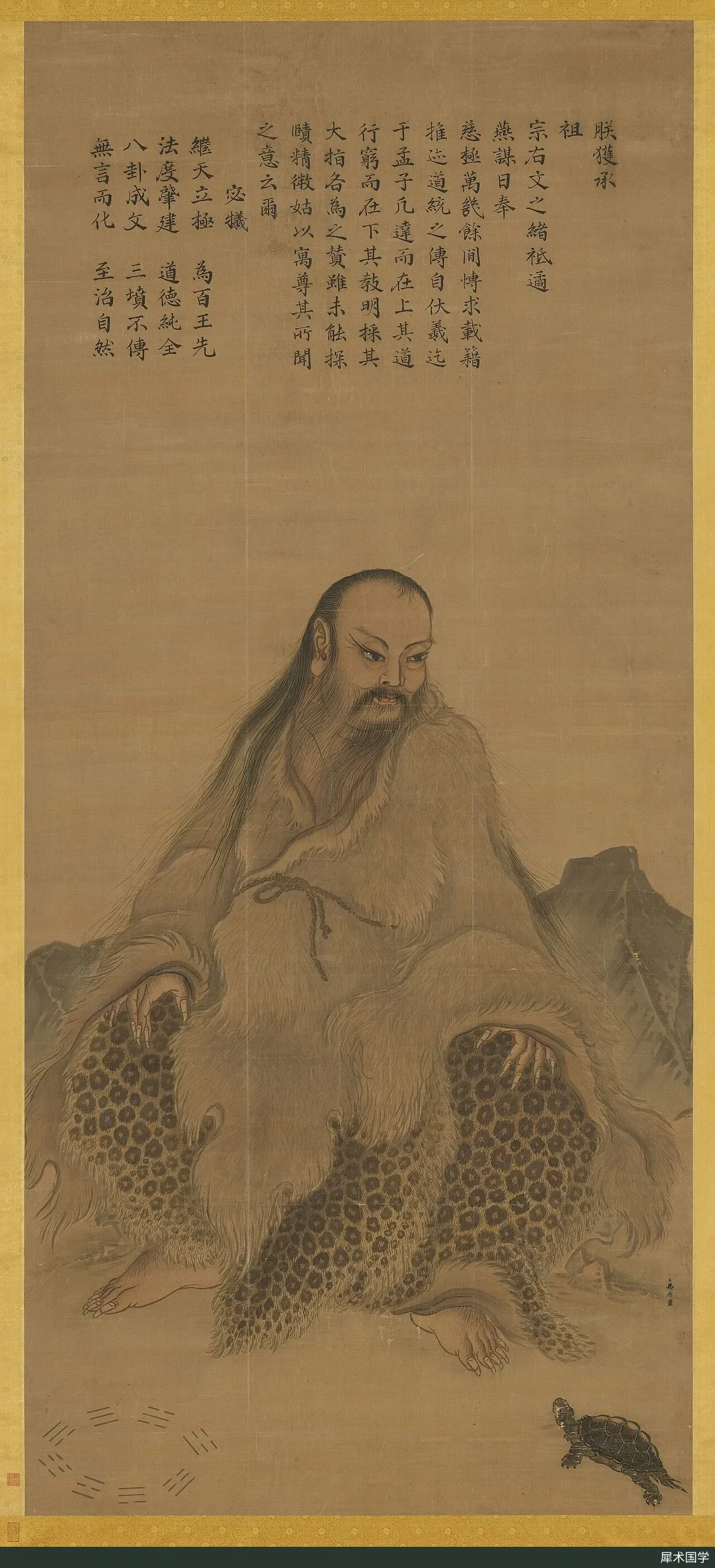
Figure: Ma Lin, Southern Song, Seated Fuxi (eulogy composed in Song Lizong Shaoding 3 / 1230), National Palace Museum, Taipei. Per Li Changyuan’s study, the trigrams before Fuxi follow the “Later Heaven” arrangement. Source: Wikimedia Commons; license: public domain.
Shao Yong’s “learning of Former Heaven” is the Northern Song Yi tradition that arranges hexagram order and positions by diagrams. The familiar sequence “Qian 1, Dui 2, Li 3, Zhen 4” and the orientation “Qian south, Kun north” mainly spread through the “Four Fuxi diagrams” at the head of Zhu Xi’s Zhouyi benyi. Whether the transmission lineage is reliable, what the “method of doubling” means, and whether diagrams may stand before the classic were debated from Song through Qing. Drawing on primary texts and recent research, this article traces that history in four sections.
Sources of the Former Heaven diagrams and the transmission lineage
Shao Yong’s (1011–1077) writings were ordered into books after his death by his son Shao Bowen; Guanwu waipian also includes lecture notes by the disciple Zhang Kun and is rather loose in form (Li Changyuan, 2026). Shao’s definition of “Former Heaven” appears in Guanwu waipian: “Learning of Former Heaven is the mind; learning of Later Heaven is traces. What goes in and out of being and non-being, life and death, is the Way.” He also says: “Though the diagram has no text, all day I speak without leaving it, for the principles of Heaven, Earth, and the myriad things are fully in it” (after Zhang Xingcheng, Huangji jingshi guanwu waipian yanyi, juan 8, Siku edition). From these two lines, Shao did have a diagram as support for teaching; and “learning of Former Heaven is the mind” suggests—on this writer’s reading—that his “Former Heaven” means not only the diagram itself but the principles of observing things it carries.
The Former/Later Heaven distinction rests on two passages of the Shuogua zhuan. Shao takes the section “The Lord comes forth in Zhen… completes speech in Gen” (i.e. “beginning in Zhen, ending in Gen”) as King Wen’s eight-trigram positions, and reads “Heaven and Earth determine positions, mountain and marsh interchange breath, thunder and wind press upon each other, water and fire do not shoot at each other, the eight trigrams interlock” as Fuxi’s eight-trigram positions. Li Changyuan notes that before Shao no one read the latter passage as a statement of trigram positions; the “Later Heaven” orientation with Li south and Kan north had long been current before the Song, while the “Former Heaven” orientation with Qian south and Kun north was new in the Northern Song. Shao’s own wording in Guanwu waipian is “Qian and Kun fix the upper and lower places; Li and Kan are arrayed as the left and right gates” (Yanyi, juan 4).
Accounts of the diagrams’ origins grow more detailed the later they are. Cheng Hao’s “Epitaph for Master Shao Yaofu” only says “the Master obtained it from Li Tingzhi; Tingzhi obtained it from Mu Bochang,” and stresses that Shao was “pure and unmixed, vast and great, and much of it was what he attained himself”; late Northern Song Shao Bowen’s Yixue bianhuo pushes the source to Chen Tuan; early Southern Song Zhu Zhen, in the memorial presenting his book (recorded in Songshi juan 435, “Biography of Zhu Zhen”), inserts Zhong Fang between Chen Tuan and Mu Xiu, forming the full chain “Chen Tuan transmitted the Former Heaven diagram to Zhong Fang; Fang to Mu Xiu; Mu Xiu to Li Zhicai; Zhicai to Shao Yong.” Qian Mu’s “On the transmission of the Supreme Ultimate diagram and the Former Heaven diagrams” already noted that the Chen Tuan–to–Mu Xiu stretch lacks reliable sources; Li Changyuan therefore holds that this lineage “seems to have been gradually amplified and constructed by later ages” and cannot prove Chen Tuan was the source of Shao’s Yi learning.
Zhu Xi accepted the lineage. The diagram notes at the head of Zhouyi benyi say: “The four Fuxi diagrams at right all come from the Shao school. Shao obtained them from Li Zhicai Tingzhi; Tingzhi from Mu Xiu Bochang; Bochang from Master Xiyi of Mount Hua, Chen Tuan Tunan—this is so-called learning of Former Heaven.” In Zhuzi yulei he also says the Former Heaven diagrams “were transmitted from Xiyi, and Xiyi in turn had a transmission. Fangshi techniques used them for cultivation; what the Cantong qi says is that” (cited from Li Changyuan, 2026). Li Changyuan holds that it was Zhu Xi who linked the Former Heaven diagrams to the alchemy of the Zhouyi cantong qi; when early Qing scholars criticized the diagrams as Daoist, they were “in effect criticizing Zhu Xi on the basis of Zhu Xi’s own account.”
“One divides into two” and the “method of doubling”
Shao’s most concentrated account of hexagram generation is in Guanwu waipian: “Once the Supreme Ultimate divides, the Two Modes stand. Yang intersects below with yin, yin intersects above with yang, and the Four Images are born… thus the eight trigrams are complete. The eight trigrams interlock, and then the myriad things are born. Hence one divides into two, two into four, four into eight, eight into sixteen, sixteen into thirty-two, thirty-two into sixty-four; therefore it is said ‘divide yin and yang, alternate soft and hard; the Changes completes its pattern in six places’” (Shao Yong quanji, vol. 3, Shanghai Ancient Books, 2015, p. 1196, cited from Li Zhen; also Zhang Xingcheng, Yanyi, juan 4). The passage takes Xici shang “In the Changes there is the Supreme Ultimate; it produces the Two Modes; the Two Modes produce the Four Images; the Four Images produce the eight trigrams” as its base, yet pushes on to sixty-four. Li Zhen notes that earlier Yi learning mostly explained the eight trigrams by taking images and the sixty-four by doubling; Shao joined the two into one, “substituting generating hexagrams by number for generating hexagrams by image.”
The phrase “method of doubling” is not Shao’s own; it comes from Cheng Hao. Henan Chengshi waishu juan 12 records: Shao’s “Yi numbers are very refined”; one day when Cheng Hao had nothing to do while invigilating an exam, he calculated by Shao’s method and all matched. Going out he said to Yaofu: “Yaofu’s numbers are just the method of doubling; from this one knows the Taixuan is of no use.” Yaofu, startled, patted his back and said: “Elder brother, how clever you are!” Later when Cheng Yi asked “how is the doubling number,” Cheng Hao answered “I have forgotten it all” (Er Cheng ji, Zhonghua Book Company, 2004, p. 428).
Literally, “doubling” means the count doubles at each step: one to two, two to four, four to eight, on to sixty-four. Zhu Xi equated it with “one divides into two,” explaining generation line by line from bottom up: first draw one yin and one yang as the Two Modes; each time add one yin and one yang above; two lines make the Four Images, three the eight trigrams, six the sixty-four hexagrams (Yixue qimeng, juan 2, Zhuzi quanshu, vol. 1, p. 218, cited from Li Zhen). The note to Fuxi sixty-four hexagrams in sequence at the head of Zhouyi benyi also says: “If generated line by line, then what Master Shao called eight dividing into sixteen, sixteen into thirty-two, thirty-two into sixty-four especially shows the natural marvel of the model-image.” Yet Li Zhen warns that Cheng Hao spoke in a context of “calculating the calendar” and “knowing Heaven”; whether “method of doubling” means a principle of hexagram formation or some convention in Shao’s calendrical numbers remains open; figures such as Zheng Guai and Zhang Xingcheng around the Song transition mostly understood Shao through hexagram change, while Zhu’s line-by-line generation was influenced by Cai Yuanding, whose Huangji jingshi zhiyao records Fuxi first drawing the eight trigrams and Jingshi yan Yi diagrams close in form to Zhu’s horizontal diagrams. Li Zhen therefore conjectures that the horizontal diagrams more likely come from Cai than from Shao’s transmission.
The nine diagrams at the head of Zhouyi benyi
The earliest surviving Zhouyi benyi is the Song Xianchun 1 (1265) Wu Ge imprint, now in the National Library of China; its head lists nine Yi diagrams: Yellow River Chart, Luo Writing, Fuxi eight trigrams in sequence, Fuxi eight-trigram orientation, Fuxi sixty-four hexagrams in sequence, Fuxi sixty-four-hexagram orientation, King Wen eight trigrams in sequence, King Wen eight-trigram orientation, and Hexagram-change diagram. Each diagram is followed by a note linking it to classic and commentary: the eight-trigram sequence diagram is paired with the Xici “In the Changes there is the Supreme Ultimate” chapter and Shuogua “the Changes numbers backward,” citing Master Shao “Qian 1, Dui 2, Li 3, Zhen 4, Xun 5, Kan 6, Gen 7, Kun 8”; the eight-trigram orientation diagram with Shuogua “Heaven and Earth determine positions,” citing “Qian south, Kun north, Li east, Kan west, Zhen northeast, Dui southeast, Xun southwest, Gen northwest”; the King Wen orientation diagram citing “this is King Wen’s eight trigrams, the positions for use—learning of Later Heaven.” The nine diagrams close: “There is the natural Changes of Heaven and Earth, Fuxi’s Changes, King Wen and the Duke of Zhou’s Changes, and Confucius’s Changes. From Fuxi upward there was no writing, only charts and writings—most worthy of deep contemplation.”
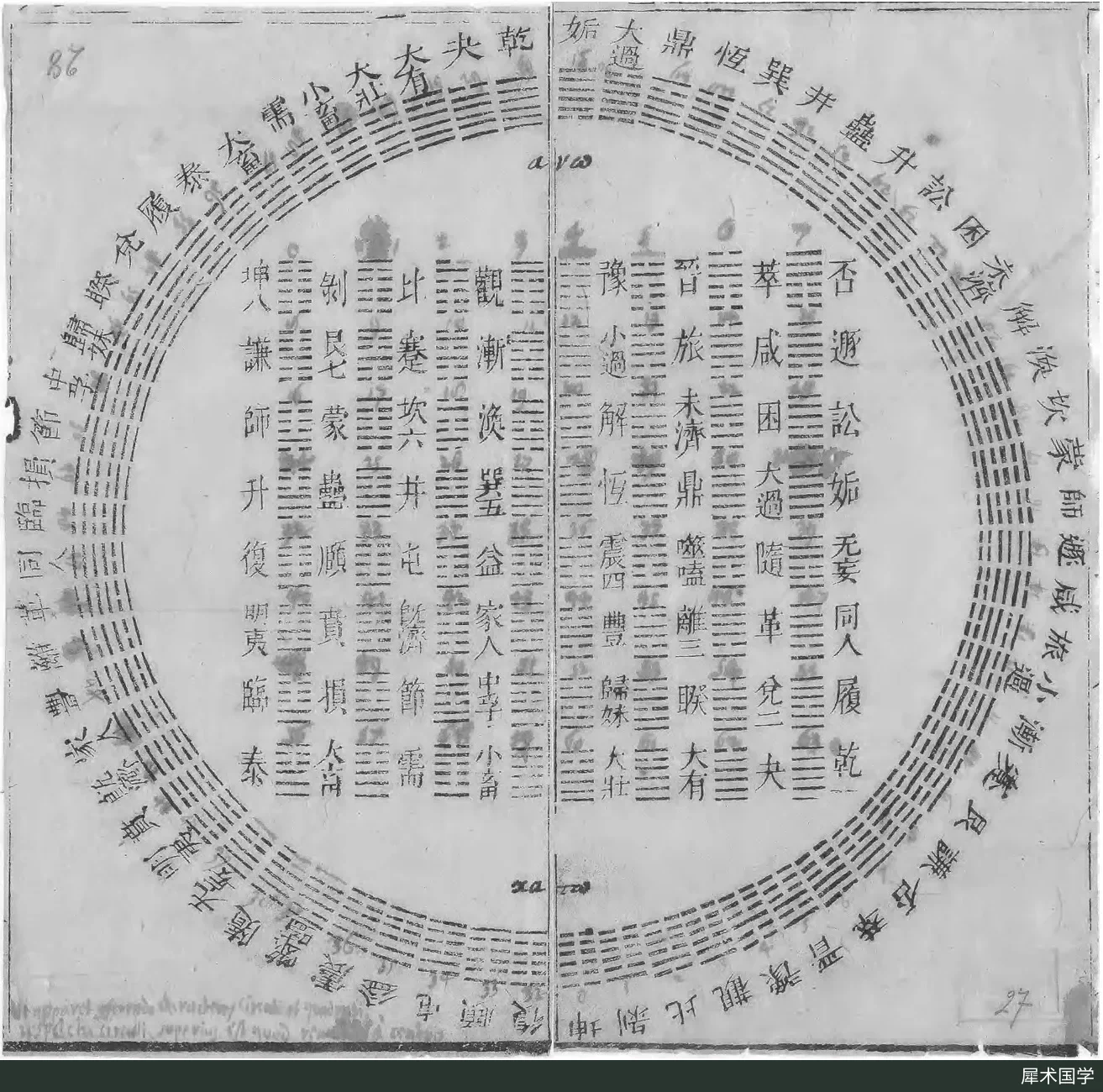
Figure: Manuscript of the Fuxi sixty-four hexagrams square-and-circle diagram (a Former Heaven diagram of the same type as “Fuxi sixty-four-hexagram orientation” at the head of Zhouyi benyi), sent in 1701 by the French Jesuit Joachim Bouvet to Leibniz, with Arabic numerals added by Leibniz; original in the Leibniz Library, Hanover. Source: Wikimedia Commons; license: public domain.
Li Changyuan holds that the main force behind the wide spread of the Former Heaven eight trigrams was Zhu Xi’s Yixue qimeng and Zhouyi benyi. Yixue qimeng, compiled jointly by Zhu and Cai Yuanding, was sent to scholars across regions after completion in Chunxi 13 (1186); Yuan Shu, Lin Li, and others soon criticized Shao’s Former Heaven claims; Zhouyi benyi later far outstripped the Qimeng in influence. With diagrams crowning the classic, readers opening the Changes first see “Fuxi’s Changes”—precisely the later point of controversy. Whether the nine diagrams come from Zhu’s own draft is also disputed: the Siku quanshu zongmu, citing Wang Maohong’s Baitian zazhu, compares Zhu’s Wenji and Yulei and finds the nine diagrams “often contradictory, and believes they were attached by disciples.” The view is worth keeping in mind, but Li Changyuan still treats whether Zhu’s draft included diagrams as an open question, not yet settled.
Visual evidence offers another angle. In Ma Lin’s Southern Song court painting Seated Fuxi (National Palace Museum, Taipei; eulogy by Song Lizong in Shaoding 3 / 1230), eight trigrams are drawn before Fuxi. Li Changyuan, examining the arrangement, takes them as “Later Heaven eight trigrams” with the outer ring as the first line—not the Former Heaven eight trigrams Zhu attributed to Fuxi. Lizong’s court was promoting Neo-Confucianism, yet the painting still uses the old diagram; Li therefore holds that Former Heaven diagrams did not at once replace Later Heaven ones in the Southern Song but coexisted with them.
Debates on the diagrams from Yuan–Ming to early Qing
Doubt about the Former Heaven diagrams did not begin in the Qing. The Siku quanshu zongmu abstract of Hu Wei’s Yitu mingbian traces the line: contemporaries of Zhu Xi such as Yuan Shu and Xue Jixuan already differed; Yuan Chen Yingrun’s Yaobian yi yun (as the abstract names it) “first pointed to the Former Heaven diagrams as Daoists borrowing Yi principles for cultivation techniques,” and Wu Cheng and Gui Youguang attacked in turn; early Qing Mao Qiling wrote Tushu yuan chuan bian, Huang Zongxi Yixue xiangshu lun, and Huang Zongyan Tushu bianhuo (as the abstract names them), “contending with especial force.”
Huang Zongxi’s critique looks to the classic text itself. Yixue xiangshu lun juan 1, “Former Heaven diagram,” holds that the “produce” of Xici “In the Changes there is the Supreme Ultimate” “is the ‘produce’ of ‘producing and producing is called the Changes,’ not successive production. Kangjie’s method of doubling comes from this chapter but is not in fact this chapter’s intent”; the Shuogua already has the order Qian, Kun, Zhen, Xun, Kan, Li, Gen, Dui, and Shao’s change to “Qian 1, Dui 2, Li 3, Zhen 4, Xun 5, Kan 6, Gen 7, Kun 8” “embellishes the diagram’s left yin and right yang,” whence the question: “Do learners trust the classic text or the commentaries?” On orientation he notes that “Heaven and Earth determine positions” only means Heaven above and Earth below—“one has not heard of south above and north below”; trigram positions “are already seen in the ‘Lord comes forth in Zhen’ chapter,” yet Shao “abandons what is clearly available” and sets up Former Heaven positions instead. He also notes that Liu Mu’s Goushen suoyin tu already has number assignments matching the Former Heaven eight trigrams, “so one knows transmission of the Former Heaven diagram was not Shao’s alone.”
Hu Wei’s (1633–1714) ten-juan Yitu mingbian is the culmination of this critique: juan 3 treats the Zhouyi cantong qi and Former Heaven Supreme Ultimate; juan 5 the charts and writings of Yixue qimeng; juan 6–7 Former Heaven ancient Yi; juan 8 Later Heaven learning. In the prefatory verses he says: “Only the Changes has no use for diagrams; the drawings of the sixty-four hexagrams’ two bodies and six lines are themselves its diagram.” Yet Hu does not wholly deny Shao’s diagrams: “Of Shao’s four diagrams, the horizontal diagram’s sense will not hold, but the circular diagram has a separate ultimate principle—why? Because the Dao of the elixir resides in it.” His conclusion: “The Former Heaven diagrams and the sages’ Changes, separated, are both beautiful; joined, both are harmed.” The Siku editors say the book lets learners know that chart-and-writing claims, “though spoken with grounds and held with reason, are side streams by which alchemy and mantic arts branched from Yi learning, not the root of making the Changes.” Wan Sitong’s preface is still more direct: the diagrams “are Shao’s school alone; to take them as Shao’s Changes is permissible; to take them straight as Fuxi’s and Wen’s Changes is greatly impermissible.”
Modern placement of Hu Wei is not simple. Luo Shengbao (2016) notes that Hu largely rejects the Yellow River Chart, Luo Writing, and Five Phases / Nine Palaces, yet treats the Cantong qi, inner-alchemy readings of the Changes, and the Former Heaven circular diagram as “a separate transmission outside the Changes,” partly accepting diagram learning; in distinguishing Former Heaven diagrams and interpreting the classic he in fact accepts Zhu learning at points, and is better seen as a transitional scholar. Taking the materials together, this writer holds that the Song–Qing debate’s focus is less whether the Former Heaven diagrams are ingenious than whether Shao’s school alone may be called “Fuxi’s Changes” and set before the classic: Zhu Xi took them as the root of making the Changes; early Qing scholars urged that diagram and classic be kept apart.
References
-
Zhu Xi: Zhouyi benyi, Song Xianchun 1 (1265) Wu Ge imprint, head Yi diagrams. National Library of China; images on Wikimedia Commons; transcription on Chinese Text Project, Yuanben Zhouyi benyi.
-
Cheng Hao and Cheng Yi; Zhu Xi, ed.: Henan Chengshi waishu, juan 12, Siku edition, transcription on Shidian guji; punctuated edition in Er Cheng ji, Beijing: Zhonghua Book Company, 2004, p. 428 (cited from Li Zhen).
-
Shao Yong; Zhang Xingcheng, expansion: Huangji jingshi guanwu waipian yanyi, juan 4 and 8, Siku edition, transcriptions on Chinese Text Project · juan 4, Wikisource · juan 8; punctuated text also in Shao Yong quanji, vol. 3, Shanghai: Shanghai Ancient Books, 2015, p. 1196 (cited from Li Zhen).
-
Huang Zongxi: Yixue xiangshu lun, juan 1, “Former Heaven diagram,” Siku edition, transcription on Wikisource.
-
Hu Wei: Yitu mingbian, ten juan; head Siku quanshu zongmu abstract, Wan Sitong preface, and prefatory verses; transcription on Chinese Text Project.
-
Li Changyuan: “Reconsidering the appearance and spread of Former and Later Heaven eight trigrams: starting from Ma Lin’s Seated Fuxi in Shengxian tu,” Gujin lunheng no. 46, Taipei: Institute of History and Philology, Academia Sinica, June 2026, PDF.
-
Li Zhen: “From Shao Yong to Zhu Xi: the evolution and settling of ‘one divides into two,’” History of Chinese Philosophy 2021 no. 6; web reprint on Rujia wang.
-
Luo Shengbao: “The argumentative line and classic interpretation of Hu Wei’s Yitu mingbian,” Bulletin of the Department of Chinese Literature, National Taiwan University no. 54 (September 2016): 159–221, Airiti Library abstract.
-
Qian Mu: “On the transmission of the Supreme Ultimate diagram and the Former Heaven diagrams,” in Zhongguo xueshu sixiangshi luncong (5) (Complete Works of Qian Binsi, vol. 20), Taipei: Linking, 1998, pp. 163–177 (original not seen; cited from Li Changyuan).
-
Information compiled and published by Scholay academic one-stop platform; report infringement for takedown.
-
Also published on EnterScholar, a scholars’ community for the intelligent age