Project overview
The old-book resource index (open-guji/guji-resource-index) is a public catalogue on GitHub of entrances to sites that have digitized old books. It is suited to checking which resource libraries exist before you look for an edition, a commentary, or images. It offers clues for finding a library. It is not a full-text collection of old books.
On the README read on 27 October 2026, the current catalogue first separates holding institutions from platforms that organize material. The first publish their own digitized holdings. The second gather or arrange material from elsewhere. Under holding institutions, digital libraries are listed by region: mainland China, Hong Kong and Macau, Taiwan, Europe and America, Japan, and others. The general table of organizing platforms lists the Chinese Text Project, Shidian Guji, Wikisource, Wikimedia Commons, the Internet Archive, and others. The intelligent-service platform for Chinese old books is inside the table of holding institutions. The classification follows the current repository.
When you look something up, choose an institution or a platform first, and then read the introduction, the copyright column, and the download column. The general table also has a resource-type column, for telling text from images. The copyright column is the catalogue maintainer’s label. It does not replace the terms of the original site or of a particular book. The download column describes an entrance or a method. It cannot be taken as permission for a bulk harvest. Where the note says “to be confirmed” or “not stated,” keep checking. Do not assume the material may be republished.
The repository also links notes on single sites, which can be a clue for looking further. The full text of those single-site notes could not be read this time. The URL structure and the operating details were not checked. After a site is chosen, go back to the original site and search for the title, and record the responsible person, the edition, the juan, the holding number, and the original link. Text is convenient for looking up a word. Variant characters, layout, and commentary still need the images of the original book, with the classic, the commentator’s explanation, and a later editor’s arrangement kept apart.
Entries and links can go out of date, and third-party terms differ. The terms were not checked site by site this time, and downloading or bulk harvesting was not tried. The coverage the catalogue claims is not proof that every old-book resource has been listed. Use should follow the original site. Do not bypass a limit or harvest in bulk against the rules.
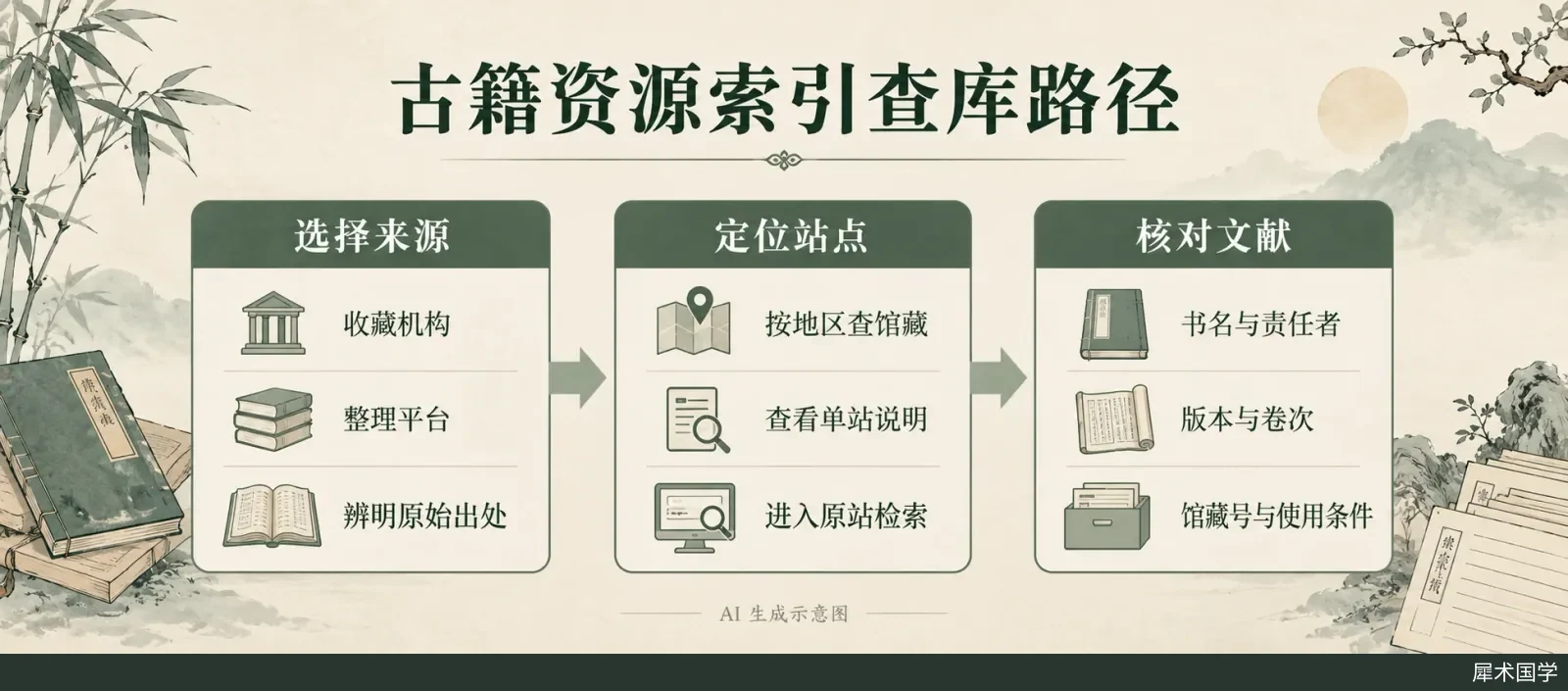
A schematic of the path through the old-book resource index. An original structural drawing for this site. It does not mean each site was tried.
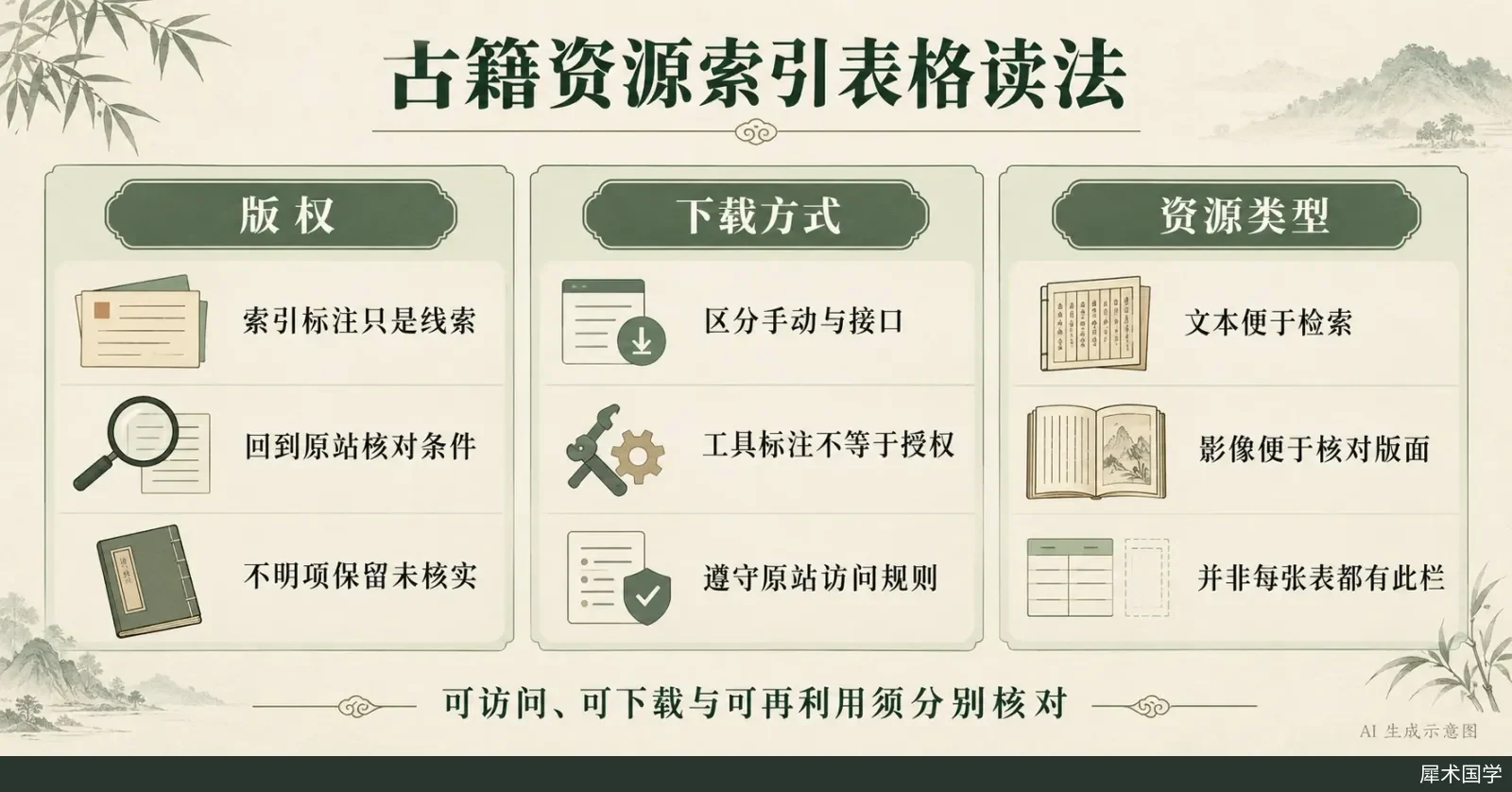
Copyright, download, and resource type have to be read separately. Not every table has a resource-type column. An original structural drawing for this site.
References
- open-guji, old-book resource index, GitHub README, read 2026-10-27: https://github.com/open-guji/guji-resource-index. The current classification and column headings are the basis. Third-party holding figures in it were not checked independently.
- The commit feed supplied by the author: https://github.com/open-guji/guji-resource-index/commits/main.atom. The request did not succeed this time, and the feed’s contents were not checked. This piece does not mount feeds.opml, and the attribution of its entries was not checked independently.
Practical value
A starting point for finding editions and materials. It helps a reader compare entrances, tell the use of text from the use of images, and keep a trail back to the original holding.
References
- Xisi Guoxue.
- Compiled and published by Scholay. For a takedown request, send feedback.
- Also published at Enter Scholar.