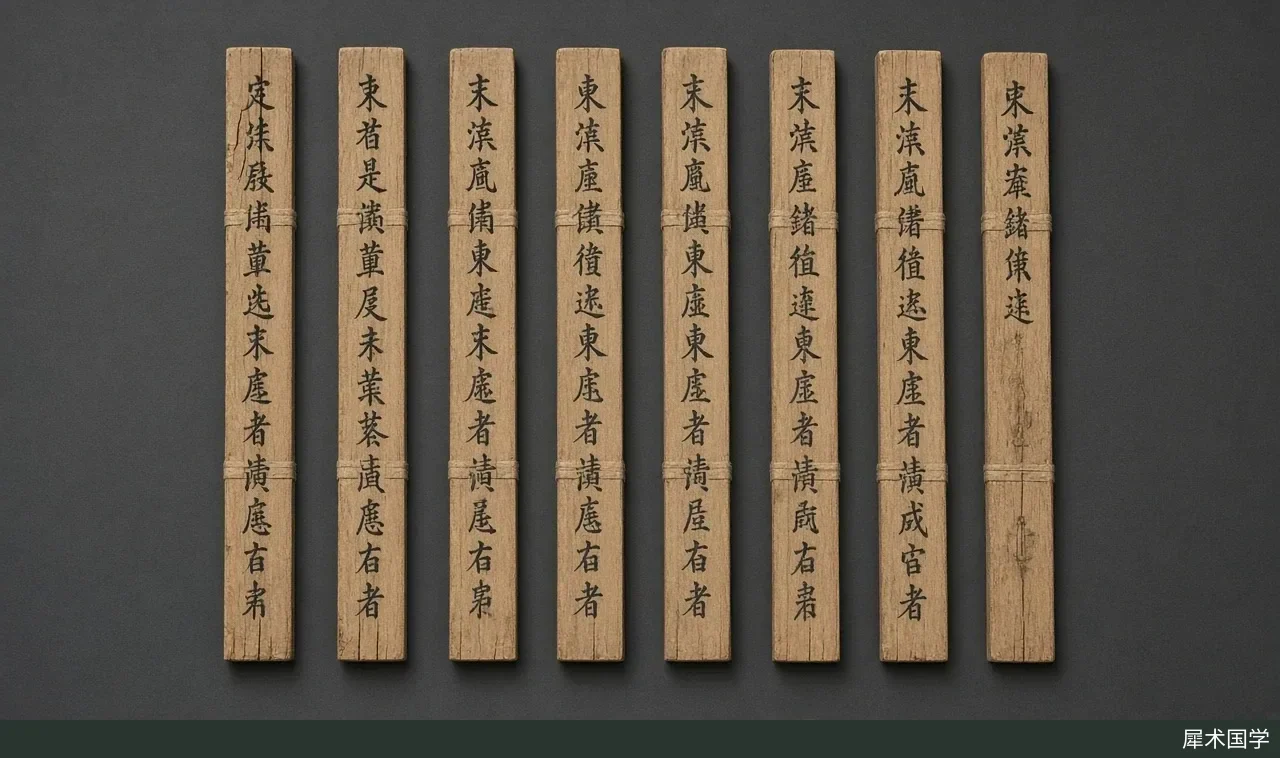
In 1959, a batch of slips of the 'Yili' was unearthed from the No. 6 Han tomb at Mozuizi, Wuwei, Gansu Province. After being sorted and compiled by the Gansu Provincial Museum and the Institute of Archaeology, Chinese Academy of Sciences, the slips were included in the 1964 publication 'Wuwei Han Slips' by the Cultural Relics Press. The slips are divided into three groups, A, B, and C, and consist of seven complete texts, representing a rare surviving Han dynasty manuscript of the 'Yili'. Its sequence, titles, arrangement of canonical texts and commentaries and usage of characters differs from the current version of the Zheng Xuan annotated edition, providing tangible evidence for understanding the transmission of the Yili prior to Zheng Xuan's annotations.
Overview of excavation and sorting
In 1959, the Gansu Provincial Museum conducted excavations at the Mozuizi Han tomb complex in Wuwei and unearthed 469 slips of the 'Yili' text from Tomb No. 6. The same tomb also yielded a number of slips belonging to the 'Ri Ji' and 'Za Zhan' categories (the exact number of slips pending verification). The editors classified the 'Yili' slips into three groups based on material, size, and content: Group A, consisting of 398 wooden slips, contains the seven chapters 'Shi Xiang Jian Zhi Li', 'Fu Zhuan', 'Te Sheng', 'Shao Lao', 'You Si', 'Yan Li', and 'Tai She'; Group B, comprising 37 wooden slips, contains only the chapter 'Fu Zhuan'; Group C, made of 34 bamboo slips, copies the text of the 'Sangfu' canon. The back of the first slip of each chapter in Group A bears the title and chapter number, and each slip has a sequential number, so although the binding ropes have rotted and broken, the overall order of the slips can be largely reconstructed.
The report 'Wuwei Han Slips' was compiled by the Gansu Provincial Museum and the Institute of Archaeology, Chinese Academy of Sciences, published by the Cultural Relics Press in 1964, with Chen Mengjia responsible for the main scholarly interpretation. The report includes illustrations, transcriptions, and annotations; the annotations are cross-referenced sentence by sentence with the modern version of 'Yili', and include a specialized article discussing the Han dynasty slip system; this article was later included in Chen Mengjia's 'Han Slips: Supplementary Notes' (Zhonghua Book Company, 1980). Regarding the burial context and copying period, the report tentatively dates it to around the late Western Han period, although subsequent research has continued to discuss this issue, and this article does not provide a precise dating.
Differences and similarities in chapter order, chapter titles, and text between the slip manuscript and the current edition
The most obvious difference lies in the order of the chapters. The current version follows the arrangement of Liu Xiang's 'Bielu' with Zheng Xuan's annotations; Jia Gongyan's commentary references Zheng Xuan's 'Directory' under each chapter title, while also recording the sequence of the Da Dai and Xiaodai schools. When comparing the chapter order inscribed on the reverse of the Group A slips, it becomes clear that the slip manuscript differs from all three traditions:
| Title (modern edition) | Wuwei Group A | Da Dai | Xiao Dai | The Bielu / modern edition |
|---|---|---|---|---|
| The Etiquette of Meeting Between Scholars | The third | The third | The third | The third |
| funeral garments | Eighth (titled 'Fu Zhuan') | Seventeenth | Ninth | The eleventh |
| The Special Sacrifice Feeding Ceremony Rite | The tenth | Seventh | The tenth | Fifteenth |
| The Lesser Sacrificial Feeding Ceremony | The eleventh | The eighth | The eleventh | Sixteenth |
| You Si Che | Twelfth | Ninth | Twelfth | Seventeenth |
| Yan Li | Thirteenth | Twelfth | Sixth | Sixth |
| Great Archery | Fourteenth (title: 'Tai She') | Thirteenth | Seventh | Seventh |
The order of the three texts, 'Te Sheng', 'Shao Lao', and 'You Si', in the slip manuscript is the same as that of Xiao Dai; 'Yan Li' and 'Tai She' are placed later, and 'Fu Zhuan' comes eighth. The 'Book of Han: Records of Literary Works' states that the three schools of ritual studies—those of Dai De, Dai Sheng, and Qing Pu—founded by the disciples of Hou Cang—were all established as official teachings in the Western Han dynasty. Chen Mengjia, based on the discrepancy in the sequence between the texts and the arrangements of the large and small Dai schools, speculated that the slip manuscript might belong to the Qing school; however, since the Qing school's version has long been lost, this speculation cannot be directly verified, and the academic community has not reached a definitive conclusion.
Regarding the titles, the slips often use abbreviations: the current edition's titles for 'Special Sacrificial Feeding Rites', 'Lesser Sacrificial Feeding Rites', and 'Officials Removing the Food' are abbreviated to 'Special', 'Lesser', and 'Officials' respectively; the current edition's 'Great Shooting Rites' is titled 'Tai She' in the slips; 'Rites of a Scholar's Meeting' has an additional 'zhi' character compared to the current edition. The current edition of 'Funeral Attire' combines the text, commentary, and records, with the commentary attached below each text passage; Groups A and B are titled 'Fu Zhuan', with the commentary as the main content and the text incomplete; the Group C copy of 'Funeral Attire' only copies the text without including the commentary. This indicates that the text and commentary of 'Funeral Attire' were separately copied in different forms during the Han dynasty. The exact time when the text and commentary were first combined and the authorship of this compilation remain uncertain and require further verification against relevant research.
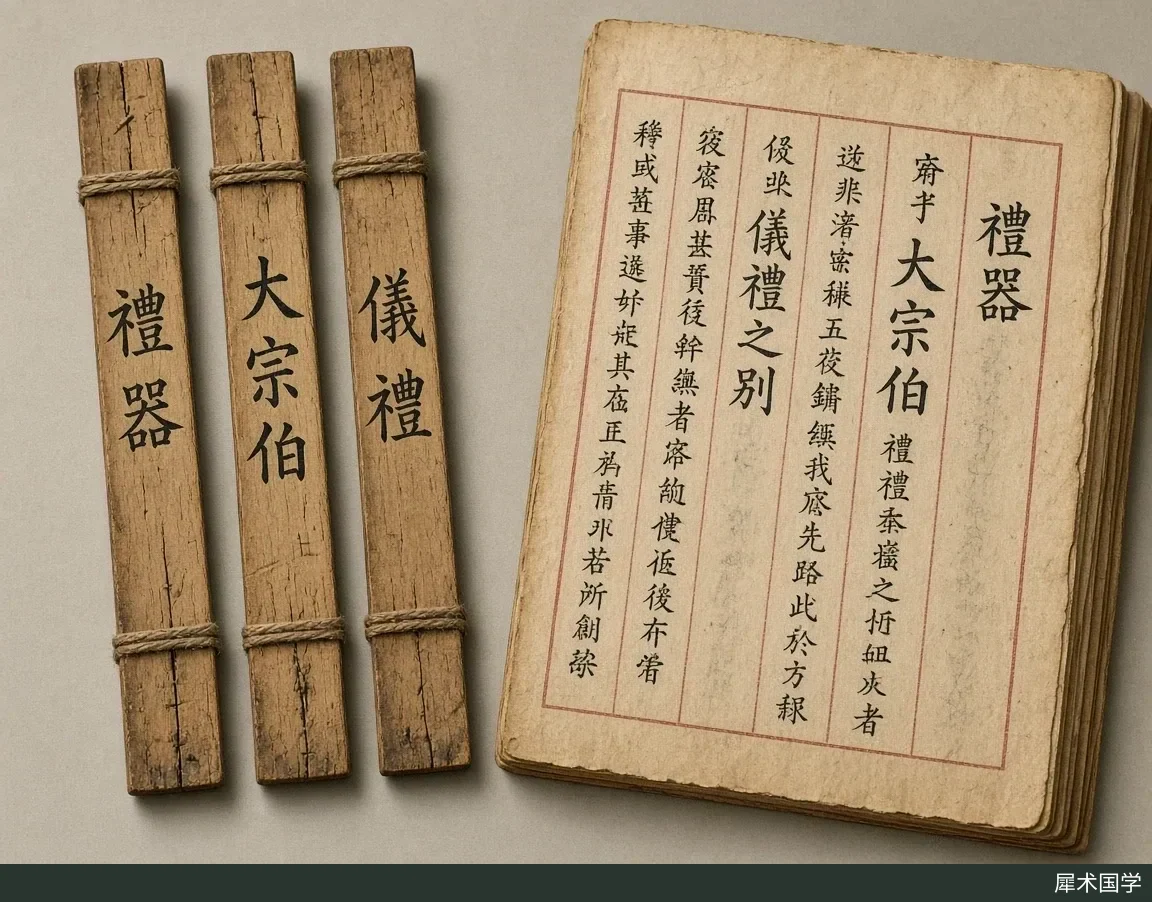
In terms of text, there are numerous discrepancies between the slip manuscript and the current version, with the editorial report's annotations listing them item by item, including cases of homophonic characters, variant characters, additions or omissions of particles, and occasional differences in sentence structure. Zheng Xuan's annotations of the current version often specify 'the ancient text reads X' or 'the modern text reads Y'; by comparing these annotations, it can be seen that the slip manuscript contains characters that correspond to both modern and ancient texts. There is no consensus among the editors of the slip manuscript and subsequent researchers regarding its main textual tendency; this divergence is merely recorded here, with specific examples of textual variations to be verified against the editorial report's annotations.
Significance and Limitations for Understanding the Transmission of Han Ritual Texts
According to the 'Book of Han: Catalogue of Literature,' the 'Rites' text transmitted in the Western Han dynasty consisted of seventeen chapters, with the transmitted versions originating from Hou Cang's lineage and the Da Dai, Xiao Dai, and Qing schools existing side by side. However, except for the annotated version by Zheng Xuan, none of the versions from these schools have survived to the present day; later scholars can only gain partial insights from the chapter order cited by Jia's commentary and the differing characters recorded in Zheng's annotations. The Wuwei slips are physical manuscripts from before Zheng Xuan's time, providing, for the first time, a text for comparison with these indirect records.
Based on the slip manuscript, the content of the seventeen chapters is quite stable, but the order and titles vary depending on the transmission tradition. The current order is the result of Liu Xiang's compilation and Zheng Xuan's adoption, and is not the only 'original form.' The slip manuscript uses a mixture of modern and ancient characters, also reminding readers that the distinction between 'modern' and 'ancient' texts in the history of Confucian studies mainly refers to transmission systems and exegetical traditions; when it comes to the actual characters used in written manuscripts, the boundaries may not be as clear-cut.
The significance of this set of slips is not limited to the texts themselves. The length of the slips, the position of the binding cords, the writing of the titles, and the numbering on the reverse sides are all preserved intact, allowing Chen Mengjia to discuss the form of Han dynasty book bundles, which has become a key reference for later studies on slip systems. However, it has limitations: only seven texts are preserved, among which the content related to 'Sangfu' appears in three copies; it is a manuscript buried in a tomb, and it remains uncertain whether it belongs to a private edition or an official school standard edition. Therefore, caution is required when using it to infer the complete picture of a particular school's teachings.
References
-
Gansu Provincial Museum, Institute of Archaeology, Chinese Academy of Sciences: "Wuwei Han Slips," Beijing: Cultural Relics Press, 1964. (Page numbers for each section pending verification)
-
Chen Mengjia: "Han Slips Annotated", Beijing: Zhonghua Book Company, 1980. (The titles and page numbers of the articles on slip systems require verification).
-
[Han] Zheng Xuan's annotation, [Tang] Jia Gongyan's commentary: The Annotations and Commentaries on the Yili, [Qing] Ruan Yuan's edited and printed version of The Thirteen Classics Annotations and Commentaries. (Below each chapter title, Jia Gongyan's commentary references Zheng Xuan's 'Catalogue' recording the sequence of chapters of Da Dai, Xiao Dai, and 'Bielu'; the volume numbers, page numbers require verification.)
-
[Han] Ban Gu: The 'Bibliographical Treatise' of the 'Han Shu', Beijing: Zhonghua Shuju, punctuated and collated edition, 1962.
-
Xi Shu Guo Xue The heart communicates intuitively, understanding through mere words.
-
Information provided by Scholay Academic One-Stop Platform Organize and publish; if there is any infringement, please provide feedback for removal.
-
Information synchronization published in EnterScholar, Scholar Community in the Age of Intelligence