The “Hanji Full-Text Database” was built by the Institute of History and Philology of Taiwan’s “Academia Sinica.” Its predecessors were the “Handian” full-text retrieval system and the “Hanji Electronic Documents Database,” and in 2023 they were unified under the current name. The official website states that it contains 1,582 classical texts totaling about 8.8 hundred million characters, with the history branch predominating. The Twenty-Five Histories, the Commentaries and Subcommentaries on the Thirteen Classics, and some other texts can be searched for free; the remaining content requires authorization. This article introduces its coverage and authorization, its search filters, and how to cite editions, and compares it with ctext and the Zhonghua Jingdian Guji Ku (Chinese Classical Ancient Books Database).
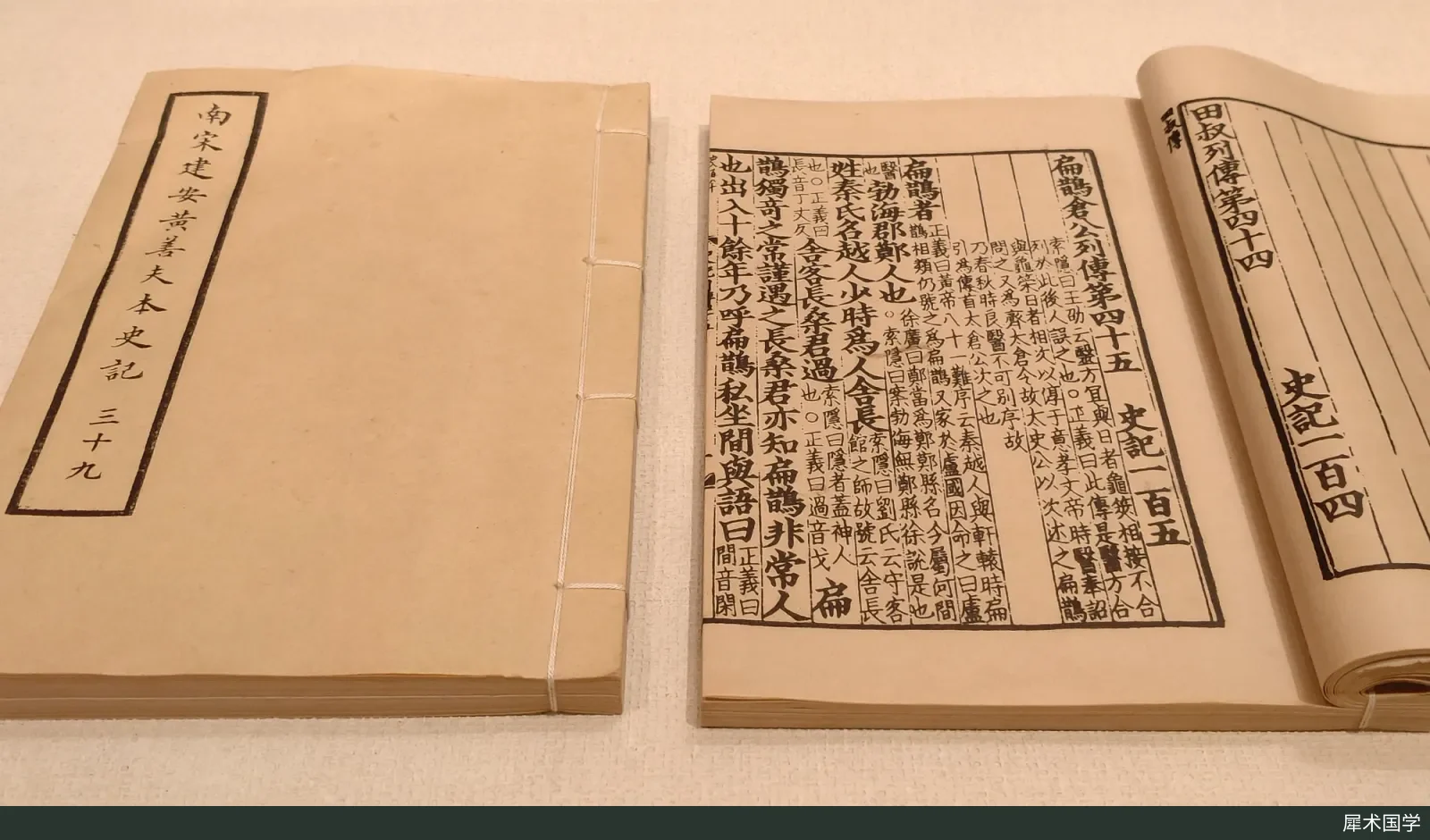
The Southern Song edition of the Shiji (Records of the Grand Historian) printed by Huang Shanfu of Jian’an, photographed at the National Museum of Natural Science in Taichung (whether the exhibit is the original printing is to be verified). Photographer: 丘嵐 (Qiu Lan); Source: Wikimedia Commons; License: CC0 1.0.
Scope of Coverage and Access
The database originated in the “Automation of Historical Texts” project of 1984, a collaboration between the Institute of History and Philology and the Institute of Information Science; the first texts entered were the Twenty-Five Histories. According to Liu Zhengyun’s 2018 retrospective article, the full text of the Twenty-Five Histories was completed in 1990, and the Commentaries and Subcommentaries on the Thirteen Classics went online in May 1994. In 1995 a web version, the “Hanji Electronic Documents Handian Full-Text Retrieval System,” was launched, which is where the name “Handian” comes from; in January 2008 the new “Hanji Electronic Documents Database” went online, and in 2023 (the 112th year of the Republic of China) the name was unified as the “Hanji Full-Text Database.” The current entry point is hanchi.ihp.sinica.edu.tw.
As for size, the database homepage states that it contains 1,582 texts and 879,820,418 characters, while the Institute’s “Hanji Full-Text Database Studio” page says that “as of the end of year 112” it held more than 1,400 texts and more than 8 hundred million characters. The homepage figures carry no statistics date, so when citing them it is advisable to state your access date (for this article, October 22, 2026). The content is arranged in five categories: the four branches of Classics, Histories, Masters, and Collections, plus collectanea. Liu Zhengyun notes that the history branch is the largest in the database, followed by the masters branch, with the classics branch the smallest, which is related to the Institute’s primary focus on historical research. Besides the Twenty-Five Histories and the Commentaries and Subcommentaries on the Thirteen Classics, other large multi-volume sets include the Zhengtong Daoist Canon, the Veritable Records of the Ming and Qing dynasties, the Ten Comprehensive Institutional Histories (Shitong), the Collected Statutes of the Qing (Qing huidian) of five reigns, and the Taishō Revised Tripiṭaka, which is being put online volume by volume in collaboration with Dharma Drum Institute of Liberal Arts. For readers studying classical scholarship and the Masters, although the classics branch has few titles, the core classics, commentaries, and subcommentaries can be searched as complete sets.
Access is offered in two tiers. The first tier is the free area: according to Liu’s article, after the new version went online in 2008, the Twenty-Five Histories such as the Shiji and the Hanshu, the Commentaries and Subcommentaries on the Thirteen Classics, and texts obtained through exchanges with other institutions were opened for free use by people around the world. The current homepage still has a free-use entrance, but this article has not checked one by one which books the free area currently contains; the book list inside that entrance should be taken as authoritative (to be verified). The second tier is the authorized area: since January 1, 2009, academic, educational, and cultural institutions in Taiwan, as well as individuals residing in Taiwan (regardless of nationality), may apply for authorization free of charge. Institutions connect via locked IP addresses; individuals are limited to one account each, bound to one set of fixed IPs, valid for one year at a time counted from the 1st of the month, and must apply for renewal before it expires. Institutions outside Taiwan have used it by paying annual fees since 2008. The authorization rules also prohibit sharing accounts, copying database content by browsing and downloading, and commercial for-profit use, and they require individual users to include a statement in their works when publishing research results. The “Text Reading” subsystem is open only to authorized members, and it automatically logs users out after 30 minutes of inactivity. In other words, individuals living outside Taiwan cannot apply for individual authorization themselves; generally they can only use the free area, or use the full database through their own institution if it has subscribed.
Search Methods and Filters
Searching on the main site falls roughly into three groups. In Basic Search you enter one term and can specify searching in titles, main text, or notes; by default the system searches main text and notes together. Checking “Variant characters” includes characters with the same meaning but different written forms (e.g., “煙” and “烟”), checking “Synonyms” calls on word lists such as alternative personal names (e.g., “方苞” and “方望溪”), and “Dynasty of Compilation” limits the scope by the era of the author or editor. Advanced Search lets you set multiple fields at once and combine conditions with and, or, and not. On top of this, the Institute successively added several post-processing tools: in 2012, “Narrow Search,” which searches again within existing results, and “Affix Analysis” (綴詞分析), which combines the search term with the 1 to 7 characters before or after it into new terms and tallies them; in 2013, an “Edition” option; in 2015, “Text-to-Text Search” (文找文), which lets you paste a passage of up to 2,000 characters and have the system find passages with a similarity between 50% and 100% (set by the user); and in 2016, “Dynasty of Authorship.” Search results can be exported as a “Result List” (檢索條列) and a “Result Report” (檢索報表). The “Text Reading” subsystem also has a book-list search, allowing you to look up books by fields such as title, author, collectanea title, imprint, and edition. The above descriptions of features come from a 2012 library user guide and a 2018 article from the Institute; the button names and positions in the current interface may have changed, and whether the free area offers all features is to be verified. The text in the database is in Traditional Chinese Unicode; whether Simplified Chinese input is automatically mapped is to be verified, and the safe approach is to type Traditional characters directly.
Example One: Finding the commentary and subcommentary on a line of a classic
- Goal: the commentary and subcommentary on the chapter of the Analects, “Yan Yuan,” containing “To subdue oneself and return to ritual is humaneness” (克己复礼为仁).
- Scope: in the four-branch classification on the left, check the Commentaries and Subcommentaries on the Thirteen Classics under the classics branch, then narrow down to the Lunyu zhushu (the specific levels of the classification tree are to be verified).
- Search: in Basic Search enter 「克己復禮」 and check the “Main text” and “Notes” fields.
- Reading the results: distinguish paragraph by paragraph between the classic text, the earlier commentaries quoted in He Yan’s Collected Explanations (Jijie), and Xing Bing’s subcommentary; how each of these three layers of text is marked in the database is to be verified.
Example Two: Searching for a ritual term with logical combinations
- Goal: examine records of the “village drinking” ritual (乡饮酒) in the standard histories.
- Scope: the Twenty-Five Histories under the history branch.
- Search: Advanced Search with 「鄉飲酒」 in the main text, using not to exclude 「鄉飲酒義」, to reduce mere citations of the Book of Rites chapter title.
- Post-processing: run “Affix Analysis” on the results, taking suffixes of 1 to 2 characters, to see which histories contain expressions such as 「鄉飲酒禮」 and 「鄉飲酒之禮」, then go back from the “Result List” to the original text item by item.
Example Three: Tracing the source of a quotation
- Goal: having read the quotation “大學之道,在明明德,在親民,在止於至善” (“The way of great learning lies in illuminating bright virtue, in loving the people, and in resting in the highest good”) in a certain collected works, you want to know which other texts in the database quote or rework this sentence.
- Procedure: paste this passage into “Text-to-Text Search,” first setting a relatively high similarity, then gradually lowering it if there are too few results.
- Verification: matched passages must be checked against the original sentence in the “Great Learning” of the Liji zhushu; Cheng Yi and Zhu Xi read “亲民” (loving the people) as “新民” (renewing the people), and such textual variants are easily missed or mixed in by similarity search, requiring manual judgment.
- Note: whether “Text-to-Text Search” is available in the free area is to be verified.
Base-Text Information and Citation Format
When citing text from the database, you need to state not only the URL but also the printed base text on which it is based. Taking the Twenty-Five Histories as an example, according to a 1991 introduction by Yeen-Mei Wu (吴燕美) of the University of Washington East Asia Library, the full-text base was the Newly Collated Twenty-Five Histories published by Dingwen Book Company in Taipei in 1986 to 1987; Wu states that its content is identical to the Zhonghua Book Company (Beijing) edition of 1975 to 1977, and that the Institute made 135 textual corrections based on other authoritative editions. This was the situation when the build was completed in 1990; whether further corrections have been made since should be determined by the “Imprint” and “Edition” fields of each book in the database. For the Commentaries and Subcommentaries on the Thirteen Classics, the Legislative Yuan Parliamentary Library’s database introduction calls it the “Ruan-printed Thirteen Classics,” that is, the line of Ruan Yuan’s collated printed edition; but this article could not find an official source stating which photographic reprint the database uses, or its publisher and year (to be verified). Further, according to Liu’s article, when the Institute found errors in the original books during proofreading, it did not alter the original text but added a “Hanji note” (漢籍按) to flag them; collation and annotation text that the original books placed at the end of a section was inserted into the corresponding positions in the main text. Therefore, when citing, keep “Hanji notes” separate from the original text; when you need page numbers, check the “text–image comparison” images or the printed book, and do not infer the layout solely from the arrangement of paragraphs in the database.
The “Text Reading” subsystem provides a ready-made citation tool: after you select text and click “Copy Citation” (引用複製), the system generates, in order, the author, title, imprint, (edition), the juan and chapter levels following the title, page number, the selected text, the date, and a link to that edition; you can choose “volume before” or “volume after,” and can also append note text. The generated result should still be checked item by item, especially to confirm which printed base text the page number corresponds to. Users of the authorized area must also, when publishing research results, state in their works that they used this database, as required by the individual use rules.
A citation can be organized in the following format; items in square brackets are to be filled in according to the bibliographic data in the database:
(Wei) He Yan, collected explanations; (Song) Xing Bing, subcommentary: Lunyu zhushu (Commentary and Subcommentary on the Analects), juan twelve, “Yan Yuan,” [place of publication: publisher, year of publication], [edition], p. [ ]. From the “Hanji Full-Text Database” of the Institute of History and Philology, “Academia Sinica,” [link to the edition], date retrieved: October 22, 2026.
Write it this way even if you used only the free area; do not omit the base-text information.
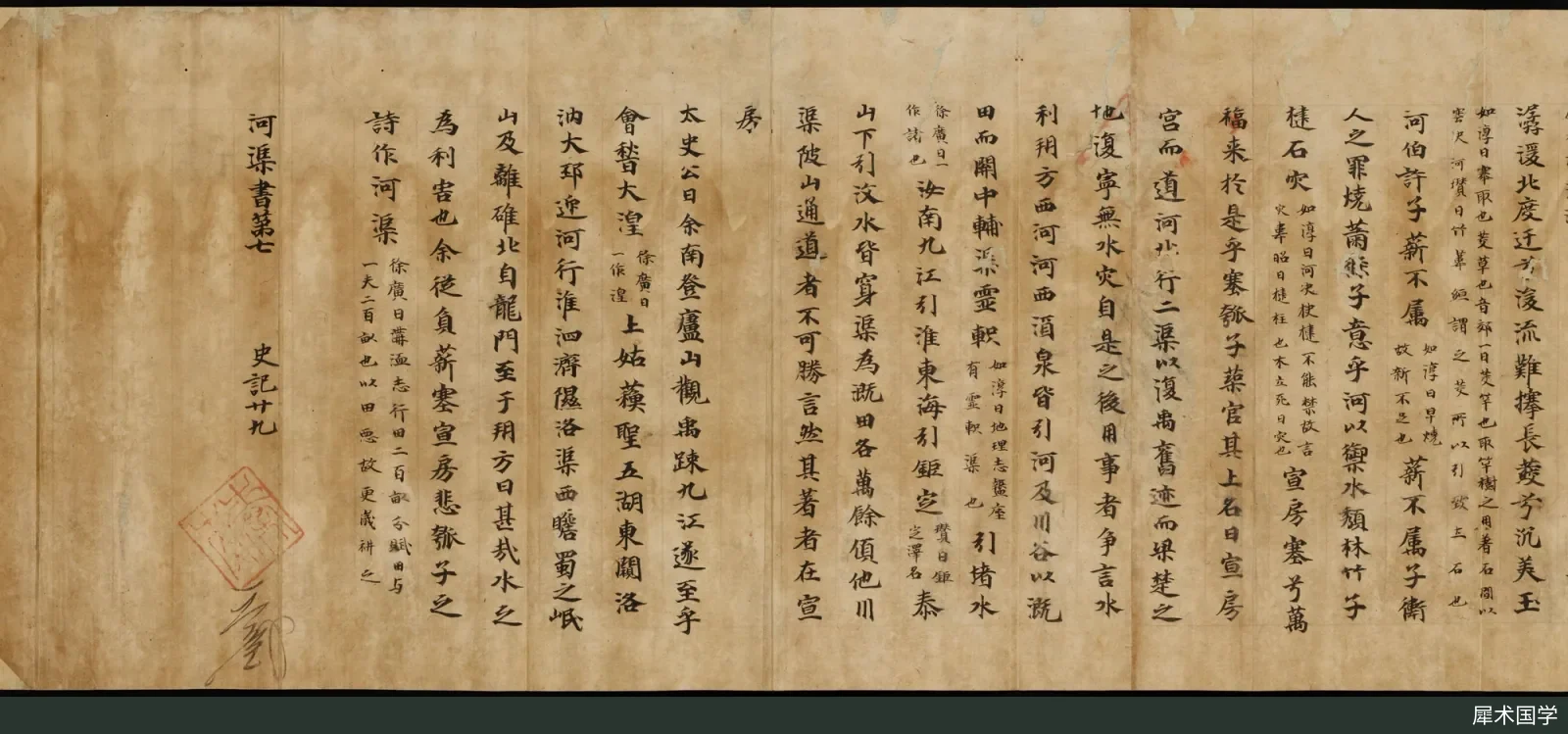
The final section of a Tang manuscript of the “Treatise on Rivers and Canals” from the Shiji, in the collection of the Tokyo National Museum (TB-1573). Source: ColBase (Integrated Collections Database of the National Institutes for Cultural Heritage, Japan) / Wikimedia Commons; License: CC BY 4.0.
Comparison with ctext and the Zhonghua Jingdian Guji Ku
The three serve different purposes. The Hanji Full-Text Database consists of transcriptions built in-house by a research institution, with texts mainly entered by hand; according to Liu’s article, the vendors’ typed drafts were required to have an error rate no higher than five in ten thousand, and the first, second, and third proofs were required to be below three, two, and one in ten thousand respectively. Its strength lies in large multi-volume works such as the standard histories, the Veritable Records, and the Daoist Canon; the Twenty-Five Histories and the Commentaries and Subcommentaries on the Thirteen Classics are free, while the rest requires authorization. ctext (the Chinese Text Project) states that it holds more than thirty thousand works and five billion characters, all free and sustained by donations. Its original-text libraries, such as “Pre-Qin and Han,” are kept separate from the “Wiki” area, whose content standards are looser and much of whose text comes from character recognition of book scans, so it should be checked against the attached images before citing. It also offers an API, with some functions requiring an institutional subscription; since March 2026 it has also added AI-generated English translations for a large number of texts, and the official notice says these translations inevitably contain errors. The Zhonghua Jingdian Guji Ku is operated by Gulian, a company under Zhonghua Book Company, and contains published critical editions from Zhonghua Book Company and other publishers, retaining proper-name lines, annotations, and collation notes; the text is matched to the original page images by page number, and it can automatically generate citations that include page numbers. However, it is sold mainly by institutional subscription, the sales status of the individual version should be checked on the current Jihe Wang (籍合网) page, copying and citing are subject to character limits, and downloading is not supported.
| Item | Hanji Full-Text Database | ctext | Zhonghua Jingdian Guji Ku |
|---|---|---|---|
| Text source | Entered by the Institute from base texts, proofread multiple times | Edited texts in the original-text libraries; Wiki area mostly from character recognition | Digitized published critical editions |
| Cost | Twenty-Five Histories and Commentaries and Subcommentaries on the Thirteen Classics free; the rest requires authorization | Free | Paid subscription |
| Basis for page numbers | Imprint data in the database and “Copy Citation” | Compare with attached book scans | Automatically generated critical-edition page numbers |
| Suitable uses | Full-text search and comparison of standard histories, classics, commentaries, and subcommentaries | Pre-Qin and Han original texts, book scans, bulk data | Citing page numbers of modern punctuated and collated editions |
In practice, you can divide the work like this: first locate the original text and find all its occurrences in the Hanji Full-Text Database or ctext, then, depending on your citation needs, check the page numbers and punctuation of the critical edition in the printed book or the Zhonghua Jingdian Guji Ku. The strengths of the Hanji Full-Text Database are stable searching across complete sets of standard histories and classics with commentaries and subcommentaries, and clear statements of base texts; its weaknesses are the authorization threshold and Traditional-character input. When you encounter “Hanji notes,” collation text inserted into the main text, or books whose base-text information is still to be verified, it is advisable to confirm against the printed book before citing.
References
-
Institute of History and Philology, “Academia Sinica”: Homepage description of the Hanji Full-Text Database (《漢籍全文資料庫》), publication date not stated, https://hanchi.ihp.sinica.edu.tw/ihp/hanji.htm, accessed October 22, 2026.
-
Institute of History and Philology, “Academia Sinica”: Hanji Full-Text Database Studio (《漢籍全文資料庫工作室》), publication date not stated, https://www1.ihp.sinica.edu.tw/Research/Groups/scriptaSinica, accessed October 22, 2026.
-
Institute of History and Philology, “Academia Sinica”: IHP Database Membership Application (《史語所資料庫會員申請》) (institutional use rules, individual use rules), publication date not stated, https://copyright.ihp.sinica.edu.tw/ihptp/ihptp/notice3.htm, accessed October 22, 2026.
-
Institute of History and Philology, “Academia Sinica”: Hanji Full-Text Database Text Reading: Instructions (《漢籍全文資料庫文本閱讀 使用說明》), publication date not stated, https://hanchi.ihp.sinica.edu.tw/ihp/hanjibook/help/help.htm, accessed October 22, 2026.
-
Liu Zhengyun: “The IHP Hanji Electronic Documents Database: Retrospect and Prospect” (〈史語所漢籍電子文獻資料庫:回顧與展望〉), Gujin lunheng no. 31, Taipei: Institute of History and Philology, “Academia Sinica,” October 2018, https://www1.ihp.sinica.edu.tw/storage/w2_file/4511DtMGCKd.pdf.
-
Feng Chia University Library: User Guide to the Hanji Electronic Documents Database (《漢籍電子文獻資料庫使用指引》), July 2012, https://web.lib.fcu.edu.tw/library/sites/default/files/eresources/edb_guides/ftms/ftms_userguide_201207.pdf.
-
Legislative Yuan Parliamentary Library: Database introduction for the Academia Sinica Hanji Electronic Documents Database (《中央研究院漢籍電子文獻資料庫》), publication date not stated, https://npl.ly.gov.tw/do/www/dbNotation?dbId=59&key=dbCategory, accessed October 22, 2026.
-
Yeen-Mei Wu, "Twenty-Five Dynastic Histories Full Text Retrieval Database at the University of Washington," Journal of East Asian Libraries, no. 94 (October 1991), https://scholarsarchive.byu.edu/jeal/vol1991/iss94/5.
-
Chinese Text Project: Homepage and “Latest News” (entry of March 1, 2026), https://ctext.org/zh, accessed October 22, 2026.
-
Chinese Text Project: Instructions: Wiki (《使用說明:維基區》), https://ctext.org/instructions/wiki/zh, accessed October 22, 2026.
-
Chinese Text Project: "Digital humanities," https://ctext.org/digital-humanities/ens, accessed October 22, 2026.
-
Tsinghua University Library (reprinting materials from Gulian): User Guide to the Zhonghua Jingdian Guji Ku (《〈中华经典古籍库〉使用指南》), publication date not stated (statistics in the text as of early 2020), https://lib.tsinghua.edu.cn/PDF/sygn.pdf.
-
Gulian (Beijing) Digital Media Technology Co., Ltd.: Zhonghua Jingdian Guji Ku User Guide (《〈中华经典古籍库〉用户使用指南》), reprinted by Toho Shoten, publication date not stated, https://www.toho-shoten.co.jp/er07/chukakeiten_manual_CN.pdf.
-
Jihe Wang: Product details page for the Zhonghua Jingdian Guji Ku (《中华经典古籍库》), https://www.ancientbooks.cn/buygoods?goodsid=401, accessed October 22, 2026.
-
Xishu Guoxue · Minds in tune; a few words reveal the art
-
Compiled and published by Scholay One-Stop Academic Platform; in case of infringement, please let us know and it will be taken down.
-
Also published on EnterScholar, a community for scholars in the age of intelligence.