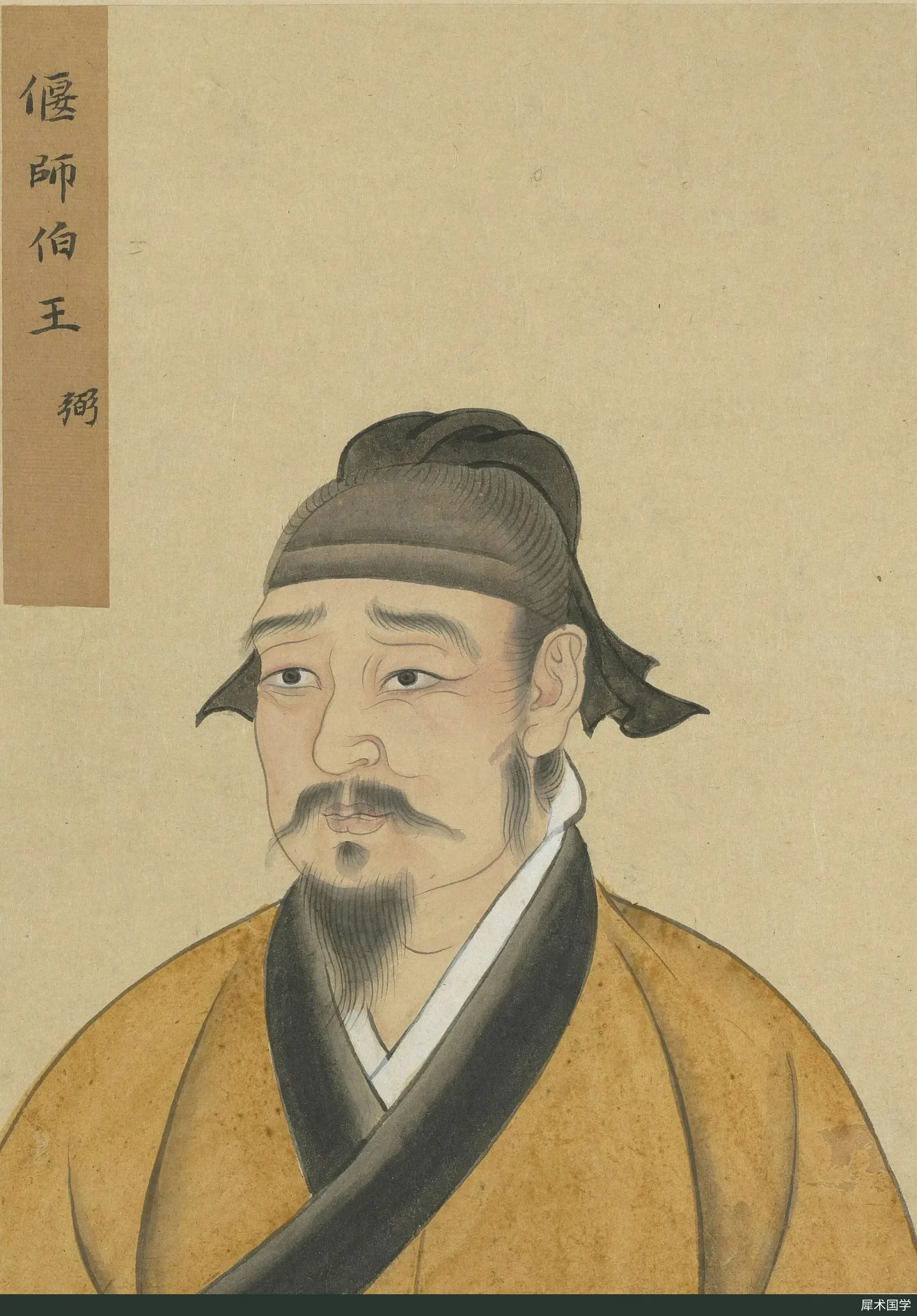
Portrait of Wang Bi from the album Half-Length Portraits of the Supreme Sage and Former Worthies, painted by a Yuan-dynasty artist (an imagined portrait made in a later age, not a likeness from life). It was formerly in the Nanxun Hall collection and is now in the National Palace Museum, Taipei. Image published via Wikimedia Commons; public domain.
In the “Ming xiang” (Clarifying the Images) chapter of his Zhouyi lüeli (General Remarks on the Zhouyi), Wang Bi of the Wei state in the Three Kingdoms period put forward the idea of “grasping the meaning and forgetting the image”: words serve to clarify images, images serve to preserve meaning, and once the meaning has been grasped there is no need to cling to the image. Taking Lou Yulie's Wang Bi ji jiaoshi (Collated and Annotated Works of Wang Bi; Zhonghua Book Company, 1980) as its textual basis, this article traces the levels of argument in this passage; the scope of its criticism, which targets the Han-dynasty Yi-ology theories of interlocking trigrams, hexagram changes, and the Five Phases; its relation to the methodological conventions of the Zhouyi zhu (Commentary on the Zhouyi); and the differing assessments of Kong Yingda, Zhu Xi, and the editors of the Siku quanshu.
The Edition, Text, and Levels of Argument of “Ming xiang”
“Ming xiang” is one chapter of the Zhouyi lüeli by Wang Bi (226—249). The modern critical edition used here is Lou Yulie's Wang Bi ji jiaoshi (Beijing: Zhonghua Book Company, 1980, in the series Zhongguo sixiangshi ziliao congkan [Collected Materials on the History of Chinese Thought], in two volumes). That book places the Zhouyi lüeli after the upper and lower canons of the Zhouyi zhu; according to the page numbers cited in Bu Zhangmin's article, “Ming xiang” appears on pp. 609—612. The received text also exists in a version with the commentary of Xing Shu, an Assistant Instructor at the School of the Four Gates in the Tang dynasty; juan ten of the Zhouyi in the Chinese Text Project is this edition with Xing's commentary. The quotations below are transcribed from the Xing commentary edition. A word-by-word comparison with Lou's text still requires checking the printed book, and individual textual variants are noted where they occur.
Now, images are what bring forth meaning; words are what clarify images. For fully expressing meaning, nothing is better than images; for fully expressing images, nothing is better than words. Words arise from images, so one may follow the words to observe the images; images arise from meaning, so one may follow the images to observe the meaning. Meaning is fully expressed through images, and images are made manifest through words. Thus words are the means of clarifying images: once the image is grasped, the words are forgotten. Images are the means of preserving meaning: once the meaning is grasped, the image is forgotten. It is just as the snare exists for the hare: once the hare is caught, the snare is forgotten; and as the fish trap exists for the fish: once the fish is caught, the trap is forgotten. …… Therefore, one who holds on to the words is not one who has grasped the image; one who holds on to the image is not one who has grasped the meaning. …… Thus images are set up to fully express meaning, yet the images may be forgotten; the strokes are doubled to fully express the true circumstances, yet the strokes may be forgotten.
—Wang Bi, Zhouyi lüeli, “Ming xiang”
The argument of this passage can be read in three steps (what follows is the author's own summary of its structure). The first step sets out an order: meaning is fundamental, images serve to express meaning, and words serve to make images clear; hence “for fully expressing meaning, nothing is better than images; for fully expressing images, nothing is better than words.” This continues the statement in the “Xici” (Appended Statements), Part One, that “the sages set up images to fully express meaning.” The second step borrows a metaphor from the “Waiwu” (External Things) chapter of the Zhuangzi. The original Zhuangzi text reads: “The fish trap exists for the fish; once the fish is caught, the trap is forgotten. The snare exists for the hare; once the hare is caught, the snare is forgotten. Words exist for the meaning; once the meaning is grasped, the words are forgotten.” It speaks of only two levels, words and meaning. Wang Bi inserts “image” in the middle, producing three levels—words, image, and meaning—and then likens words and images to the snare and the fish trap respectively, showing that both are tools. The third step argues from the reverse: “one who holds on to the words is not one who has grasped the image; one who holds on to the image is not one who has grasped the meaning.” Those who cling to the tools are precisely those who have not obtained what the tools were meant to convey.
“Forgetting the image,” then, does not mean “doing without images.” Wang Bi first says “for fully expressing meaning, nothing is better than images” and “meaning is fully expressed through images,” acknowledging that meaning depends on images for its full expression. “Forgetting” is set against “holding on,” that is, treating the image as an end in itself and clinging to it. Xing Shu's commentary takes the dragon in the Qian hexagram as an example: “Once the dragon image is grasped, its words may be forgotten; once the meaning of Qian is grasped, its dragon may be cast aside.” This likewise understands the image as an intermediary leading to meaning. On this basis, Bu Zhangmin argues that Wang Bi was “by no means denying the function of hexagram and line images”; what he swept away were “images that cannot fully express meaning.”
The Criticism of Han Yi-ology's “Searching the Hexagram According to the Text” and Its Scope
Therefore, whatever touches upon the category may serve as its image; whatever accords with the meaning may serve as its sign. If the meaning lies in strength, why must it be the horse? If the category lies in compliance, why must it be the ox? If a line accords with compliance, why must it be Kun that is the ox? If the meaning corresponds to strength, why must it be Qian that is the horse? Yet some fix the horse to Qian and, going by the text, demand the trigram; where there is a horse but no Qian, false theories proliferate beyond all recording. When interlocking trigrams do not suffice, they turn to hexagram changes; when the changes still do not suffice, they push on to the Five Phases. Once the origin is lost, the more ingenious they become, the worse it gets. Even if they occasionally hit the mark, there is no meaning to be gained from it. This is the result of holding on to the image and forgetting the meaning. Forget the image in order to seek its meaning, and the meaning will then appear.
—Wang Bi, Zhouyi lüeli, “Ming xiang”
The “Shuogua” (Discussion of the Trigrams) associates Qian with the horse and Kun with the ox, yet in the canonical text some hexagrams mention a horse without containing Qian, or an ox without containing Kun. Xing Shu's commentary gives examples: the Kun hexagram contains no Qian, yet its judgment speaks of a “mare”; Mingyi (Darkening of the Light) contains no Qian, yet its Six in the Second line also mentions a horse; Dun (Retreat) contains no Kun, yet its Six in the Second line speaks of an ox. If one insists that “Qian must be the horse,” one can only “search the hexagram according to the text”—taking an object image from the canonical text and going back into the hexagram to force a matching trigram. If none is found, one resorts to interlocking trigrams (forming a trigram from three of the middle lines among the six), then to hexagram changes (claiming that the hexagram was transformed from another), and if that still does not suffice, one pushes on to the Five Phases. Wang Bi's judgment is that even if such methods occasionally hit the mark, “there is no meaning to be gained from it.” Xing's commentary sums up this point: “If one abandons strength and compliance, one speaks of dragons and horses in vain.”
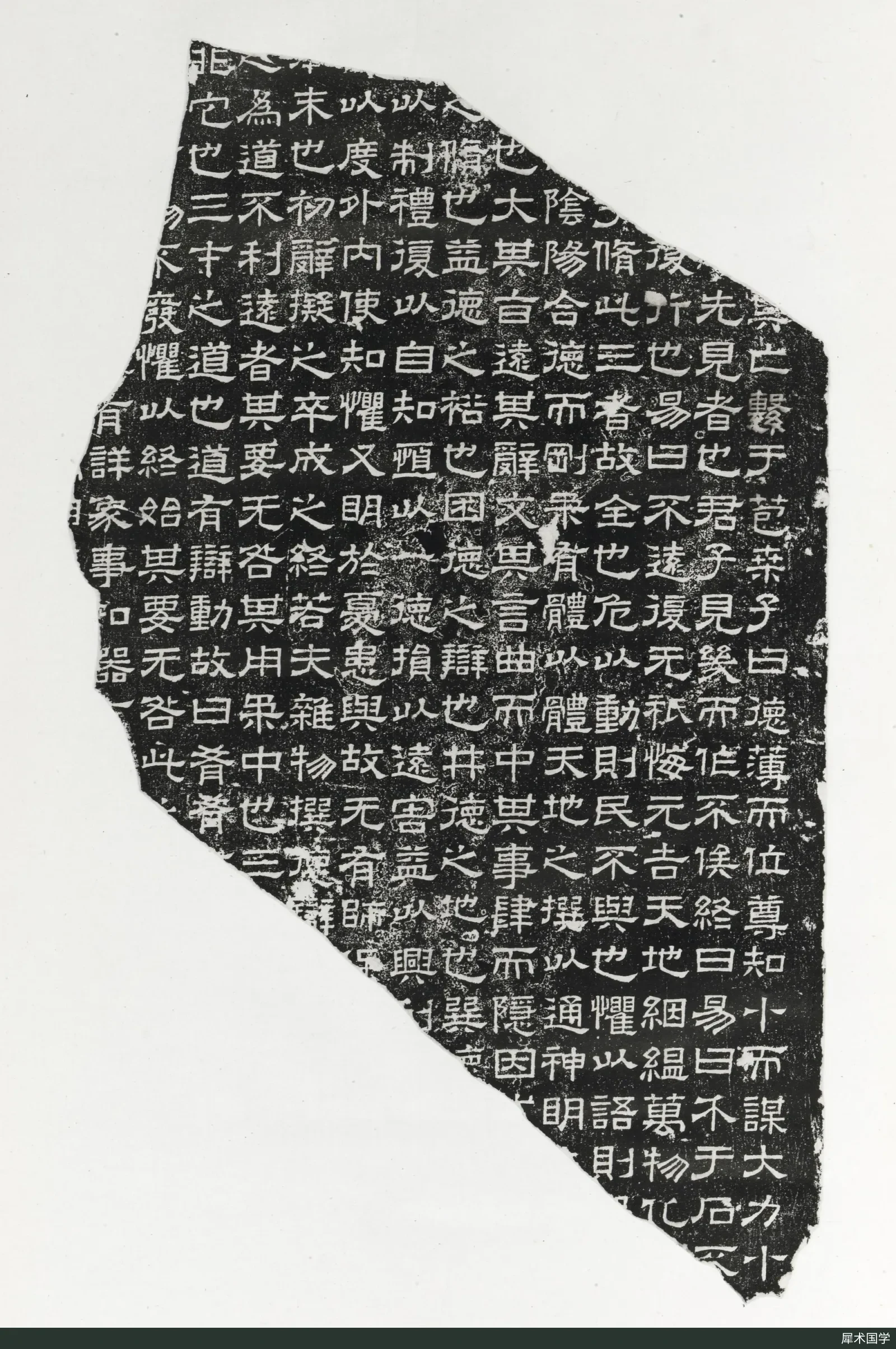
Fragment of the Zhouyi from the Eastern Han Xiping Stone Classics, held by the Shanghai Museum. The Xiping Stone Classics were canonical texts officially collated and then carved in stone during the Eastern Han; this image serves only as background on Han-dynasty Yi-ology texts. Image published via Wikimedia Commons; public domain (PD-Art).
Later scholars have differed on how far Wang Bi's criticism went. The “Prefatory Note to the Yi Category” in the Siku quanshu zongmu (General Catalogue of the Complete Library of the Four Treasuries) says that “Wang Bi completely dismissed images and numbers, explaining [the Changes] through Laozi and Zhuangzi,” treating him as the representative figure who swept away images and numbers. Bu Zhangmin, however, citing Lin Zhongjun's Xiangshu yixue fazhan shi (History of the Development of Image-and-Number Yi-ology), Volume Two (Jinan: Qilu Press, 1998, pp. 6—7), points out that Wang Bi's own Zhouyi zhu also makes use of interlocking trigrams, hexagram changes, and Five Phases theory; therefore what Wang Bi rejected was image-and-number reasoning that had “lost its origin,” not image-and-number methods as such. The two views focus on different things: the former summarizes Wang Bi's overall orientation in the history of Yi-ology, while the latter checks the actual practice of his commentary.
Two textual variants in this passage deserve attention: the Xing commentary edition reads 难可纪矣 (“beyond all recording”) and 巧愈弥甚 (“the more ingenious, the worse”), while Zhang Cizhong of the Qing, in the front matter of his Zhouyi wanci kunxue ji (Siku quanshu edition), quotes them as 难尽纪矣 and 巧喻弥甚. Neither pair of variants affects the general sense; which characters Lou's edition adopts must be confirmed against the printed book.
The Relation Between “Ming xiang” and the Conventions of the Zhouyi zhu
Wang Bi's writings on the Changes fall into two parts. The Zhouyi zhu annotates the canonical text item by item; from the “Xici” onward, the commentary was continued by Han Kangbo of the Eastern Jin, and the Tang-dynasty Zhouyi zhengyi (Correct Meaning of the Zhouyi) adopted the commentaries of both Wang and Han. The Zhouyi lüeli, by contrast, is a general discussion of methodological conventions; Xing Shu's preface says that “on the large scale, it gathers the overall purport of the whole work; on the small scale, it clarifies the gains and losses of the six lines.” In other words, “Ming xiang” sets out the general principle for reading images, and the Zhouyi zhu is the application of that principle to each hexagram and each line. Lou Yulie's edition compiles the Zhouyi zhu and the Zhouyi lüeli together, making them easy to compare. Zhu Bokun's Yixue zhexue shi (History of the Philosophy of Yi-ology), Volume One (Beijing: Kunlun Press, 2005), Chapter Four, “The Yi-ology Philosophy of the Wei-Jin Xuanxue School,” likewise combines “Wang Bi's Zhouyi zhu and Zhouyi lüeli” into a single section (beginning on p. 272), divided into two parts: “On the Conventions of the Zhouyi” and “The Xuanxue Outlook in Yi-ology.”
Judging from the commentary itself, Wang Bi did not refuse to discuss images altogether. Bu Zhangmin divides Wang's commentary into three types—commentary by meaning, commentary by image, and commentary combining image and meaning—and gives one example of each (all page numbers refer to Lou's edition). On the phrase “beneficial to be correct” in the judgment of Meng, Wang writes: “What benefits Meng is benefit in correctness…… Using obscurity to nurture correctness is the achievement of a sage,” reasoning purely from meaning and principle (p. 239). On the Nine in the Third line of Tai, “No level without a slope, no going without a return,” he writes: “Qian is originally above, Kun is originally below; that they attain Tai is through descending and ascending,” using the images of the upper and lower trigrams (p. 277). On the Six in the Fourth line of Meng, “Confined in ignorance; humiliation,” he writes: “Alone and far from the yang, situated between two yin, in darkness with no one to enlighten it,” combining line position with meaning and principle (p. 241). Bu Zhangmin considers the third type the most common.
Kong Yingda's “Preface to the Zhouyi zhengyi” also preserves a pair of interpretations that can be compared. On the phrase in the judgment of Gu, “three days before jia, three days after jia,” the scholars of the Southern Dynasties followed Zheng Xuan in taking jia as a day in the cyclical calendar: three days before jia is a xin day, taken to mean “renewal,” and three days after jia is a ding day, taken to mean “earnest admonition.” Wang Bi's commentary, however, says, “Jia is the decree of creating new institutions,” interpreting jia as a newly promulgated law. The former derives meaning from the cyclical stems; the latter explains directly from the logic of affairs. In the author's view, this is one instance in the commentary of the opposition to “searching the hexagram according to the text” expressed in “Ming xiang.”
The Assessments of Kong Yingda, Zhu Xi, and the Siku Editors
In the Tang dynasty, Kong Yingda directed the compilation of the Zhouyi zhengyi, taking Wang Bi's commentary as its basis. In his preface he says that among the transmitters of the Changes in the two Han dynasties, “in the Western Capital there were Ding, Meng, Jing, and Tian; in the Eastern Capital there were Xun, Liu, Ma, and Zheng. By and large they followed one another, and none was outstanding. Only the commentary of Wang Fusi of the Wei stands alone as foremost from ancient times to the present.” He also laid down the principle: “In examining matters, one must take Zhongni as the master; where meaning and principle can be explicated, one first takes Fusi as the basis.” What he criticized were the subcommentaries of the Jiangnan region, whose “language favored the empty and abstruse, and whose meanings were mostly unfounded and fanciful,” so that “having turned against the original text, they also departed from the commentary.” Yet honoring Wang's commentary did not mean rejecting images and numbers: in the same preface, when defending Wang's commentary on “returning in seven days,” Kong cites precisely the hexagram-qi theory of “six days and seven fractions” from the apocryphal Yiwei, as related by Zheng Xuan. The entry on the Zhouyi zhengyi by the China Confucius Foundation likewise summarizes Kong's subcommentary as one that “constantly uses meaning and image to illuminate each other.”
In the Southern Song, Zhu Xi, in his “Yi xiang shuo” (On the Images of the Changes) (Hui'an xiansheng Zhu Wengong wenji, juan sixty-seven, Sibu congkan edition), offered both praise and criticism of each side: “The Confucians of the two Han dynasties insisted on investigating where [the images] came from, and so became mired and unable to get through; those since Wang Bi have sought only to infer their use, and so have been cursory and groundless.” He cites Wang Bi's “if the meaning corresponds to strength, why must it be Qian that is the horse?” and Cheng Yi's “since principle has no form, images are borrowed to manifest meaning,” affirming that “in breaking the earlier Confucians' error of rigidity and fragmentation, and in opening for later learners the way of savoring the words and savoring the divinations, they reached the utmost.” He also criticizes Wang Bi for seemingly treating the taking of images as being like “the comparison and evocation of the Odes or the analogies of Mencius”; in that case, the “Shuogua” would “have nothing to do with the Changes.” Zhu Xi's conclusion is that the images “must have come from somewhere,” but since the ancient accounts can no longer be verified, one may, as Wang Bi, Cheng Yi, and his own Zhouyi benyi (Original Meaning of the Zhouyi) do, “rely directly on the images within the words to seek the meaning within the images”; yet “one cannot simply call them hypothetical and hastily wish to forget them.” That is to say, he accepted Wang Bi's method of interpreting the classic but disagreed with Wang Bi on the origin of the images. The Sibu congkan edition reads this phrase as 必已具于大卜之官 (“must already have been held by the office of the Grand Diviner”), while Zhang Cizhong quotes it as 必载于太古之官; the characters differ.
The Qing-dynasty “Prefatory Note to the Yi Category” in the Siku quanshu zongmu divides Yi-ology into “two schools and six lineages,” taking “Wang Bi completely dismissed images and numbers, explaining [the Changes] through Laozi and Zhuangzi” as the starting point of the meaning-and-principle school, after which “Hu Yuan and Master Cheng first expounded Confucian principle.” This characterization has been highly influential, but, as noted above, contemporary researchers such as Bu Zhangmin place more emphasis on the continuity between Wang Bi and both the “Xici” idea of “setting up images to fully express meaning” and Han-dynasty Yi-ology. Taken together, the disagreements among these scholars center mainly on two questions: whether Wang Bi truly cast aside images and numbers, and whether the hexagram images have an independent origin apart from meaning and principle.
References
-
[Wei] Wang Bi, author; Lou Yulie, collator and annotator. Wang Bi ji jiaoshi (two volumes). Beijing: Zhonghua Book Company, 1980. Zhouyi lüeli, “Ming xiang” is on pp. 609—612 (page numbers as cited in Bu Zhangmin's article). Bibliographic information at the Niigata University Library catalog and Dushu.com.
-
[Wei] Wang Bi, author; [Tang] Xing Shu, commentator. Zhouyi lüeli, “Ming xiang.” See Chinese Text Project, Zhouyi, juan ten; see also the Handian ancient-texts edition.
-
Zhu Bokun. Yixue zhexue shi, Volume One. Beijing: Kunlun Press, 2005, Chapter Four, Section One (beginning on p. 272). Edition information at the Queshu.com catalog.
-
Bu Zhangmin. “An Examination of the Origins of Wang Bi's Yi-ology Theory of ‘Image’ and ‘Meaning’.” Zhongguo zhexue shi (History of Chinese Philosophy), 2021, No. 2, pp. 29—36, PDF.
-
[Tang] Kong Yingda. “Preface to the Zhouyi zhengyi,” front matter of the Zhouyi zhushu, Siku quanshu edition. See Shidian Guji.
-
China Confucius Foundation. Entry “Zhouyi zhengyi · Kong's Subcommentary,” China Confucius Net.
-
[Song] Zhu Xi. “Yi xiang shuo,” Hui'an xiansheng Zhu Wengong wenji, juan sixty-seven, Sibu congkan edition. See Wikisource.
-
[Qing] Zhang Cizhong. Zhouyi wanci kunxue ji, front matter, “Du Yi dayi” (General Ideas on Reading the Changes), Siku quanshu edition. See Wikisource.
-
[Qing] Yongrong, Ji Yun, et al. Siku quanshu zongmu, juan one, “Prefatory Note to the Yi Category.” See Wikisource.
-
Zhuangzi, “Waiwu.” See Wikisource.
-
Xishu Guoxue · Minds in tacit accord; the art revealed in a few words
-
Compiled and published by Scholay, a one-stop academic platform. If this infringes any rights, please let us know and it will be taken down.
-
Also published on EnterScholar, a community of scholars for the intelligent era