Cheng Yi's 'Yi Zhuan' (now commonly known as 'Zhouyi Chengshi Zhuan' or 'Yichuan Yi Zhuan') is a representative work of the Yili school of the Northern Song Dynasty. It follows Wang Bi's path of eliminating speculative interpretations of the numerical and symbolic elements, yet replaces the Neo-Taoist concept of 'nothingness' with Confucian 'li', advocating 'clarifying the principles through the forms'. This article is based on Wang Xiaoyu's edited version of 'Er Cheng Ji' and references Zhu Bokun's 'Philosophical History of Yi Learning', to systematically outline the structure and exegetical methods of this text, its similarities and differences with Wang Bi's annotations, and its position within the development of Yi learning from the Song to the Ming dynasties.
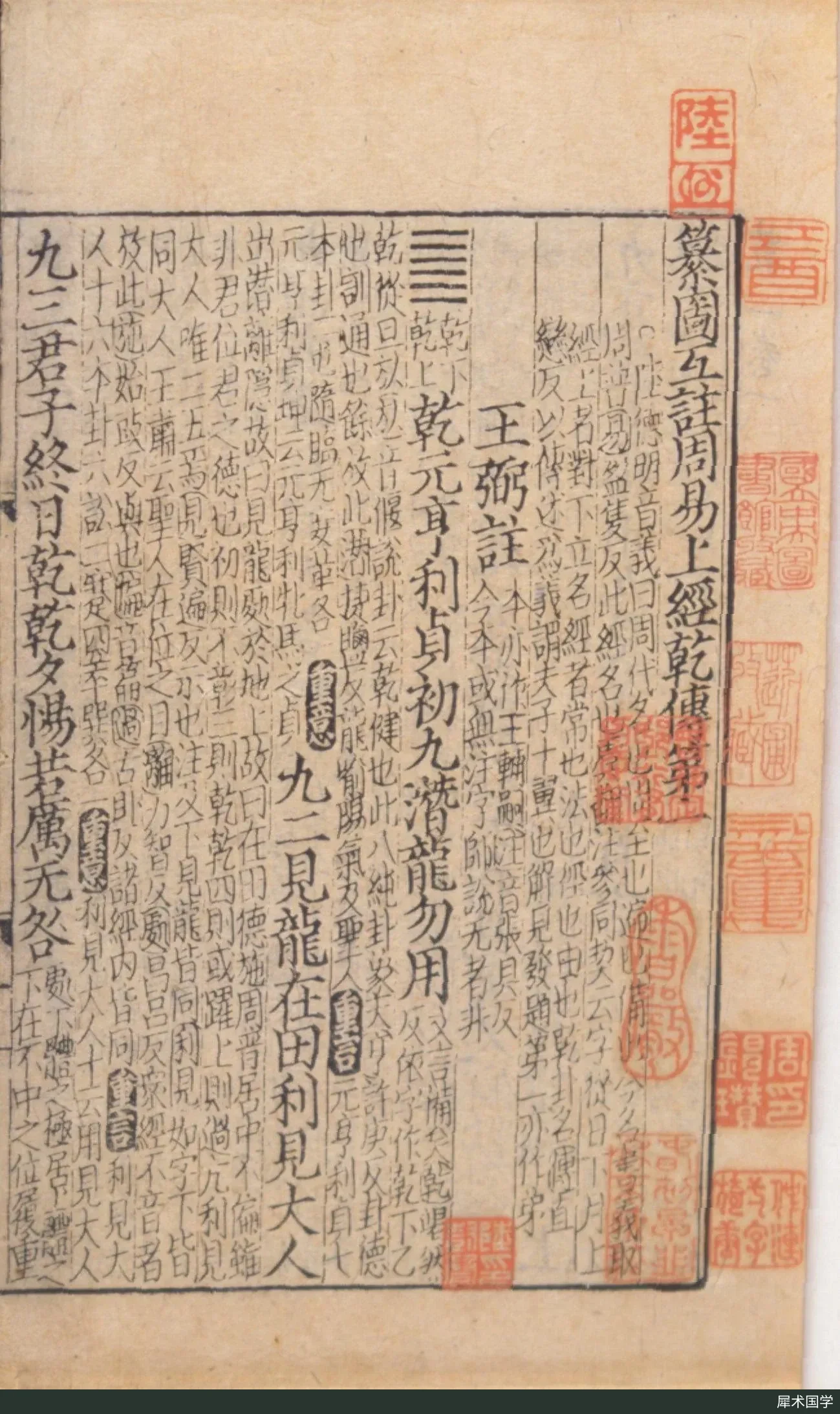
A page from a Song Dynasty edition of The Book of Changes, housed in the Taipei National Library. This is a photographic reproduction of a Song Dynasty printed edition of the classical text, not a printed edition of Cheng Yi's Commentary on the Changes, used to illustrate the form in which the text of the Book of Changes was printed during the Song Dynasty. Image source: Wikimedia Commons (File:I Ching Song Dynasty print.jpg), public domain (PD-Art).
Compilation, structure, and widely circulated editions
Cheng Yi (1033–1107), styled Zhengshu, is known as Mr. Yichuan among scholars. His "Yi Zhuan" is now known as "Zhouyi Chengshi Zhuan," also commonly referred to as "Yichuan Yi Zhuan" or "Chengshi Yi Zhuan," and represents Cheng Yi's most deeply worked-out commentary on the classics. The extant edition begins with a self-written preface by Cheng Yi; the preface is dated the second year of Yuanfu (1099). It is said that after completing the manuscript, Cheng Yi believed he could still revise it and thus kept it concealed for a long time, only eventually handing it over to his disciples in his later years; these details regarding transmission come from accounts by his disciples, and various sources offer inconsistent versions; this text does not make further assertions on the matter.
In terms of structure, Cheng's commentary follows the arrangement of Wang Bi's version of the text, that is, attaching the 'Tuan Tradition' and 'Xiang Tradition' to the respective hexagram texts, and separately adding the 'Wenyan' to the texts of the Qian and Kun hexagrams. Cheng Yi only provides explanations for the hexagram and line statements of the sixty-four hexagrams and the accompanying commentaries, without composing separate commentaries on the 'Xi Ci', 'Shuo Gua', 'Xu Gua', or 'Za Gua'; however, except for the Qian hexagram, each hexagram begins with a quotation from the 'Xu Gua' explaining why this hexagram follows the previous one, followed by an explanation of the hexagram's name and meaning. The currently widely circulated edition is the edited version by Wang Xiaoyu of the 'Collected Works of the Cheng Brothers' (published initially by Zhonghua Book Company in 1981, included in the 'Li Xue Series'; second edition in 2004), in which the 'Cheng Shi Zhuan on the Book of Changes' is divided into four volumes. Cheng Yi's letters discussing his methodology in studying the Book of Changes, such as 'Reply to Zhang Hongzhong', are included in the same collection, Volume Nine of the 'Henan Chengshi Wenji'.
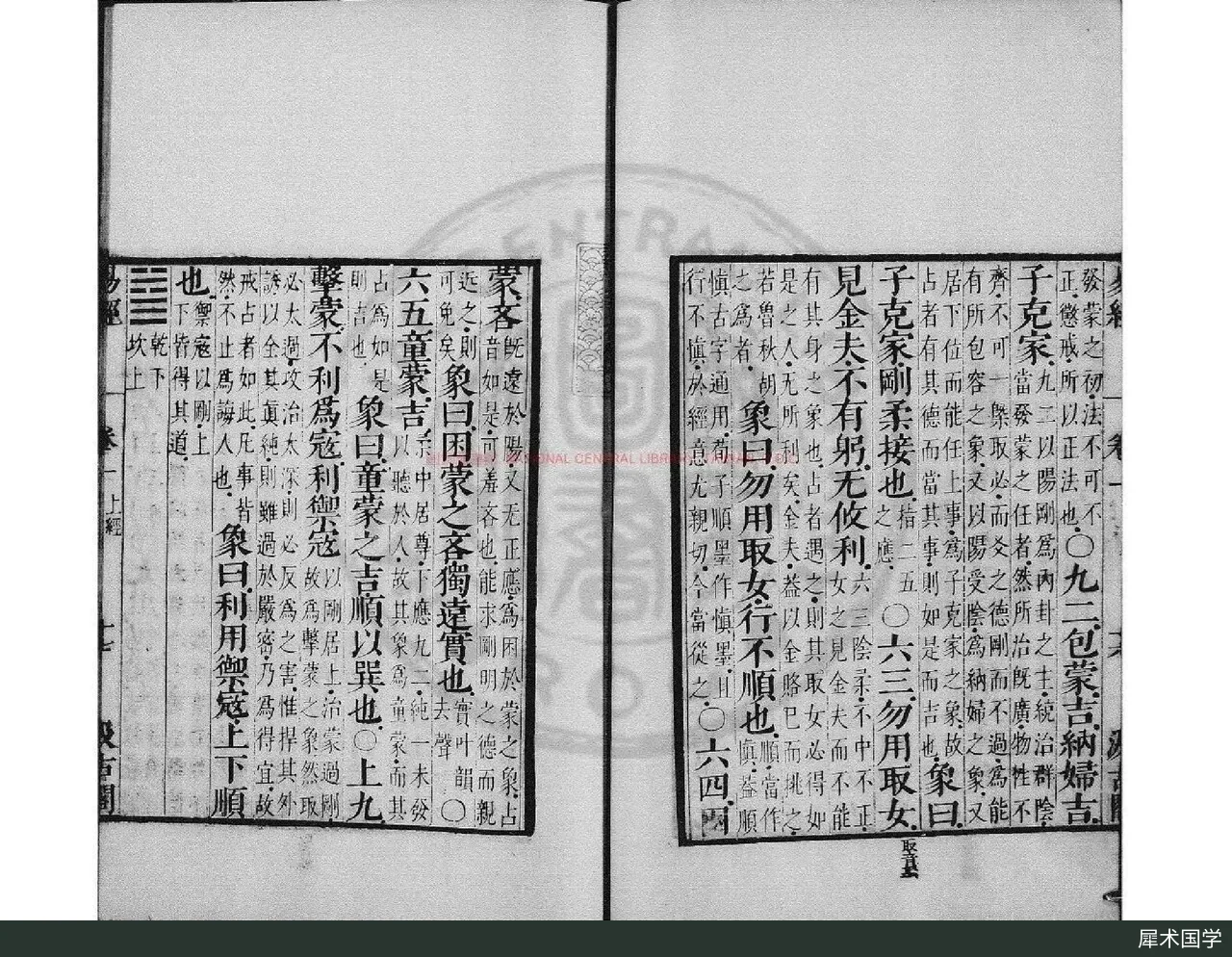
A page from the Jikuge edition of Zhu Xi's Zhouyi Benyi, published by the Mao family of Yushan during the Ming dynasty, housed in the Taiwan National Library. After the Southern Song period, Zhouyi Benyi has often been read and published together with Cheng's commentary; this illustration is not a reproduction of Cheng's commentary. Image source: Wikimedia Commons (File:NCL-00038 周易本義.pdf), public domain (PD-old).
The exegetical method of clarifying principles through images
Cheng Yi's interpretive purpose is most clearly expressed in the "Preface to the Commentary on the Book of Changes." The opening lines state: "The Book of Changes refers to change; it is change in accordance with the times and in alignment with the Way." This can be understood as meaning that the concept of 'change' in the Zhouyi emphasizes not the calculation of fortune or misfortune, but rather how individuals should conform to the 'Way' in different circumstances. The preface further states: "The most subtle is the principle; the most manifest is the image. The essence and application are one origin, with no distinction between the subtle and the manifest." The principle is most subtle, the image most evident, and both are the essence and application of the same thing, not divided into two separate entities. As for where to begin, the preface is very direct: "What I transmit is the language of the hexagrams; from the language one arrives at its meaning, and grasping that meaning depends on the reader." Cheng Yi considers himself merely interpreting the hexagram and line statements; according to his overall approach, 'meaning' refers to the principle embodied in the language.
Regarding the attitude toward objects and numbers, see the letter to Zhang Hongzhong: 'There must be principle before there is form, and form before there is number. The Book of Changes uses form to clarify principle, and through form one comes to understand numbers. Once the meaning is grasped, then forms and numbers are contained within it. Yet if one insists on probing the subtle intricacies of form and the minute details of numbers, one merely follows trivialities and ends up in the methods favored by practitioners of esoteric techniques, not the concern of Confucian scholars.' This passage is often summarized as Cheng Yi's 'elimination of form and number,' but a careful reading reveals that he does not deny the existence of form and numbers; rather, he establishes a hierarchy: principle comes first, and form and number arise from principle. The purpose of interpreting the classics is 'to clarify principle,' and form serves as a means to reach principle. What he opposes is the expenditure of effort on meticulous examination of hexagram details and numerical calculations. Historiographical scholarship generally interprets this criticism as directed against the methods of mutual derivation and transformation from the Han dynasty onward, as well as the prevailing trend in the Northern Song period concerning the study of diagrams, forms, and numbers.
When applied to specific hexagrams and lines, Cheng Zhuan employs several common techniques. The first is using imagery to explain principles. For instance, in the initial line of the Qian hexagram, 'The hidden dragon should not be used,' Cheng says: 'Principles have no form; thus, imagery is used to illustrate meaning. The Qian hexagram uses the dragon as an image.' The dragon here is merely an image used to convey the principle, emphasizing that when yang energy is just beginning to emerge, a noble person in a lower position should remain concealed and wait for the right time. The second technique involves discussing 'time' and 'position,' explaining one's circumstances based on whether the line is properly aligned, whether it occupies the central position, and whether the upper and lower parts correspond. The third technique applies the hexagram's meaning to human affairs, especially to the relationship between ruler and minister, the decisions regarding entering or leaving office, and the path of self-cultivation. These techniques make Cheng Zhuan read more like a Confucian philosophical work using the classics to discuss principles, rather than a manual for divination.
A Comparison of Similarities and Differences between Wang Bi's Annotation on the Zhou Yi and Cheng Yi's Commentary
Cheng Yi and Wang Bi belong to the same tradition of rational interpretation. In his Zhouyi Lue Li: Ming Xiang, Wang Bi says: 'The image serves to express meaning; speech serves to clarify the image.' He criticizes the Han scholars for 'insufficient mutual interpretation, leading to discussions of hexagram transformations; transformations themselves are insufficient, so they extend to the five elements,' and advocates 'to grasp the essence while forgetting the image, and to grasp the image while forgetting speech.' Cheng Yi opposed the exhaustive study of numerical and symbolic systems, aligning with Wang Bi's position; the Cheng Yi's commentary follows Wang Bi's arrangement of the text and commentaries, explaining the meanings of hexagrams and lines through positions, the central and proper principles, and mutual correspondences, continuing the lineage of Wang Bi's annotations. In his letter to Jin Tang Xie Jun, Cheng Yi also lists Wang Bi, Hu Yuan, and Wang Anshi as three key figures whose works on the Book of Changes should be read first (this is a summary, see Volume Nine of the Henan Chengshi Wenji).
The difference first lies in the concept of 'the original principle'. The Commentary on the Hexagram of Fu states: 'Fu represents the manifestation of the heart of heaven and earth.' Wang Bi comments: 'Fu means returning to the original principle. Heaven and earth take the original principle as their heart.' It then argues that when movement ceases, stillness prevails, and the state of absolute stillness and emptiness is the original principle of heaven and earth, which reflects the Wei-Jin metaphysical stance of 'taking nothingness as the fundamental principle'. Cheng Yi, however, comments on the same sentence: 'One yang energy returns to the lower position, which is the heart of heaven and earth for generating life. Earlier scholars all regarded stillness as the manifestation of the heart of heaven and earth; they failed to recognize that the beginning of movement is actually the heart of heaven and earth.' He interprets the heart of heaven and earth as the ceaseless process of generation and movement, and directly criticizes the earlier view that takes stillness as the fundamental principle. The same passage in the commentary, interpreted in two different ways, precisely illustrates the boundary between Xuanxue and rationalist Confucianism in the study of the Book of Changes.
Secondly, the treatment of 'xiang' (image or form). Wang Bi argues that after grasping the meaning, one can forget the form; he sees the relationship between speech, form, and meaning as that of tool to purpose. Cheng Yi, on the other hand, says 'body and function originate from the same source, with no gap between the manifest and the subtle,' asserting that reason is revealed within form, and thus does not speak of forgetting form, but rather of 'using form to clarify reason.' As for the content of the moral-philosophical aspect: Wang Bi's annotations mostly focus on dealing with the world, non-action, and governing the many through the few, exhibiting a Daoist and Zhuangist flavor; Cheng Yi's interpretations, by contrast, conclude with Confucian ethics. The 'General Preface' of the 'Four Treasuries' category on the Book of Changes summarizes the evolution of Change studies by stating: 'Wang Bi completely discarded the numerical and formal aspects, advocating the teachings of Laozi and Zhuangzi. A shift then occurred with Hu Yuan and Cheng Yi, who first clarified Confucian principles.' Zhu Bokun's 'Philosophical History of the Book of Changes' also discusses Wang Bi and Cheng Yi in sequence within the context of the moral-philosophical school, providing a parallel reading. As for the extent to which each of them 'eliminated form,' scholarly opinions differ, and this paper does not offer a definitive conclusion.
The impact on Song and Ming dynasty yixue
One of the most important links in the influence of Cheng Yi's commentary on later generations was Zhu Xi. Zhu Xi highly valued the philosophical interpretations in Cheng Yi's commentary, yet he believed that the Book of Changes was originally composed for divination purposes; the approach of Cheng Yi's commentary, focused on rational explanation, strayed from the original function of the text. Thus, Zhu Xi composed the Original Meaning of the Book of Changes, supplementing it with content on divination and symbolic numbers (the source and evaluation of Zhu Xi's view on this matter are covered in a dedicated article in this section). The two works differ in orientation, yet they have often been combined and published together as the Commentary on the Book of Changes. During the Yongle period of the Ming dynasty, in the official state compilation of the Five Classics, the Complete Commentary on the Book of Changes was primarily based on Cheng Yi's commentary and Zhu Xi's Original Meaning. In Ming dynasty imperial examinations, the Book of Changes was taught according to the Cheng-Zhu school of thought, and thus Cheng Yi's commentary became a mandatory reading text for scholars.
In the Song dynasty, Cheng Yi's commentary also gave rise to another branch. The "General Catalogue of the Four Treasuries" adds after the preceding text: "Later it evolved into Li Guang and Yang Wanli, who further referenced historical events." Yang Wanli's "Chengzhai Yi Zhuan" generally followed the commentary's approach of interpreting the Book of Changes through human affairs, yet extensively cited historical examples to validate the hexagrams and lines, which later scholars categorized as "historical events". In the Qing dynasty, scholars such as Hui Dong shifted their focus to collecting and examining the image-and-number interpretations of the Book of Changes from the Han dynasty, criticizing Song dynasty scholars for interpreting the text through principles, thereby casting doubt on the status of Cheng Yi's commentary; nevertheless, as a representative annotation of Song dynasty philosophical exegesis of the Book of Changes, it remains a fundamental text for studying rational interpretations of the Book of Changes. Overall, the strength of Cheng Yi's commentary lies in interpreting the Book of Changes as a Confucian classic discussing "time" and "principles", but this same feature also constitutes its limitation: interpreting the text through principles does not always conform to the original contextual setting of the hexagram and line statements, which precisely became the focal point of criticism by Zhu Xi and Qing dynasty scholars.
References
-
Cheng Hao, Cheng Yi: "The Cheng Brothers' Collected Works", edited by Wang Xiaoyu, Beijing: Zhonghua Book Company, first edition 1981 (Lixue Series), second edition 2004. Texts used: Volume one to four of "Cheng Shi's Commentary on the Zhou Yi" (including the "Preface to the Commentary on the Zhou Yi"); Volume nine of "The Henan Cheng Family Writings", "Reply to Zhang Hongzhong" and "Letter to Jin Tang Xie Jun".
-
Wang Bi, with correction and annotation by Lou Yulie: 'Collected and Annotated Works of Wang Bi,' Beijing: Zhonghua Book Company, 1980. Texts used: 'Annotations on the Book of Changes,' the Hexagram Fu; 'On the Manifestation of Images' in 'Brief Exposition of the Book of Changes.'
-
Zhu Bokun: "A History of the Philosophy of Yi Studies" (Revised Edition, four volumes), Beijing: Hua Xia Press, 1995; the first edition was published by Peking University Press. Sections used: chapters related to Wang Bi and the Song Dynasty rationalist school.
-
Yong Rong et al.: 'General Catalogue of the Four Treasuries', Volume I, 'Classical Section · Book of Changes' Preface, Beijing: Zhonghua Book Company, 1965 reprint edition.
-
Li Jingde compiled, Wang Xingxian edited: The Collected Sayings of Zhu Xi, Beijing: Zhonghua Book Company, 1986. Portions used: Volume 67, entries on Cheng Yi's 'Yi' commentary.
-
Xi Shu Guo Xue The heart communicates intuitively, understanding through mere words.
-
Information provided by Scholay Academic One-Stop Platform Organize and publish; if there is any infringement, please provide feedback for removal.
-
Information synchronization published in EnterScholar, Scholar Community in the Age of Intelligence