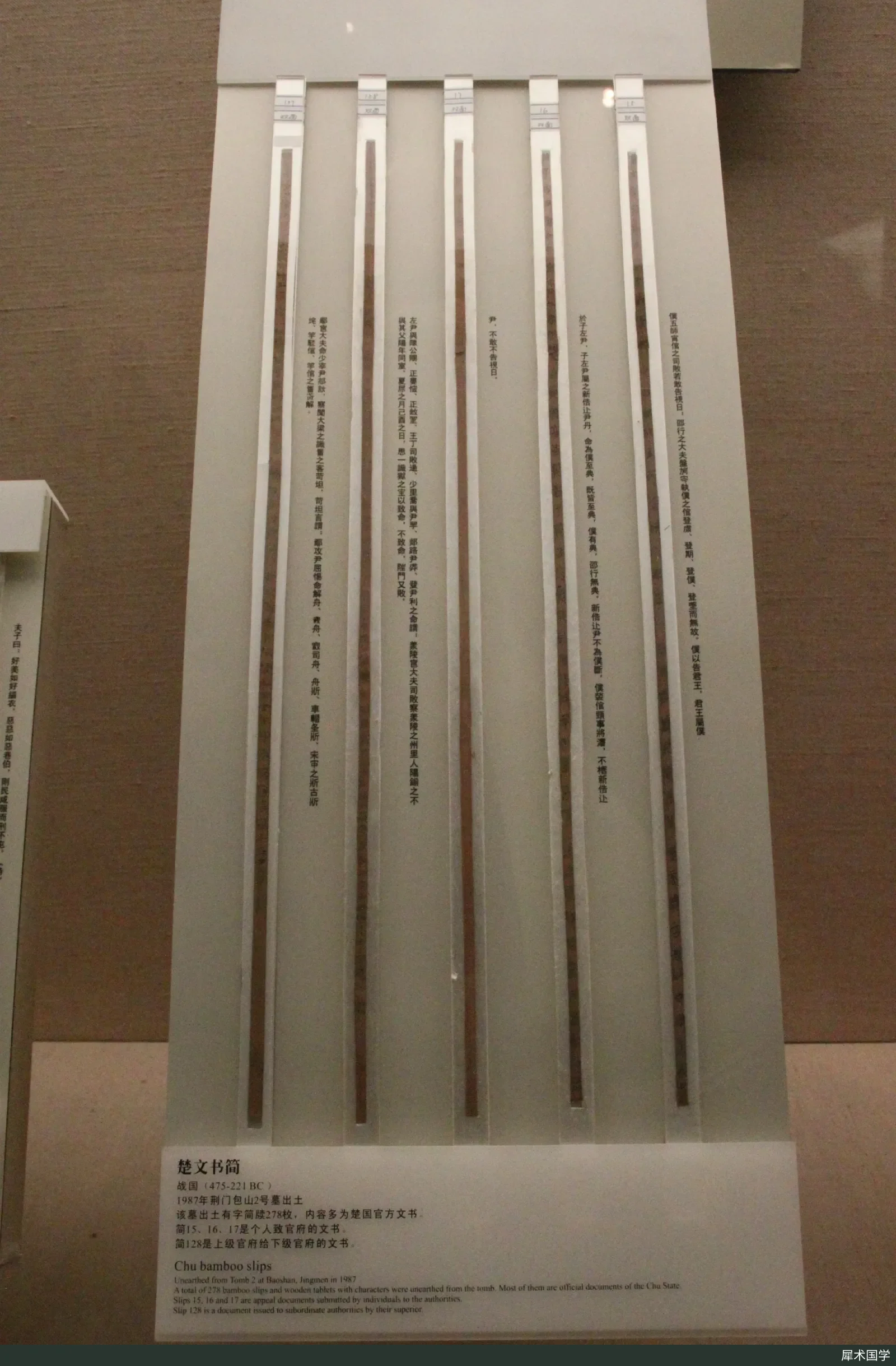
Figure: Baoshan Chu slips on display at the Hubei Provincial Museum—not the Shanghai Museum Kongzi shilun; used only as a formal reference for Warring States Chu slips. Photo: Gary Todd; source: Wikimedia Commons; license: CC0.
In 2001, Shanghai Museum Collection of Warring States Chu Bamboo Books (I), edited by Ma Chengyuan, was published by Shanghai Ancient Books Publishing House; the opening piece is what the editors named Kongzi shilun. The extant Chu text runs to 29 slips and about a thousand characters: first a general discussion of Song, Ya, and Feng, then poem-by-poem remarks on about sixty poems. Drawing on the editorial edition and studies by Li Xueqin and others, this article sorts out the slips’ provenance, the text’s remarks on Guanju and Gantang, debates over authorship, and its place in the history of Shijing studies.
Acquisition and editing of the slips
According to Ma Chengyuan’s “Discovery, Protection, and Editing of the Warring States Chu Bamboo Books” for volume I, in spring 1994 bamboo slips began appearing on the Hong Kong antiques market; Professor Cheung Kwong-yue of the Chinese University of Hong Kong told him and successively faxed tracings. From script and content Ma judged them pre-Qin texts and decided the Shanghai Museum would fund purchase; the slips reached Shanghai around May 1994. Another batch appeared that autumn and winter—497 slips in all—with the same features as the first. In Zhu Yuanqing’s interview “Mr. Ma Chengyuan on the Shanghai Museum Slips,” Ma said this second batch was jointly bought by five friends of the Shanghai Museum in Hong Kong, including Zhu Changyan, and donated to the museum. The two batches together total more than 1,200 complete and fragmentary slips; the publisher’s series blurb gives over 35,000 characters.
It must be noted that these slips are not archaeological excavation finds. In the same essay Ma says “the time and place of excavation can no longer be known; rumor then was that they came from Hubei roughly.” From dating reports and Chu script he further inferred burial goods from a late Warring States Chu elite tomb. Neither tomb nor find spot can be verified; citation should keep the limit “editors’ inference.”
Editing took years. Per Ma’s preface, in 1995 Professor Li Ling of Peking University was first asked to make a preliminary classification and transcription; in 1997 dehydration and cleaning of all slips were finished, and that summer an advisory group met to divide annotation work; after the October 2000 Peking University “International Conference on Newly Excavated Bamboo and Silk” it was decided to publish by piece in successive volumes. Volume I contains Kongzi shilun, Ziyi, and Xingqing lun, each with color enlargements and transcription-commentary. Per bibliographic notices, the Kongzi shilun section also appends a table matching slip and received poem titles, and a table matching shilun remarks with Mao shi minor-preface remarks.
The text originally had no title; “Kongzi shilun” was Ma Chengyuan’s proposal. Zheng Yushan’s research abstract, following the editorial count, notes 29 complete and fragmentary slips extant, only one complete, about 1,006 characters. Pu Maozuo notes that six slips leave blank space at both ends, with writing only between the first and third binding notches; the rest are fully written. The editors held that this piece matches Zigao and Lu bang dahan from the same batch in script, slip length, and form, but that the contents are independent, so they published Shilun first on its own. Li Ling instead argued it was originally the poetry discussion within Zigao; Huang Huaixin and others renamed it Shilun; the title remains unsettled.
Because many slips are broken and there is no transmitted text to match, slip order has never been settled. Pu Maozuo recalls Ma Chengyuan tried more than ten arrangements while editing; Li Xueqin divided the 29 slips into 4 groups and 12 chapters, estimating the original at no fewer than 23 slips, with narrative order from the Two Nan of the Guofeng to the Song; Scott Cook published a new joining and transcription in Zhongguo wenzi overall issue 4 (2020). Citations below note the editorial slip numbers; transcription mainly follows Li Xueqin’s “Shilun divided-chapter transcription,” with disagreements in reading noted separately.
Classification of poems and remarks on poetic intent
The general discussion evaluates in turn “song” (Song), “daxia” (Daya), “xiaoxia” (Xiaoya), and “bangfeng.” Slip 2 says of the Song that it is “level virtue… its thought deep and far-reaching—utmost”; slip 3 says “bangfeng takes things in broadly, observes people’s customs, and gathers talent widely. Its words are patterned, its sounds good.” In slip 1, “Confucius said: poetry has no □ intent, music has no □ feeling, pattern has no □ speech,” the key character replaced by □ is read by Ma Chengyuan as “leave” (li) and by Li Xueqin as “conceal” (yin); both readings still stand; the last character Ma reads as “speech” (yan), Li as “meaning” (yi). Li also notes that the line agrees with “shi yan zhi” in Shangshu · Shundian and with “what is in the heart is intent; when uttered it is poetry” in the Shi daxu.
The name “bangfeng” has drawn much discussion. The editors held that “bangfeng” was the early name for the Feng poems and was changed to “guofeng” only in the Han to avoid the taboo of Gaozu Liu Bang (editorial pp. 129–130, via Wang Gang). Xiong Liangzhi questioned this in 2006, arguing that Han taboo practice was still loose and that “guofeng” already appears in pre-Han texts; Wang Gang in 2014 further argued that both “bangfeng” and “guofeng” were informal category names coexisting in the Warring States, after which “guofeng” prevailed and “bangfeng” dropped out. The taboo explanation remains a hypothesis and should not be treated as settled.
The particular discussion evaluates poems one by one; Pu Maozuo counts about sixty. Most titles can be matched to the received Mao shi, but spellings often differ: slip 8’s “yu wang zheng” and “ji nanshan” are today’s Yu wu zheng and Jie nanshan; Li Xueqin’s Jiang dache corresponds to received Wu jiang dache. Whether Zhongshi, Heshui, and others match the received text—and to which poems—is disputed, so counts of “how many match the received text” also vary by scholar.
The most concentrated set of remarks is on slip 10: “Guanju’s reform, Jiumu’s timing, Hanguang’s knowing, Quechao’s return, Gantang’s repayment, Lüyi’s longing, Yanyan’s feeling—why? It is said: all are better than at their start when young.” The seven poems belong to today’s Zhounan, Zhaonan, and Beifeng. The text first marks each poem’s gist in one character, then later slips explain poem by poem.
On Guanju, slip 10 says “Guanju uses desire to illustrate ritual”; slip 14 says “with the delight of qin and se, it figures the wish for beauty; with the music of bells and drums…,” matching the classic’s “qin and se befriend her” and “bells and drums delight her”; slip 12 continues “…fondness, turning it back into ritual—is that not ability to reform?”; slip 11 adds “Guanju’s reform then advances its thought.” Ma Chengyuan reads “gai” as “yi” (ease/delight); Li Xueqin reads it as “gai” (reform). On Li’s reading, the poet turns the wish for beauty into expression through qin–se and bells–drums ritual, finally returning to ritual. The Mao shi xu instead says “Guanju is the virtue of the royal consort… whereby the world is influenced and husband and wife set right.” Comparing the two, this writer’s understanding is that the Mao preface places the poem on consort virtue and moral teaching, while the slip text speaks only of feeling and ritual and names no particular person. That is this writer’s contrast of the two texts, not a conclusion the slip text itself draws.
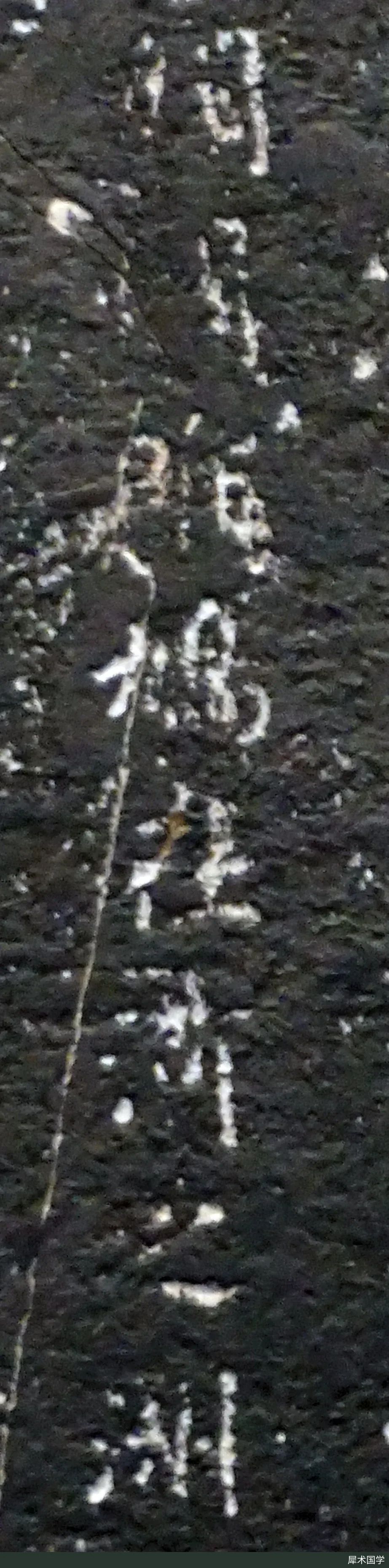
Southern Song Imperial University stone classic, Shijing · Guanju “Guan guan ju jiu, zai he zhi zhou” carved detail—received classic wording that can be read against the slip remarks. Author: Sanlie; source: Wikimedia Commons; license: CC BY-SA 4.0.
On Gantang, slip 15 says “…reaching the person, they revere and love the tree—their repayment is thick. Love of the gantang is for the Duke of Shao…”; slip 24 says “From Gantang I get reverence for ancestral temples; human nature is always thus—when they greatly value a person, they must revere his place; when they delight in a person, they must like what he does; those who hate a person are likewise.” In transmitted literature, Kongzi jiayu · Haosheng has Confucius say: “In Gantang I see how deep is reverence for ancestral temples. Thinking of the person, one must love the tree; honoring the person, one must revere his place—that is the Way.” The line of thought is close to slip 24. The Mao shi xu has “Gantang praises the Earl of Shao. The Earl of Shao’s teaching was clear in the southern states,” stressing his moral teaching. Dating and authenticity of the Kongzi jiayu have long been debated; close wording only shows the saying has an early source and cannot prove the whole Jiayu reliable.
Other remarks are often very short. Slip 16: “Confucius said: From Getan I get a poem of the clan’s beginning; human nature is always thus—seeing its beauty, one must wish to return to the root.” Slip 26: “Lu’e has filial intent.” Slip 8: “Yu wu zheng and Jie nanshan both speak of decay above; the kings and dukes are ashamed of it.” Overall, the slip text often marks poetic intent in one or two characters or a short sentence, and repeatedly uses “human nature is always thus” to ground poetic meaning in ordinary human feeling.
Several views on authorship
The authorship debate centers on a combined graph that appears six times before “said” (yue). Ma Chengyuan read it as the combined graph for “Kongzi,” named the piece Kongzi shilun accordingly, and held that disciples recorded Confucius’s teaching of the Shi; Li Ling, Pu Maozuo, and others hold similar views. Pu adds a side proof: in Lu bang dahan, copied by the same hand, this speaker calls himself “Qiu” to Zigong, and “Qiu” is Confucius’s personal name.
The Zixia view is represented by Li Xueqin. In his 2002 “Genre and Author of the Shilun” he notes that slip 10’s pattern “Guanju’s reform… why? It is said” matches the Guodian Cheng zhi wen zhi practice of citing the Shu, then asking “why,” then explaining: before “why” is earlier received wording; after it is the author’s own exposition. Thus the whole piece should be an essay by a Confucian of the Kong school that often cites Confucius, structurally close to Zisi’s Zhongyong. He further cites Hou Hanshu · Xu Fang zhuan—“Shi, Shu, Li, and Yue were fixed by Confucius; inventing chapter-and-verse began with Zixia”—and Hanshu · Yiwen zhi—“Mao Gong’s learning claimed transmission from Zixia”—and infers that the author “can only be Zixia.”
A 2009 survey on the Zhengzhou University School of Literature site, “On the Poetry Teacher and Dating of Kongzi shilun,” lists seven views. Besides Confucius and Zixia, there are Zigao (Liao Mingchun), Confucius’s grandson Zishang (Huang Xijin), a second-generation disciple (Chen Li, Huang Huaixin), a Spring and Autumn official Shi tradition (Zheng Jiewen), and a southern Chu classics teacher of the Warring States (Chen Tongsheng). The survey notes that the Zixia side once read the combined graph as “Buzi,” meaning Bu Shang (Zixia), and listed Qiu Xigui among Zixia representatives; opponents note that pre-Qin and Han texts never call Zixia “Buzi.” It also says Li Xueqin and Qiu Xigui later came to accept the “record of Confucius teaching the Shi” view. This writer has not obtained Qiu Xigui’s full “On Kongzi shilun” and has not checked the two scholars’ revised statements in the original; this is only a report of that survey.
This writer’s view is that two questions need separating: whether the speaker of “Confucius said” in the slips is Confucius, and who fixed the whole piece in writing. The former has Lu bang dahan as side evidence and is more widely accepted; the latter involves the common pre-Qin pattern of disciples and later students arranging books, and present materials are not enough to pin it to one person.
Place in the history of Shijing studies
Before this, the earliest complete transmitted systematic explanations of poetic intent were the Han Mao shi prefaces and commentary; pre-Qin material on poetry is mostly scattered citation in the Lunyu, Mencius, Zuozhuan, and the like. Kongzi shilun is a Warring States manuscript that evaluates poems one by one at some length, letting one compare directly how Warring States readers and Han Confucians read the poems. Even so, the comparisons below are all limited by reading and joining.
First is category order. The general discussion lists Song, Daya, Xiaoya, bangfeng—the reverse of today’s Feng, Xiaoya, Daya, Song. Pu Maozuo held this showed rank and chronological priority and was Confucius’s post-editing order; but in Li Xueqin’s joining the whole piece runs from the Two Nan of the Guofeng to the Song. Thus the judgment that “the bamboo Shi puts Song first” still depends on how slip order is restored and should not be asserted.
Second is the relation to the Shi xu. The editorial edition appends a table matching slip remarks with Mao minor-preface remarks; they agree in places and differ clearly in others—Guanju is one case. The slips’ appearance can show that a systematic poem-by-poem tradition already existed in the Warring States, but is not enough to settle right and wrong about the Mao shi xu. As for “Zixia wrote the Shi xu,” that is a transmission pedigree in later texts such as Lu Ji’s Mao shi caomu niaoshou chongyu shu; one cannot reverse-prove that legend just because the slips are linked to the Zixia view.
Third is text and intellectual-historical material. Variant title spellings and the name “bangfeng” give direct evidence for early Shi texts; sayings such as “human nature is always thus” and “using desire to illustrate ritual,” Li Xueqin held, can be read against discussions of nature, feeling, virtue, and destiny in the same volume’s Xingqing lun (i.e. Guodian Xing zi ming chu).
Limits of the material are also clear: not an excavation find, slips broken, joining and graph readings widely disputed, and many conclusions change with the reading of a single character. When reading, keep three layers apart: graphs on the slip, the editors’ transcription and reading, and scholars’ poetic interpretation. Citation should also name which transcription is used.
References
-
Ma Chengyuan, ed.: Shanghai Museum Collection of Warring States Chu Bamboo Books (I), Shanghai: Shanghai Ancient Books Publishing House, 2001 (catalog lists November). “Bangfeng” view at pp. 129–130 (via Wang Gang). Bibliographic info
-
Ma Chengyuan: “Discovery, Protection, and Editing of the Warring States Chu Bamboo Books,” in Shanghai Museum Collection of Warring States Chu Bamboo Books (I); also in Zhongguo wenwubao 20 January 2002 (per Pu Maozuo’s note). Web reprint
-
Zhu Yuanqing: “Mr. Ma Chengyuan on the Shanghai Museum Slips,” in Zhu Yuanqing and Liao Mingchun, eds., Studies on the Shanghai Museum Warring States Chu Bamboo Books, Shanghai: Shanghai Bookstore Publishing House, 2002. Bamboo and Silk Studies archive
-
Li Xueqin: “Genre and Author of the Shilun” (dated 20 January 2002 at the end), with “Shilun divided-chapter transcription,” in Studies on the Shanghai Museum Warring States Chu Bamboo Books, 2002. Web reprint
-
Qiu Xigui: “On Kongzi shilun,” Zhongguo zhexue vol. 24, Jingxue jinquan sanbian, Shenyang: Liaoning Education Press, 2002; also in Ten Lectures on Chinese Excavated Ancient Literature, Shanghai: Fudan University Press, 2004. Full text not obtained for this article. Bibliographic info
-
Pu Maozuo: “On the Editing and Study of Kongzi shilun,” Shandong University Confucian Bamboo and Silk site edition (page undated). Link
-
Wang Gang: “Revisiting ‘Bangfeng’: Early Forms of the Feng Poems from the Shanghai Museum Kongzi shilun,” Journal of Chinese Studies no. 59, Chinese University of Hong Kong, July 2014. PDF
-
Xiong Liangzhi: “Doubts on the Claim that ‘Bangfeng’ Was Taboo-Changed to ‘Guofeng,’” Social Science Research 2006 no. 6, pp. 160–164. Abstract
-
Scott Cook (Gu Shikao): “A New Arrangement of the Shanghai Museum Chu Kongzi shilun,” Zhongguo wenzi overall issue 4, December 2020, pp. 23–61. Abstract
-
Zheng Yushan: Research on Shanghai Museum (I) · Kongzi shilun, Huamulan Cultural Press (year unverified). Bibliographic abstract
-
“On the Poetry Teacher and Dating of Kongzi shilun,” Zhengzhou University School of Literature site, posted 16 February 2009, author unmarked. Link
-
Li Ling: Collation Notes on Three Shanghai Museum Chu Pieces, Beijing: China Renmin University Press, 2007 (via Wang Gang’s note).
-
Mao shi, Zheng Xuan commentary; minor prefaces to Zhounan · Guanju and Zhaonan · Gantang. Shidian Classics edition
-
Kongzi jiayu · Haosheng, Wang Su commentary, Sibu congkan edition. Shidian Classics edition
-
Full-text bamboo and silk search: Shanghai Museum Collection of Warring States Chu Bamboo Books (I) · Kongzi shilun slips 01–29 transcription. Link
-
“Re-evaluating the Shanghai Bamboo Kongzi shilun and the Mao shi xu,” paper-site reprint; author and venue unverified; used only to contrast Ma’s and Li’s readings of slip 1. Link
-
Information compiled and published by the Scholay academic one-stop platform; report infringement for takedown.
-
Also published on Enter Scholar, a scholars’ community for the intelligent age