The aims and exegetical method of Kong Yingda’s Zhouyi zhengyi
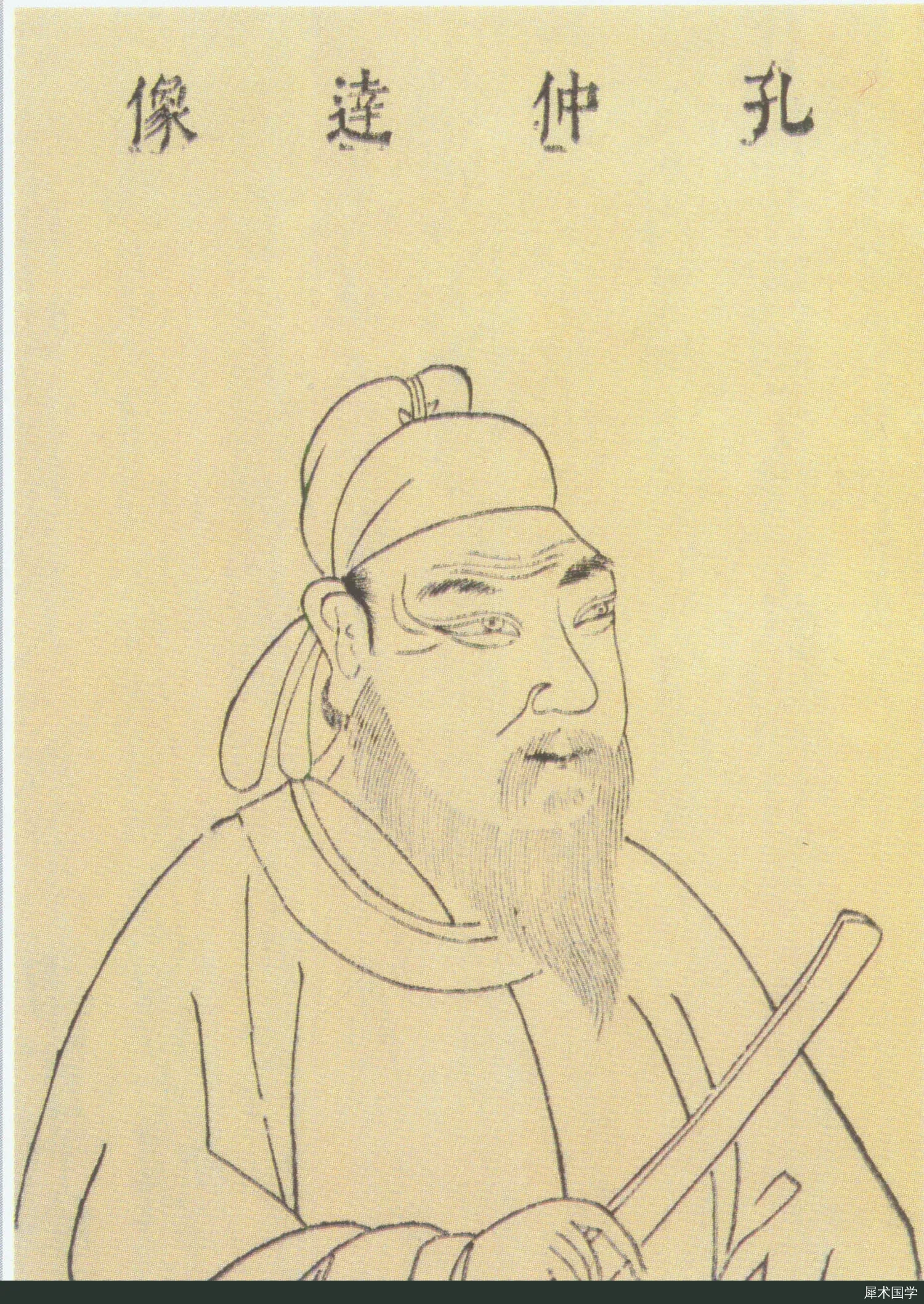
Portrait of Kong Yingda, from Wang Qi’s Ming Sancai tuhui (printed ca. 1607). Source: Wikimedia Commons, public domain.

In the Zhenguan reign of the Tang, Kong Yingda by imperial order directed the compilation of the Wujing zhengyi (Correct Meaning of the Five Classics). Within it, the Zhouyi zhengyi takes the commentaries of Wang Bi and Han Kangbo as the base for its subcommentary; the preface declares that one must “take Zhongni as the ancestral standard; where meaning can be elucidated, take Fusi first as the foundation.” Drawing on the preface and the Qian hexagram subcommentary in Ruan Yuan’s Shisan jing zhushu, and consulting the Siku quanshu zongmu and modern studies, this article traces the work’s compilation, its principle of staying with the base commentary, its criticism of Jiangnan subcommentaries, and its mediation between taking images and taking meaning.
Compilation by imperial order and the preface’s aims
Kong Yingda (574–648) was a classicist bridging the Sui and Tang. When the Wujing zhengyi began is recorded differently: Gu Jiming’s collation notes that the Tang huiyao, “On the meaning of the classics,” places it in Zhenguan 12 and says the work was first titled Yizan, later renamed Zhengyi by edict; Zizhi tongjian juan 195 places it in Zhenguan 14. Neither account separates the start of writing from completion; what can be fixed is that the work began after Kong became Chancellor of the Directorate of Education in Zhenguan 12. The Zhouyi zhengyi xu describes the process: first he “deliberated together” with Erudite of the Imperial University Ma Jiayun, Assistant Instructor Zhao Qianye, and others; “by the sixteenth year,” with the earlier subcommentary revisers and Erudite of the Four Gates Su Derong and others, he again “examined in detail” before the edict commissioner Zhao Hongzhi, producing a book “in fourteen juan in all.” After Kong’s death, the Jiu Tangshu, “Annals of Gaozong,” records that in the third month of Yonghui 4 the court “promulgated Kong Yingda’s Wujing zhengyi throughout the realm, and ordered that each year’s mingjing examinations follow it.” Juan counts also disagree: the Siku editors note that the preface says fourteen juan, the Tang bibliography eighteen, Chen Zhensun’s Zhizhai shulu jieti thirteen, while the Qing palace copy has ten juan, matching the Wang–Han commentary’s juan count; they conjecture later redactors merged by the commentary’s divisions.
The preface first reviews the transmission of Yi learning: in the Western Han Ding, Meng, Jing, and Tian; in the Eastern Han Xun, Liu, Ma, and Zheng—“largely transmitting from one another, without anyone of unmatched stature”—and only “Wang Fusi’s commentary of the Wei age uniquely crowns antiquity and the present.” On that judgment the preface states the editorial aim: “Now that we have been ordered to abridge and settle, examining the matters, we must take Zhongni as the ancestral standard; where meaning can be elucidated, take Fusi first as the foundation. Discard the florid and keep the solid, so that belief may have evidence.” The two clauses are ordered. “Take Zhongni as the ancestral standard” is the overall principle; Kong’s subcommentary trusts that the Ten Wings come from Confucius, and Liu Yujian accordingly holds that its exegetical format rests on the Yizhuan. “Take Fusi first as the foundation” means that where meaning-based exposition is possible, Wang Bi’s commentary is the basis. The opening “eight discussions” treat in turn the three names of yi, who redoubled the trigrams, the names of the Yi in the Three Dynasties, who composed the hexagram and line statements, the division into upper and lower parts, the Master’s Ten Wings, transmitters of the Yi, and who added the word “classic”—settling basic questions of classic and commentary before hexagram-by-hexagram subcommentary.
Subcommentary on Wang and Han, and criticism of Jiangnan subcommentaries
The received Zhouyi zhengyi uses Wang Bi’s notes on the upper and lower classics and on the Tuan, Xiang, and Wenyan inserted into the classic, and Han Kangbo’s notes on the Xici, Shuogua, Xugua, and Zagua; Kong’s subcommentary then glosses classic and commentary phrase by phrase. Later writers often summarize this format as “the subcommentary does not break the commentary”; the Siku quanshu zongmu is more concrete: “The form of the subcommentator is to elucidate the base commentary and not to wish to go beyond it.” The editors give two kinds of example. For Qian nine-two, “it is beneficial to see the great person,” Wang’s note says “it is beneficial to see the great person only at two and five”; Kong’s subcommentary accordingly rejects the view of Chu, Zhang, and Zheng Xuan that “nine-two benefits from seeing the great person of nine-five,” judging it “wrong in meaning.” For Fu, “return in seven days,” Wang’s sense happens to agree with Zheng Xuan’s citation of the Yi wei “six days and seven parts”; Kong’s subcommentary then cites Zheng to elaborate. The editors call such practice “openly partial,” even where Wang left no note “tortuously citing elsewhere to fit it.” Staying with the commentary therefore does not mean excluding Han scholars; whether a Han reading is used depends on whether it agrees with the base note.
The principle of staying with the commentary was also set against Southern Dynasties subcommentaries. The preface says: “As for the Jiangnan subcommentaries, more than ten schools, all prize empty mystery in wording and float in far-fetched meaning. … If one discusses emptiness of dwelling within and without, or theories of who is able and what is attained, that already involves Buddhist doctrine and is not teaching for Confucius’s gate. It both turns its back on the root and violates the commentary.” “Turns its back on the root” means departing from the aim of the Confucian classics; “violates the commentary” means going beyond or against Wang Bi. The preface’s example is again Fu’s “return in seven days”: various scholars took “seven days” as “the seventh month,” counting from the fifth month, jianwu, when yang begins to wane, to the eleventh month, jianzi; Kong held this matches neither Wang’s wording “altogether seven days” nor Zheng Xuan. Comparing the old manuscript Jiang Zhouyi shulun jia yiji formerly held at Kōfukuji in Japan, Gu Jiming holds that “prize empty mystery … float in far-fetched meaning” mainly points to two things: dense sectional divisions modeled on Buddhist lecturing, and borrowing Buddhist terms such as “object-wisdom” and “form-appearance” to explain the Yi. He also notes that the Zhengyi does not refute Buddhist doctrine head-on; the criticism appears mainly in what was cut. What “emptiness of dwelling within and without” concretely meant still lacks solid evidence; Gu’s essay also makes no conjecture.
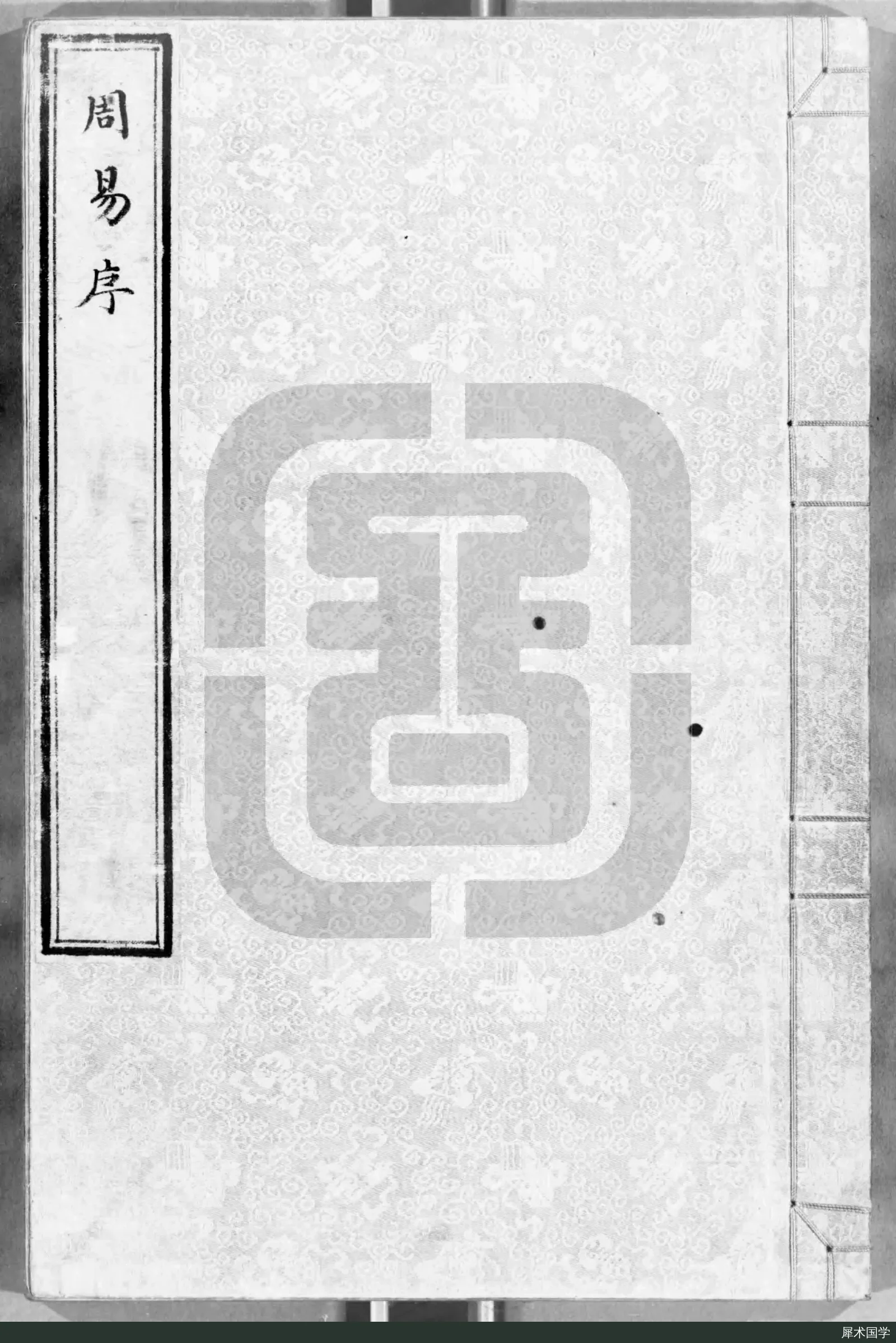
Woodblock Zhouyi zhengyi, first fascicle, held by the National Library of China; this fascicle contains the Zhouyi zhengyi xu, original PDF p. 1. Commons lists it as a Ming Yongle 2 (1404) edition, 8 columns of 18 characters, rare-book no. 12951; the bibliographic description remains to be verified. Source: Wikimedia Commons (National Library of China digital rare books); public domain.
The textual sources of the Zhouyi zhengyi are also debated. Qing scholars such as Liu Yusong argued that each classic’s Zhengyi was largely abridged from older subcommentaries; Gong Pengcheng holds that the Zhouyi zhengyi was written by Kong himself and that the subcommentary quietly uses Buddhist reasoning. Gu Jiming rejects the claim of quiet Buddhist use, and, noting that the preface says “ordered to abridge and settle,” holds that older subcommentaries must still have been available, so calling it Kong’s sole composition is also unfit. Hu Haizhong, starting from differences of format and intellectual tilt among the upper part, lower part, and Xici subcommentaries, proposes three conjectures: abridgment of two kinds of older subcommentary; division of labor in drafting then unified editing; or intentional intellectual construction. He rules out simple inheritance of Jiangnan subcommentaries, leans toward division of labor, and keeps the third explanation open. These questions have no settled answer yet.
Mediation between taking images and taking meaning
On the relation of image and meaning, Kong’s subcommentary values hexagram images more than Wang Bi. The preface opens by citing the Xici: “As for the Yi, it is image; as for the lines, they are imitation”; the opening discussion “On the three names of yi” further says: “The principle of yi fully embraces being and non-being, yet yi images lie only in being, because the sage made the Yi originally to hand down teaching, and what teaching furnishes is furnished in being.” Liu Yujian sees this as a correction of Wang Bi’s xuanxue tilt toward “forgetting the image.” Yet Kong’s subcommentary does not return to the elaborate formats of Han image-number scholarship. Liu notes that when Kong uses the images of the eight trigrams, he generally argues only from the upper and lower bodies of the derived hexagram, rarely discussing interlocking trigrams or hexagram change—still following Wang Bi on that point.
What best shows this mediation is the Qian hexagram-statement subcommentary’s summary of naming practice. The subcommentary says the sage named hexagrams by “differing formats”: Pi, Tai, Bo, Yi, Ding, and the like take names from thing-images; Qian and Kun take names from “what the image is used for”; Jiaren, Guimei, Qian, and Lü “though taking thing-images, yet take human affairs as hexagram names.” The reason is that “things have ten thousand images, people have ten thousand affairs; if one clings to a single affair, one cannot cover the images of the ten thousand things; if one confines oneself to a single image, one cannot sum the affairs of the ten thousand beings; hence names have the hidden and the manifest, wording has unevenness—one cannot seek them by one rule, one cannot take them by one class,” citing the Xici “cannot be taken as a fixed standard” and Han Kangbo’s note “cannot set a fixed measure.” The Qian Daxiang subcommentary also records earlier scholars’ split of real and provisional images: “water upon the earth, Bi” is a real image; “Heaven within the mountain” and “wind issuing from fire” “have in reality no such image, and are provisionally made for meaning,” hence provisional images; the conclusion is that “though there are real images and provisional images, all show meaning to people and are collectively called images.” The initial nine subcommentary likewise says that outside Qian, “the six lines of the remaining hexagrams each clarify meaning by the image and arise with the meaning.” Taken together, Kong’s subcommentary treats the image as the vehicle of meaning; meaning appears from the image, but how images are taken varies by hexagram and cannot be reduced to one formula for the whole classic.
Liu Yujian treats “one cannot seek them by one rule, one cannot take them by one class” as the interpretive principle Kong established, and holds that Kong was the first in the history of Yi learning expressly to advocate the unity of image-number and meaning-principle. That is a modern summary. In the subcommentary itself the sentence appears in a discussion of hexagram names, originally explaining that naming formats differ; extending it as a method through the whole book is a researcher’s reading, and citation should distinguish the subcommentary’s own sense from later extension.
Place and evaluation in the history of Yi learning
After the Zhouyi zhengyi was promulgated and used in the mingjing examinations, the Wang–Han commentaries together with Kong’s subcommentary became the official reading. The Siku editors say that once Kong and others were ordered to write the subcommentary, “they began to honor Wang’s commentary alone and the many other explanations all fell away,” citing as side evidence the Suishu, “Treatise on bibliography,” that Zheng’s learning “is now nearly extinct.” They also criticize that Wang’s commentary “swept away the old text,” so Kong’s subcommentary “had no ancient meanings available to cite,” and its exposition of wording “often uses empty talk,” unable, like the other classics’ Zhengyi, to rest on documentary sources with clear lineage. Zhu Bokun’s Yixue zhexue shi, volume 1, places Kong’s subcommentary as section 1 of chapter 5, “Development of Tang philosophy of Yi learning,” discussing “On the format of the Zhouyi” and “On the principles of the Zhouyi,” with Cui Jing and Li Dingzuo only in section 2. By chapter arrangement, Kong’s subcommentary is treated as the main trunk of Tang Yi learning; yet per Liu Yujian, when Li Dingzuo later compiled the Zhouyi jijie, though he also drew on Wang Bi, the weight still lay with Zheng Xuan, Xun Shuang, Yu Fan, and other Han Yi scholars, so Han Yi learning did not wholly die out in the Tang.
Evaluations have two sides. Liu Yujian calls it a comprehensive, systematic summing-up of nearly a thousand years of Yi learning since the Han and Wei. Gu Jiming cites Qiao Xiuyan’s view that after older subcommentaries were cut from the dense to the spare, subcommentary learning lost the speculative vitality that xuanxue and Buddhism had brought, leaving a philosophical blank in Tang Confucianism that Song Learning later filled. The two evaluations look at different things: the former at how it organized and compromised an existing tradition, the latter at its limits in intellectual creation. Reading the Zhouyi zhengyi today, the most direct gain is to see how Wang Bi’s and Han Kangbo’s commentaries were received, explained, and regulated by Tang official learning, and what kind of compromise between image-number and meaning-principle had been reached before the Song.
References
-
[Wei] Wang Bi and [Jin] Han Kangbo, commentary; [Tang] Kong Yingda, subcommentary: Zhouyi zhengyi (Zhouyi zhengyi xu and juan 1, “eight discussions”), Jiaqing 21 (1816) Ruan Yuan Shisan jing zhushu. Transcription: Chinese Text Project, Ruan Yuan Shisan jing zhushu · Zhouyi zhengyi preface and contents.
-
[Tang] Kong Yingda: Zhouyi zhengyi juan 1, Qian hexagram subcommentary, Wikisource transcription (base text to be verified): 周易正義/01乾.
-
[Wei] Wang Bi, commentary; [Tang] Kong Yingda, subcommentary; collated by Lu Guangming and Li Shen, reviewed by Lü Shaogang: Zhouyi zhengyi, Peking University Press, 1999 (simplified punctuated) and 2000 (traditional collated). Bibliographic record: CiNii; page numbers cited in this article were not checked against this edition.
-
[Qing] Yong Rong et al.: Siku quanshu zongmu juan 1, abstract of Zhouyi zhengyi, ten juan, Kyoto University Institute for Research in Humanities, nationwide Chinese rare-books database.
-
[Later Jin] Liu Xu et al.: Jiu Tangshu juan 4, “Annals of Gaozong, part 1,” Siku edition, Wikisource.
-
Zhu Bokun: Yixue zhexue shi, volume 1, Beijing: Huaxia Publishing House, 1995, chapter 5, section 1, “Kong Yingda’s Zhouyi zhengyi,” pp. 352–388 (pages per that book’s contents; to be checked against the original).
-
Liu Yujian: “On the Tang Yi scholar Kong Yingda’s view of Yi images,” Social Science Front 2004, no. 3, PDF, Center for Zhouyi and Ancient Chinese Philosophy, Shandong University.
-
Gu Jiming: “From Jiangnan subcommentaries to the Zhouyi zhengyi—Confucian–Buddhist contention in Sui–Tang Zhouyi subcommentary learning,” originally in Zhexue men 2013, vol. 2, reposted on Philosophy China. Citations of the Tang huiyao, Zizhi tongjian, and views of Gong Pengcheng, Liu Yusong, and Qiao Xiuyan are all drawn from this essay.
-
Hu Haizhong: “Three conjectures on the formation of the Zhouyi zhengyi and the building of its intellectual framework,” originally in Renwen zazhi 2024, no. 9, reposted on the Chinese Academy of Social Sciences Institute of Philosophy site.
-
Contents transcription of Zhu Bokun, Yixue zhexue shi, volume 1 (Huaxia, 1995)
-
Xishu Chinese Classics · When minds meet, craft appears in words
-
Information compiled and published by the Scholay academic one-stop platform; report infringement for takedown.
-
Also published on Enter Scholar, a scholars’ community for the intelligent age