The Qing scholar Hui Dong’s Yihanxue looks through materials scattered in received texts for Han scholars’ accounts of the Changes. It takes Meng Xi, Yu Fan, Jing Fang, Zheng Xuan, and Xun Shuang as its frame, and it also discusses the diagrams and the pre-heaven doctrines. It continues the Hui family’s study of the Changes across generations, and it shows how Qing scholars arranged the surviving Han accounts.
The family learning, and why the book was made
Hui Dong’s courtesy name was Dingyu, and his style name was Songya. He was from Changzhou. The original preface places the book in the transmission of the six classics and in the rise and fall of Han learning. Hui Dong holds that Wang Bi explained the Changes by borrowed images, that the root of that explanation is in Huang-Lao, and that the meaning of the Han classicists was then hard to preserve. That is Hui Dong’s judgment of the history of Changes learning. It shows his stance of looking for the Han scholars’ older accounts.
The compiling history in the original preface begins with his great-grandfather, Mr. Pu’an. He took material recorded in Li’s Explanation of the Changes, compared it with other accounts, and wrote a commentary. The manuscript was scattered in war. What he had learned was passed by word of mouth to the grandfather and the father. The father completed six volumes of Yishuo, and he also wanted to write the origin and course of how Han classicists explained the Changes. He did not finish. Hui Dong says he received the family learning when young, and later collected widely, meaning to carry four generations of learning back to the earlier Han and to leave later readers material they could check.
The preface speaks of “a book in seven volumes.” What that refers to is the collected examination of the five schools from Meng Changqing on. The circulating Siku quanshu copy is recorded in eight volumes. The last volume is Hui Dong developing the principles of Han Changes learning, and correcting the studies of the Hetu, the Luoshu, the pre-heaven, and the supreme ultimate. Seven volumes and eight volumes look at the five-school collection and at the shape of the whole book. They do not have to be read as accounts that cancel each other.
The eight-volume arrangement, and the order of the five schools
The abstract in the Siku quanshu zongmu lists the volumes: two volumes of Meng Changqing’s Changes, one of Yu Zhongxiang’s Changes, two of Jing Junming’s Changes, with Gan Bao’s Changes attached; one volume of Zheng Kangcheng’s Changes, one of Xun Ciming’s Changes; and a last volume on the principles of Han Changes learning and on the diagrams, the pre-heaven, and the supreme ultimate. Meng Changqing is Meng Xi. Yu Zhongxiang is Yu Fan. Jing Junming is Jing Fang. Zheng Kangcheng is Zheng Xuan. Xun Ciming is Xun Shuang.
The order has a reason in how the learning was transmitted. The abstract explains that Yu Fan follows Meng Xi because Yu Fan’s separate biography records that he said the Meng Changes had been transmitted in his family for five generations. Zheng Xuan follows Jing Fang because the Later Han History says Zheng Xuan was versed in the Jing Changes. Xun Shuang has a volume of his own, which is connected with the Fei school of the Changes. The abstract explains the arrangement from received records. The particular transmission of a family method still has to be read with the various materials.
Dividing the volumes by person gives the scattered Han materials an order in which they can be compared. Hui Dong does not only list names. In his own preface he calls the Changes of the five schools “different streams from one source.” He grants that the schools differ, and he also tries to find a shared scholarly origin. The last volume joins the collected older accounts to the author’s own discrimination. The book therefore faces two ways: a gathering of materials, and a scholarly argument.
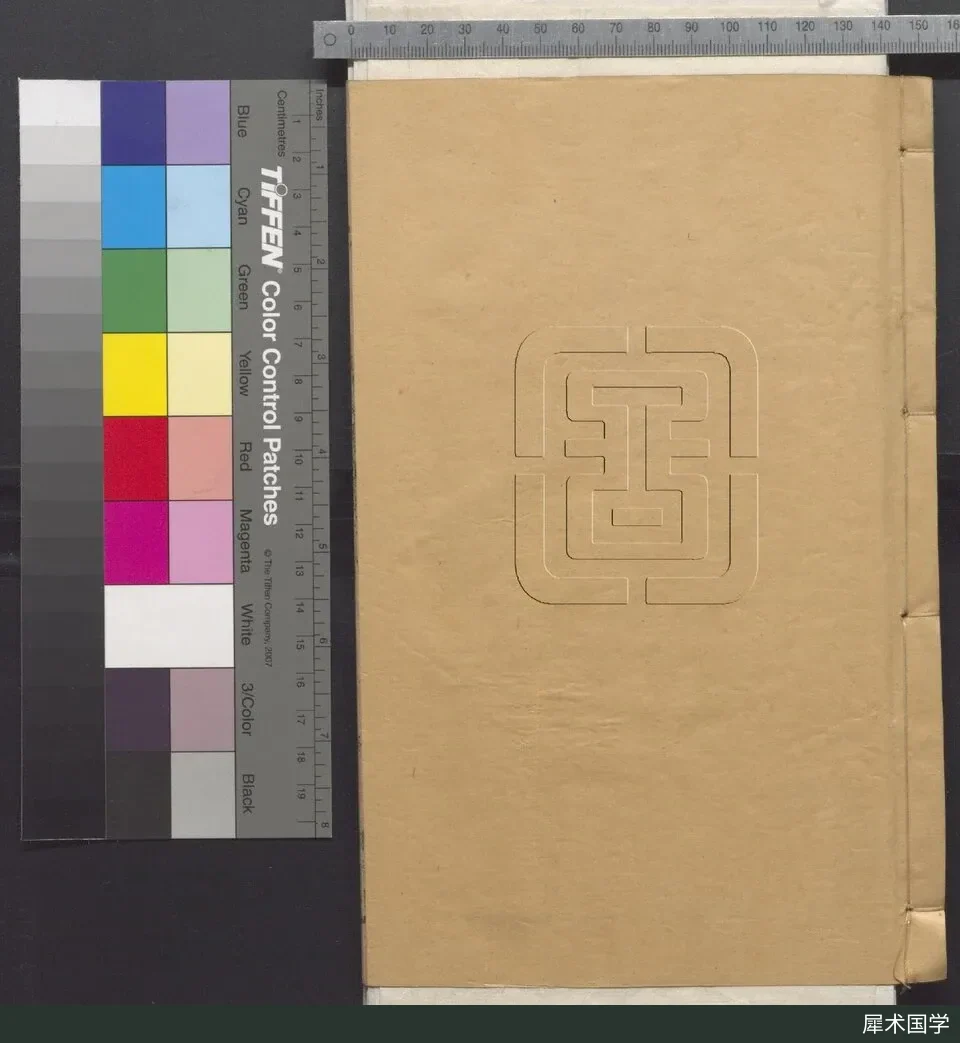
A page from the sixth volume of a Qing printing of Zhouyi shu, with Hui Dong’s collected notes and subcommentary. This is another Changes book by the same author. It is not Yihanxue. Source: Wikimedia Commons, public domain.
How the Siku catalogue places it, and what the collection is for
The Siku quanshu zongmu lists Yihanxue under the Changes in the classics section. The abstract looks back at the Han schools of Shi, Meng, and Liangqiu, treats the learning of Meng and Jing as “a separate transmission outside the Changes,” and narrates the transmission of the Fei line. It affirms that Hui Dong gathered surviving reports and searched them out, so that scholars could see something of the Han classicists’ path. That affirmation points to the work of arranging what survived. It also reminds a reader that what is in front of them is material collected and arranged by a Qing scholar.
The abstract does not treat the schools as all of one kind. It holds that the learning of Meng and Jing should be classed with the arts of number, while it calls the Fei school the orthodox transmission of image and number. Zheng used both the Jing and Fei accounts, and cannot be treated entirely as prophecy and apocrypha, so the book is still listed under the classics. That classification shows the judgment of the Siku editors. Set beside the original preface’s emphasis on restoring Han learning, the two can be compared, and each has its own stance.
After Wang Bi, Han commentaries on the Changes were gradually scattered. Tang works such as Li Dingzuo’s Zhouyi jijie kept some of the older notes, and became important material for later searches. On that kind of surviving remainder, Hui Dong examined the five schools in order, and then answered the diagrams and the pre-heaven questions in a volume of their own. The value is a frame in which a Qing scholar understood and arranged Han Changes learning. When one older account in the book is read, one can also see how it was assigned to a school, and how those family methods were rebuilt later.
Reading Yihanxue now, two layers of writing can be kept in view at once. One is the surviving Han accounts collected in the book. The other is Hui Dong’s examination and explanation. They depend on each other, and they belong to different times. Following a quotation to its source, and comparing related commentaries, helps in understanding how Han Changes material was preserved, and in seeing how Qian-Jia Han learning organized the knowledge of the ancient classics.
References
-
Hui Dong, Yihanxue, the authorized Siku quanshu copy: the abstract, the original preface, and the volumes. Wikisource; Chinese Text Project entry.
-
Hui Dong, page images of Yihanxue, volumes 4 to 8, the Siku copy, Wikimedia Commons.
-
Hui Dong, collected notes and subcommentary, page images of the sixth volume of Zhouyi shu, a Qing Qianlong printing from the Ya Yu Tang of the Lu family, Wikimedia Commons.
-
Hui Dong, punctuated and collated by Gu Jiming, Yihanxue, a new collated commentary, China Social Sciences Press, 2020, ISBN 9787520356152.
-
Compiled and published by Scholay. For a takedown request, send feedback.
-
Also published at Enter Scholar.