Project overview
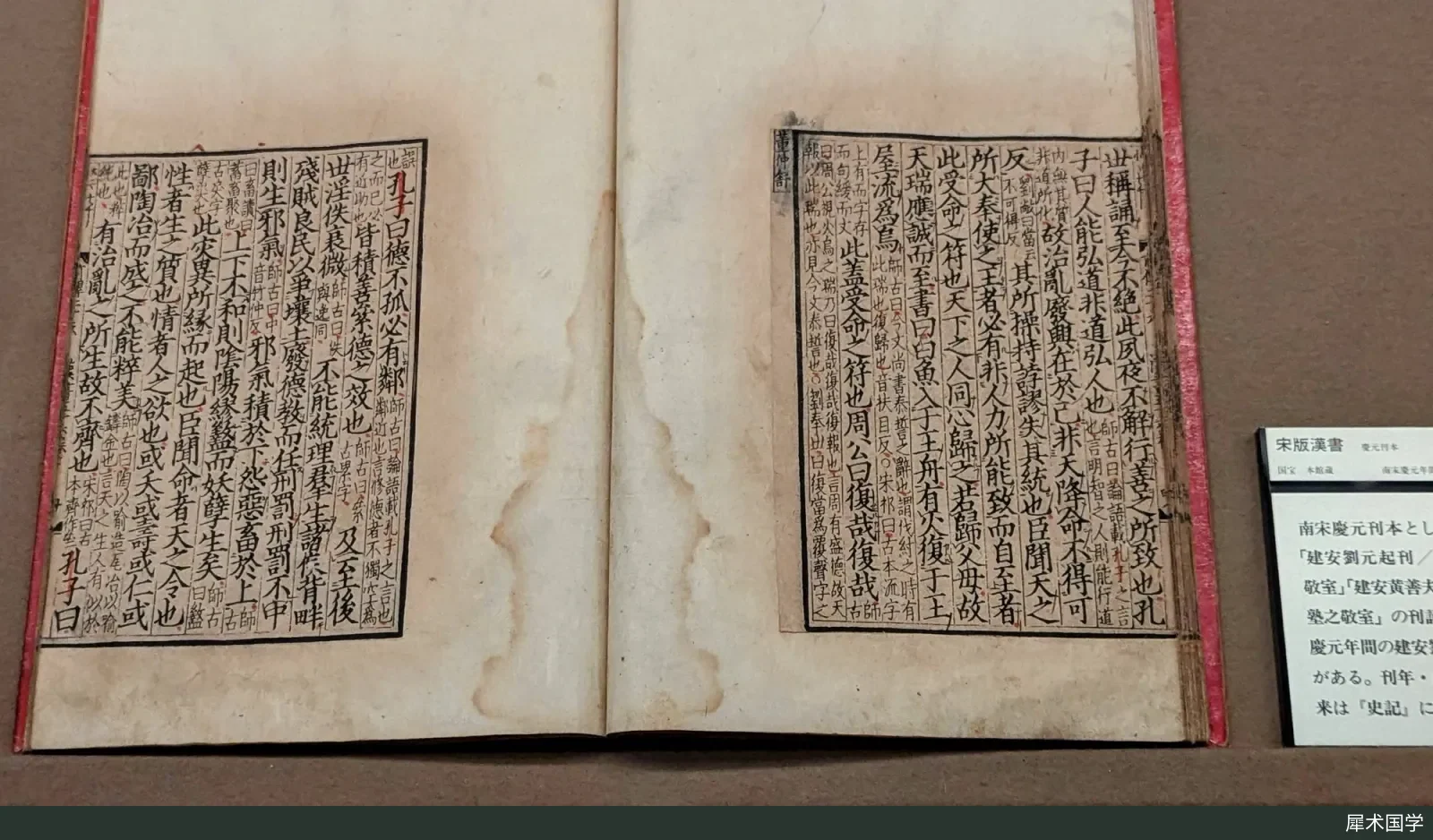
Song imprint of the Hanshu (Qingyuan edition, printed ca. 1195–1200), on display at Japan’s National Museum of Japanese History. Photo: Underbar dk; source: Wikimedia Commons; license: CC BY-SA 4.0.
MARKUS is a free online reading and markup platform for classical Chinese texts; its site is https://dh.chinese-empires.eu/markus/[1]. The site calls itself “a Free Online MARKUP System”; the authors’ paper describes it as a markup, reading, and visualization platform for classical Chinese texts; “Chinese Text Markup & Analysis Toolkit” is not an official name. The platform was designed jointly by Hilde De Weerdt and Brent Ho (Hou Ieong Ho). It first served the Communication and Empire project, systematically tagging people, places, and offices in Song-dynasty notebooks. According to De Weerdt’s 2020 article in Journal of Chinese History 4.2, the first version went live in summer 2014. The site says it was runner-up in the “Best Tool” category of the DH2016 annual awards. Basic reading and markup need no payment; saving files, custom tags, and similar features require a free personal account. The paper states that the original MARKUS and COMPARATIVUS code may be used and modified for non-commercial purposes; GitHub hosts the dHumanities/markus repository.
Markup types fall roughly into four groups. First, automatic markup: drawing on the China Biographical Database (CBDB), the China Historical Geographic Information System (CHGIS), and Buddhist authority databases, among others, it identifies personal names, place names, dates, office titles, and Buddhist terms. Second, keyword markup: you can upload your own word lists, generate KWIC (keyword-in-context) lists, or mark with regular expressions—this part works on any Unicode text; the site also integrates a keyword-extraction tool developed by Tu Hsieh-Chang of National Taiwan University. Third, manual and batch markup: you can define custom tag types and mark across dozens or even hundreds of uploaded files at once. Fourth, relation markup and in-text annotation: the paper explains that the newer relation markup can define a relation type between two tags and attach a source citation; annotations can record translations, metadata, or to-dos. A MARKUS tag consists of three parts: the marked string, the tag type, and a unique ID. The paper’s example: Wei Zheng may appear in a text as “魏徵,” “徵,” or by the posthumous name “文貞”; the platform uses aliases in CBDB to link all these forms to the same CBDB ID (15610), so that on export different appellations for the same person can be gathered together. Text can be uploaded directly as UTF-8, or imported chapter by chapter from the Chinese Text Project (ctext.org); whole-book import is limited to university users with ctext support. The paper also notes import from Kanripo.
On export formats, the site lists HTML and TEI; the paper is more specific: annotated text can be exported as HTML, XML-TEI, and MARKUS’s own format; COMPARATIVUS text-comparison results can be downloaded as CSV, TSV, Excel, or HTML; relation markup can be exported as network files with source nodes, target nodes, and relation types. Beyond file export, the platform can send tags and CBDB-linked data through the VISUS interface to Palladio and PLATIN to produce maps, network graphs, timelines, and the like; files can also be batch-handed to National Taiwan University’s DocuSky for corpus aggregation and word-frequency comparison, then to DocuGIS or Geoport for spatial analysis. Note that the paper states MARKUS then “ran only in Google Chrome”—that claim is as of 2019; current browser support was not verified for this article.
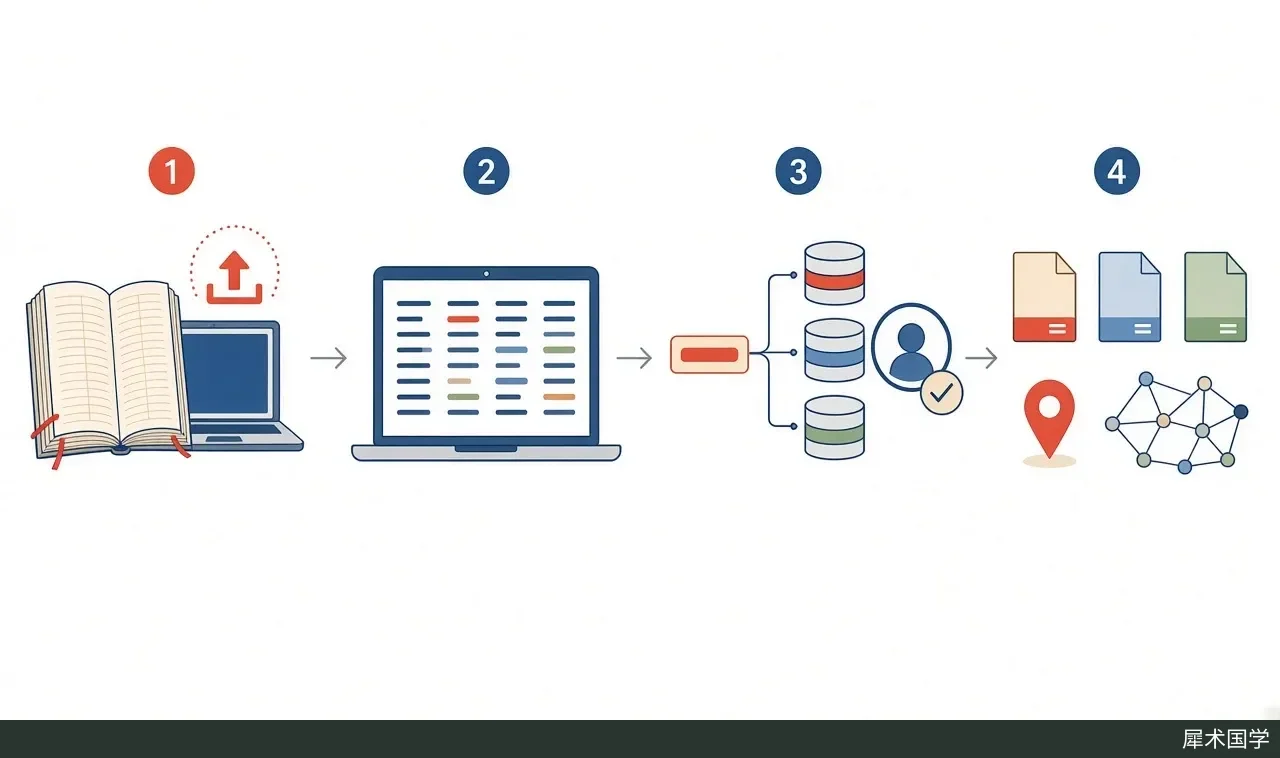
MARKUS markup workflow sketch: ① import text (UTF-8 text, ctext.org, or Kanripo); ② automatic, keyword, and manual markup; ③ tags linked to CBDB, CHGIS, and other database IDs, then human-checked; ④ export HTML, XML-TEI, or MARKUS files, or send to VISUS and DocuSky for map and network analysis. Workflow compiled from the MARKUS site and De Weerdt’s 2020 paper. AI-generated schematic.
Among public examples, the one closest to classical Chinese literature is “Reading The Essentials of Governance Digitally,” the digital reading platform for the Zhenguan zhengyao (first edition 2020; updated 20 May 2022). The platform includes four texts: the modern base follows Xie Baocheng’s collated Zhenguan zhengyao jijiao (Zhonghua Book Company, 2012); the Ge Zhi text follows Ge Zhi’s Zhenguan zhengyao jilun (1333 edition, Ming 1465 reprint); plus two Japanese manuscript traditions, the Nanke text (1275) and the Kanke text (1296). Personal names, place names, dates, and book titles in each text were tagged in MARKUS; the pages offer MARKUS file downloads that can be uploaded back to the platform for further use. Another example is DocuSky’s introductory tutorial: using a txt file of chapter 17 of the Xu Honglou meng, it shows uploading UTF-8 text, manually tagging “薛蟠” as a personal name, saving as marcus.html, then converting to ThdlExportXml for import into DocuSky. De Weerdt’s paper also notes that Chu Mingkin used MARKUS to tag personal names, offices, and place names in Song–Yuan literati letters, and split the text into individual letters to analyze letter networks.
Uses and value
For readers of classics and histories, MARKUS’s most practical gain is turning “look up and note while reading” into searchable, exportable material. While reading, selecting a personal or place name lets the right-hand panel look up CBDB biographies, historical place names, and dictionaries—suited to histories, collected works, notebooks, and letters. When compiling, you can generate lists of personal names, offices, place names, and book titles in one pass; the paper notes this can help unify translations or build indexes; with ID normalization, style names, sobriquets, posthumous names, and other variant appellations for the same person can also be aggregated. For topical research, custom word lists or regular expressions can batch-tag a class of terms or citation formats, then COMPARATIVUS can detect quotation and text reuse between two texts, with selected passages sent back to MARKUS as annotations. In teaching it is also useful for demonstrating digital markup workflows for classical texts.
The limits are equally clear. First, automatic markup is only string matching against existing databases and returns candidate hits: the same name may refer to different people, and the same person may appear in multiple databases, so the researcher must choose the ID; people not in the databases need IDs supplied by hand. The paper also warns that before markup begins you should fix the research question, text scope, and tagging scheme—not “tag first and decide later.” The machine-learning modules are described in the paper as “experimental and preliminary.” Second, MARKUS works on electronic text the user uploads; it does not judge whether a base text is reliable or which variant is correct, so it cannot replace manual collation and edition criticism. The Zhenguan zhengyao platform itself states that the digital texts of the Nanke and Kanke manuscripts were reconstructed by reverse inference from Xie Baocheng’s collation and should not be used to conclude about the manuscript originals; its edition comparison also ignores punctuation. Third, the platform depends on project servers and ongoing funding; the paper frankly says development needs money and an interdisciplinary team, so important results should be exported regularly as TEI or HTML for safekeeping. This article is compiled from the site, De Weerdt’s 2020 paper, and the public pages above; we did not log in to test upload, markup, and export; ctext import conditions, browser support, and similar points follow the site’s current statements.
References
-
MARKUS site: MARKUS - a Free Online MARKUP System (accessed 2026-10-24)
-
Hilde De Weerdt, “Creating, Linking, and Analyzing Chinese and Korean Datasets: Digital Text Annotation in MARKUS and COMPARATIVUS,” Journal of Chinese History 4.2 (2020), Cambridge University Press. doi:10.1017/jch.2020.23
-
Hu Jing, Gabe van Beijeren, Hilde De Weerdt, Mees Gelein, Reading The Essentials of Governance Digitally (first edition 2020; updated 20 May 2022)
-
DocuSky, How to use MARCUS to tag personal names, place names, offices, and dates in documents
-
GitHub repository: dHumanities/markus
-
Xishu Chinese Classics · When minds meet, craft appears in words
-
Information compiled and published by the Scholay academic one-stop platform; report infringement for takedown.
-
Also published on Enter Scholar, a scholars’ community for the intelligent age