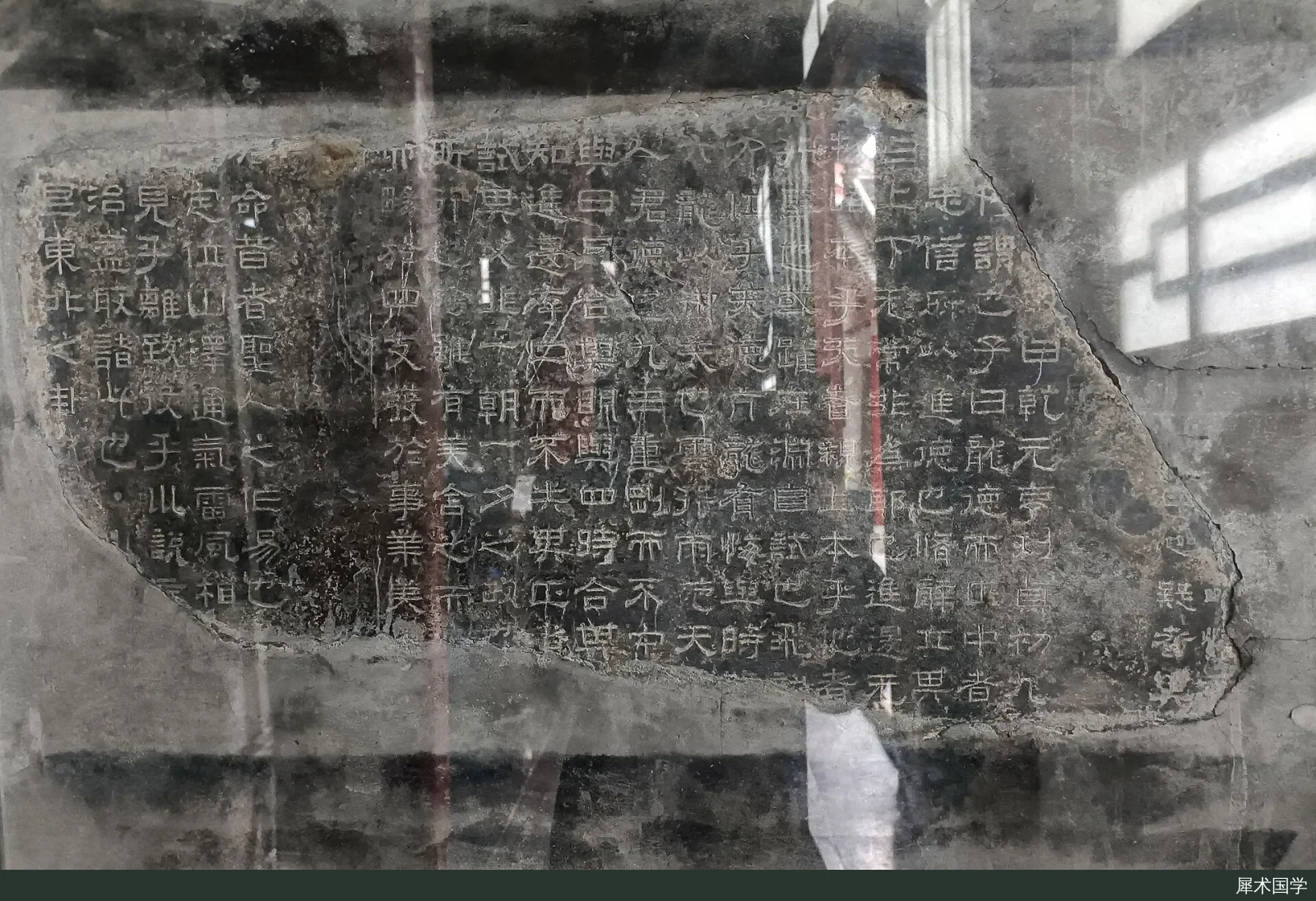
Fragment of the Xiping Stone Classics Zhouyi, displayed in Gallery 3 of the Xi’an Beilin Museum. Photo: Kcx36 (2023); source: Wikimedia Commons; license: CC BY-SA 4.0.
The Xiping Stone Classics are the officially settled classical texts ordered in Xiping 4 of the Eastern Han (175) and completed in Guanghe 6 (183). In a single clerical script they carve seven works—Zhouyi, Shangshu, Lu shi, Yili, Chunqiu, Gongyang zhuan, and Lunyu—and stood them at the Imperial University in Luoyang; later ages call them the “one-script stone classics.” The front of each stele carves one school’s main text; the reverse lists other schools’ variants. After fragments were unearthed at Luoyang in the 1920s, Luo Zhenyu, Zhang Guogan, Ma Heng, and others collated them into direct physical evidence for Han New Text classical texts.
Occasion of carving, number of classics, and stele format
The Hou Han shu, “Annals of Emperor Ling,” records that in the third spring month of Xiping 4 an edict ordered the scholars to “correct the wording of the Five Classics and carve them on stone outside the Imperial University gate.” The “Biography of Cai Yong” is more concrete: Cai Yong, “because the classics were far from the sages, the wording often wrong, and vulgar scholars forced readings that misled later learners,” with Tangxi Dian, Yang Ci, Ma Ridi, and others “memorialized requesting that the wording of the Six Classics be corrected and settled”; Emperor Ling consented, “Yong then wrote the vermilion on the steles himself and had artisans carve them and set them outside the Imperial University gate,” after which “those who came to view and make rubbings numbered more than a thousand carriages a day.” The “Preface to the Biographies of Confucian Scholars” places the cause in university examinations: after the Partisan Prohibitions, some “privately paid gold and goods to fix the characters of the lacquer classics in the Orchid Terrace to match their private texts.” Yu Wanli accordingly explains that the Eastern Han maintained fourteen Erudites, and each school’s teacher-lineage and house-lineage texts differed, affecting grading of policy examinations; the court therefore published a standard text by carving stone.
On the number of classics, the histories do not speak with one voice. In an unpublished draft Ma Heng summarized: the Hou Han shu’s “Annals of Emperor Ling,” “Biography of Lu Zhi,” “Preface to the Biographies of Confucian Scholars,” and “Biographies of Eunuchs” say “Five Classics”; the “Biography of Cai Yong” and “Biography of Zhang Xun” say “Six Classics”; the Suishu, “Treatise on bibliography,” says “Seven Classics.” Fragments seen in the Northern Song include five—Shangshu, Lu shi, Yili, Gongyang zhuan, Lunyu; those from the 1920s include six—Zhouyi, Lu shi, Yili, Chunqiu, Gongyang zhuan, Lunyu; together they yield the five classics Zhouyi, Shangshu, Lu shi, Yili, Chunqiu and the two traditions Gongyang zhuan and Lunyu. Ma Heng therefore held that “Five,” “Six,” and “Seven Classics” are only different ways of counting, not mutually contradictory.
On the writers, the “Biography of Cai Yong” says Cai “wrote the vermilion on the steles himself,” but Ma Heng, comparing the scripts of the several classics, held they were “by no means all one hand”; among the names on the fragments, besides Tangxi Dian and Ma Ridi, appear Liu Hong, Zhang Wen, Su Ling, Fu Zhen, and others. On format, Ma Heng inferred from the fragments about seventy to seventy-three characters per column and about thirty-five or thirty-six columns per stele, without ruled grids. Stele counts vary: the Xizheng ji says forty, the Luoyang ji forty-six, the Luoyang qielan ji forty-eight; Ma Heng, calculating by columns and rows, thought forty-six or forty-eight more credible, while Zhang Guogan’s Han shijing beitu prefers forty-eight. As for the “Preface to the Biographies of Confucian Scholars” saying the Xiping carving was “in the three scripts ancient, seal, and clerical,” Ma Heng pointed out that this conflates the Wei Zhengshi three-script stone classics with the Han ones: Song one-script fragments already bear the names of Ma Ridi and Tangxi Dian, proving the one-script set is Han and the three-script set Wei.
Main text on the front and collation notes on the reverse
The Xiping Stone Classics do not set each school’s text side by side. For each classic they choose one New Text version standing in the official curriculum and carve it on the front, then make collation notes of how the other schools differ. Yu Wanli summarizes the base texts of the seven as the Lu shi, Ouyang’s Shangshu, Liangqiu’s Yi, Dai De’s Li, Yan’s Chunqiu, the Gongyang zhuan, and the Lu Lunyu, and notes that the collation notes are carved on the reverse, “on the whole comprehensively displaying the texts of the Fourteen Erudites of the Five Classics,” yet front and reverse have a hierarchy, “in effect establishing the front text as the single authority.” The Library of Congress World Digital Library description of the National Library of China rubbings of the Xiping Stone Classics understands them the same way: each classic follows one transmission, and the collation notes list the schools’ variants.
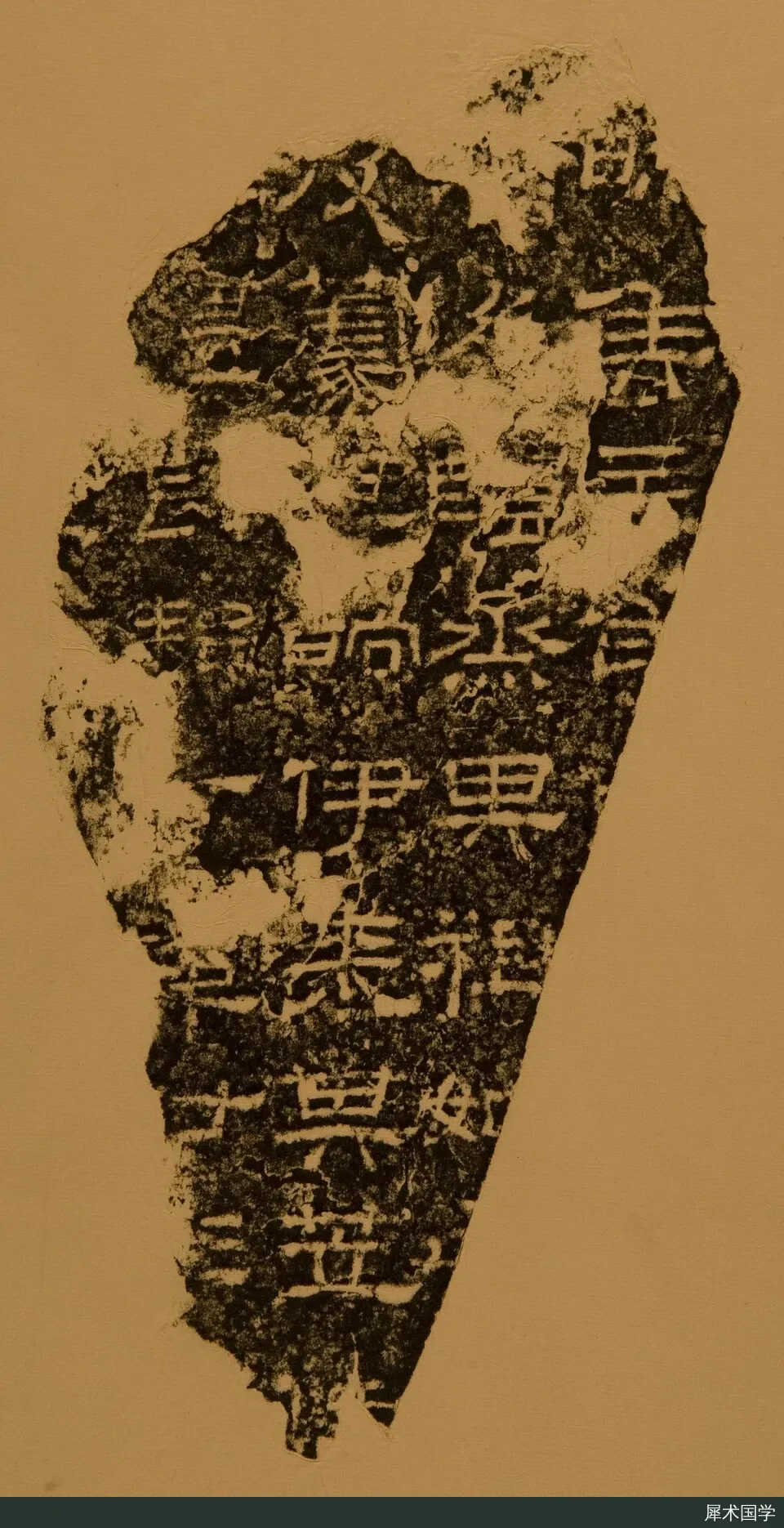
Rubbing of a Xiping Stone Classics fragment, National Library of China, published via the Library of Congress World Digital Library. Source: Wikimedia Commons; license: public domain.
Which school each classic belongs to is mainly inferred backward from the reverse collation notes, and conclusions have shifted. Ma Heng first established that the stone Lunyu is the Lu Lunyu, which the field accepted; from a large Zhouyi fragment rubbing given by Sun Zhuang he once argued that the Xiping Zhouyi used Jing Fang’s text—Qian Xuantong praised this—but it was not generally accepted; only in the 1940s, seeing a collation-note fragment of the Zhouyi, did he reassign it to Liangqiu and publish a correction. Which school the Yili belongs to Wang Guowei and Ma Heng also debated back and forth; Yu Wanli takes Dai De’s text, and other scholars’ dissent was not checked one by one for this article. These cases show that reverse collation notes are the key evidence for assigning the front main text, and the fewer the fragments, the more room conclusions must leave.
The arrangement of the front classic text itself also has version significance. Yu Wanli notes that the Xiping Zhouyi places the Ten Wings after the sixty-four hexagrams of the upper and lower classics, unlike later standard commentaries that attach the Tuan, Xiang, and the like under each hexagram and line; he accordingly holds that attaching the Wings to the classic was only one major form among several pre-Qin and Han transmissions, and became official learning because it was established for the Erudites. Compared with the Mao shi, the Lu shi also differs in chapter order, piece order, and even which pieces belong to which decade.
Dispersal of fragments and modern collation
Not long after the stone classics were finished they met war. Ma Heng records from the Suishu, “Treatise on bibliography”: in the late Northern Wei they were moved from Luoyang toward Ye, “and reaching Heyang, the bank collapsed and they sank in the water; of those that reached Ye, not even half remained”; in Kaihuang 6 of the Sui (586) they were moved again from Ye into Chang’an, and before they could be reset the Sui fell into disorder, “and the construction offices accordingly used them as column bases”; when Wei Zheng gathered them in early Zhenguan of the Tang, “not one in ten survived,” and only transmitted rubbings were kept in the palace archives. Ma Heng traced three moves—Luoyang to Ye, Ye back to Luoyang, Luoyang into Chang’an—yet after inspecting the university site he also suspected that only intact steles were moved and damaged ones remained. Yu Wanli notes that by the mid-Tang even the palace rubbings had been lost.
In the Northern Song, digging at Luoyang repeatedly turned up fragments; Hong Kuo’s Lishi and Lixu preserve some of the wording. Qing discussion of the Han stone classics largely rested only on the Lishi transcriptions; stele format and column layout could not be seen. Per Guo Yutang, in the winter of 1922 large numbers of fragments again came to light north of Zhugedang and Dongdajiao villages south of the Luo River inside the old Luoyang city walls; the next year Ma Heng and Xu Senyu went to Luoyang to identify and purchase. Ma found fragments that could be joined with residual characters of Lunyu · Yao yue and wrote “Colophon on residual characters of the Han Xiping Stone Classics Lunyu · Yao yue”; in 1928 he collected stones from eight holders into Jituo xinchu Han Wei shijing canzi, laying the ground for later systematic collation.
Luo Zhenyu’s Han Xiping shijing canzi jilu was the first large compilation of newly found residual characters; Yu Wanli calls it “rich in collecting.” Peking University Library catalogs a three-juan lithograph of Republican year 20 (1931) (first-print year to be verified); later continuations, third and fourth series, and supplements followed, gathered in volume 5 of Beijing Library Press’s 2005 Lidai shijing yanjiu ziliao jikan. In the wuyin year (1938) Luo recompiled Zengding Han Xiping shijing canzi jilu in two juan; the preface counts 5,593 characters of classic text across the seven works and 180 of collation notes, 6,163 with preface and record fragments (figures via secondary citation; original page numbers to be verified).
Zhang Guogan’s Han shijing beitu has a lead-type edition of Republican year 20 (1931) from the Guandong Printing House in Shenyang, and another of Republican year 22 (1933). Drawing on Luo’s residual characters and absorbing Qing New Text / Old Text research by Sun Xingyan, Li Fusun, Feng Dengfu, Pi Xirui, and others, Zhang for the first time laid out by received classical text the start, end, and column layout of each of the seven classics’ steles. Yu Wanli judges that Luo’s and Zhang’s textual criticism and stele arrangements “have many points open to discussion,” yet restoring more than 200,000 characters of seven-classic stone from six or seven thousand residual characters remains milestone work.
Ma Heng’s Han shijing jicun came later and is finer. Per the Ma Heng riji, from July 1952 to February 1955, using his own rubbings as base, he successively collated Sun Zhuang and Wu Baowei’s Jituo, Luo Zhenyu’s Jilu, and rubbings from many collections, checked against variant compilations by Feng Dengfu, Chen Qiaocong, and others, and in early 1955 drafted the “Overview,” but did not live to fair-copy a final manuscript. After Ma’s death Chen Mengjia and Chen Gongrou took over the collation; Science Press published it in 1957, unified as numbers 1–520, with additions beyond the draft taken from the Lishi, Lixu, and rubbings held by Luo Fuyi’s family. In 1976 Taiwan’s Lianguan and Yiwen printers successively photo-reprinted it; the Yiwen edition renames the compiler “Ma Shujiu.”
Shanghai Bookstore Press’s 2021 reprint (ISBN 9787545820645, hardcover; Yu Wanli’s review notes July 2021 first printing) was the first photo-reprint issued under Yu’s National Social Science Fund major project “Collected literature of successive Confucian stone classics.” The reprint supplies rubbings nos. 72 and 334 that Chen Mengjia could not find at the time, plus two postscript rubbings of the Xiping Stone Classics mentioned in Ma’s “Overview,” and enlarges the originally reduced Zhouyi fragment rubbings in six blocks; Yu’s essay “Ma Heng and the study of the Han stone classics” opens the volume. The published contents show transcriptions ordered Lu shi, Shangshu, Zhouyi, Chunqiu, Gongyang, Yili, Lunyu, each classic with classic text first then collation notes—e.g. Lu shi classic text nos. 1–136, collation notes 137–193; Lunyu classic text 471–515, collation notes 516–520. Catalogs disagree on month and page count (Japan’s CiNii says November 2021, 129 plates); citation should follow the book’s own copyright page.
Collation value of an officially settled New Text
The first value of the Xiping Stone Classics is that they are physical New Text classical texts formally published by the Eastern Han court. Ma Heng notes that Cao Wei carved three-script stone classics—ancient, seal, and clerical—beside the Han ones precisely because “the Han stone classics are all New Text, not Old Text”; Yu Wanli groups the Han, Wei, and Tang stone classics in the manuscript age, holding that all arose from the court’s need to unify text and script, and that their value is not matched by Song or Qing stone classics of the print age. Qing research on the three schools of the Shi and other New Text classics often recovered lost text from citations in other books; the Xiping fragments supply Han official settled wording and column layout.
Second, the reverse collation notes preserve variants among Erudite house lineages within the same classic—direct material for studying Eastern Han teacher-lineage and house-lineage differences; Ma Heng’s reassignment of the Zhouyi to Liangqiu rested on the collation notes. In the Tang Zhang Can’s Wujing wenzi already used the Xiping Stone Classics to correct classical graphs; Ma Heng also notes that Ruan Yuan’s collation of the Thirteen Classics first drew on the Han stone classics. Their place in collation is thus long established.
Third, the Xiping text can serve as a reference between excavated bamboo and silk and the received corpus. Yu Wanli observes that the Xiping Lu shi already differs from the Mao shi in chapter and piece order, so the Fuyang Han bamboo Shijing’s order differing from the Mao shi need not require inventing a “fifth school of the Shi”; the Xiping Zhouyi with Wings after the classic likewise shows that pre-Qin and Han ways of attaching the Yizhuan were not unique. These are Yu’s inferences; the field still disagrees.
Limits of the Xiping Stone Classics are equally clear. The original carving ran to more than 200,000 characters; Luo’s enlarged edition counts classic text and collation notes together at only a little over 5,700, and even with later finds the survival share remains small; stele restoration leans heavily on counting characters in the received text, and arrangements from Zhang Guogan onward disagree; school assignments often change with one or two collation-note fragments. When citing stone-classic variants, therefore, note the fragment number and the collation used (e.g. Ma Heng’s Han shijing jicun numbers), and leave room for disagreement on restored wording and school attribution.
References
-
Fan Ye: Hou Han shu juan 8, “Annals of Emperor Xiaoling”; juan 60B, “Biography of Cai Yong”; juan 79A, “Preface to the Biographies of Confucian Scholars.” Citations from Wikisource transcriptions: juan 8, juan 60B, juan 79A; Zhonghua Book Company punctuated page numbers to be verified.
-
Yu Wanli: “Han and Tang stone classics: the value of text and script in the manuscript age,” Guangming Daily National Social Science Fund special page, 18 December 2019; reposted on the National Office for Philosophy and Social Sciences site.
-
Yu Wanli: “Notes on reprinting Ma Heng’s Han shijing jicun,” Zhonghua dushu bao, 27 October 2021, p. 10; Guangming Net electronic edition.
-
Wang Su: “Overview of collation of Ma Heng’s research materials on the Wei stone classics,” Gugong xuekan 2020 (Palace Museum Press), recording Ma Heng on Han–Wei stone classics’ number of classics, scripts, columns, and stele counts, and citations from the Suishu, “Treatise on bibliography”; Palace Museum site PDF.
-
Ma Heng: Han shijing jicun, Science Press, 1957; Shanghai Bookstore Press, 2021 reprint, ISBN 9787545820645; bibliographic record: CiNii.
-
Luo Zhenyu: Han Xiping shijing canzi jilu, three juan, Republican year 20 (1931) lithograph, Peking University Library, Guoxuedashi catalog; enlarged-edition statistics via Wikipedia “Luo Zhenyu” citing Zengding Han Xiping shijing canzi jilu · wuyin preface.
-
Beijing Library Press, ed.: Lidai shijing yanjiu ziliao jikan (eight volumes), Beijing Library Press, 2005; volume 5 holds Luo Zhenyu’s Jilu series; ISBN 9787501327836.
-
Zhang Guogan: Han shijing beitu, Republican year 20 (1931) Guandong Printing House, Shenyang, lead type, Guoxuedashi catalog; Republican year 22 (1933) lead type, Guoxuedashi catalog; on stele-count preference see that book’s abstract.
-
Library of Congress, World Digital Library: Xi ping shi jing 熹平石经 (National Library of China rubbing).
-
Xishu Chinese Classics · When minds meet, craft appears in words
-
Information compiled and published by the Scholay academic one-stop platform; report infringement for takedown.
-
Also published on Enter Scholar, a scholars’ community for the intelligent age