The Image-Number Orientation of Li Dingzuo’s Zhouyi jijie
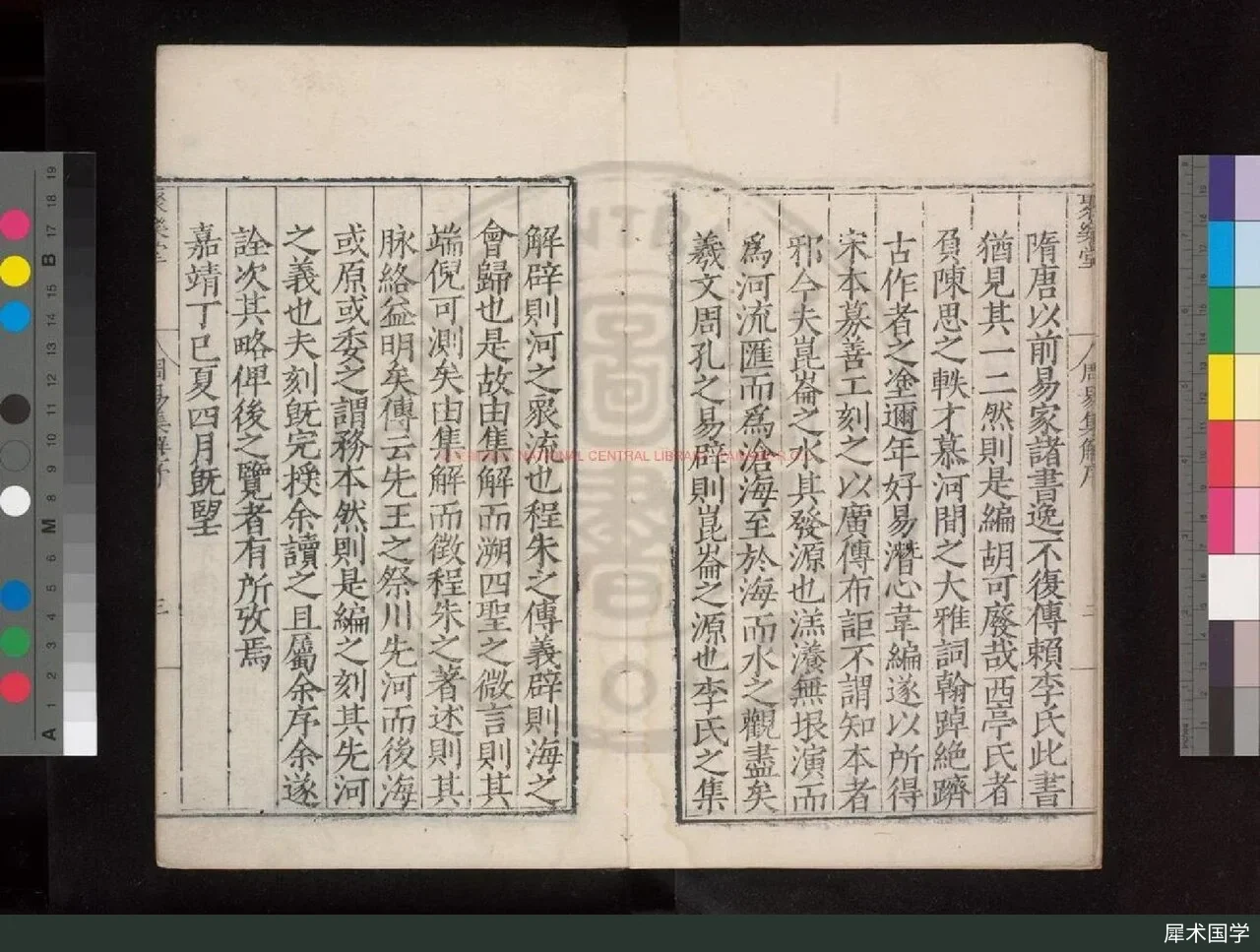
Book image of the Zhouyi jijie printed by Zhu Mujie’s Jule Tang in Jiajing 36 of the Ming (1557). Held by the National Central Library, Taipei; scan on Wikimedia Commons (File:NCL-00013 周易集解.pdf), public domain.
In the early Tang, the Zhouyi zhengyi took “Wang Bi as the foundation,” and Wang Bi’s meaning-principle Yi became the official school text, while Han–Wei image-number explanations gradually found fewer transmitters. In the mid-Tang, Li Dingzuo of Zizhou presented the Zhouyi jijie; his preface says he meant to “prune Fu Si’s wild wording and supply Kangcheng’s lost images,” gathering more than thirty earlier commentaries with Yu Fan and Xun Shuang as the main sources. Drawing on the preface, the Siku quanshu zongmu abstract, and modern collation studies, this article surveys the book’s aim, image-number orientation, documentary value, and transmission in juan and editions.
Background of composition and aim of the preface
Li Dingzuo’s birth and death dates are unknown; neither Tang history gives him a biography. The Siku quanshu zongmu abstract can fix little: from the closing signature of the preface, that he held the post of Editorial Director in the Palace Library; from Yuan Jue’s Qingrong jushi ji, which records a “Dingzuo Reading Terrace” in Zizhou, that he was from Zizhou; and, because the Jiu Tangshu · Jingji zhi lists the four bibliographic divisions of the Kaiyuan period without this work, that he lived after Tianbao. The Qing scholar Liu Yusong’s Tongyi tang wenji · Zhouyi jijie ba is more detailed: Li Dingzuo was from Panshi in Zizhou; when Xuanzong entered Sichuan he presented a Ping hu lun and was summoned as Reminder of the Left; after Daizong’s accession he presented the Zhouyi jijie, then as Editorial Director in the Palace Library, later rising to Palace Censor. The editorial note to the Peking University Ruzang Essential Edition adopts Liu’s account and dates the book to Daizong’s reign.
The work faced the dominance of Wang Bi’s Yi learning since the Sui and Tang. Kong Yingda and others, ordered to compile the Zhouyi zhengyi, stated in their preface that “where meaning can be explained, take Fu Si as the foundation first”; thereafter Tang students of the Yi mostly followed Wang Bi and Han Kangbo. In his preface to the Jiajing imprint, the Ming scholar Zhu Mujie recalled that Zheng Xuan and Wang Bi had stood side by side from Han and Jin onward, until “the Tang rose, Kong Yingda received the order to settle the Wujing zhengyi, and for the Yi alone took Wang’s commentary, so Zheng’s learning fell into disuse.” Gao Yu notes that after the Zhengyi was issued the Tang was not without dissent—Yin Hongdao’s Zhouyi xinlun zhuanshu and Cui Jing’s Zhouyi tanxuan both drew on Western and Eastern Han opinions—but those books are long lost, and the Zhouyi jijie is the only complete survivor of that tendency.
Li Dingzuo’s stance is concentrated in one passage of his preface: “Only Wang and Zheng have continued to circulate in our age; Zheng mostly draws on celestial images, Wang wholly explains human affairs. Yet can the Way of the Yi be stuck one-sidedly in Heaven or in man?” In his view Zheng often used celestial images to explain the Yi, while Wang spoke entirely from human affairs; later followers each clung to one side—“celestial images are distant and hard to seek, human affairs near and easy to practice”—so shallow human-affairs readings flourished and hard celestial-image readings were neglected. His remedy: “Surveying from blazing Han down to this great Tang, I gather the leftover words of many worthies and discuss the deep subtleties of the three sages, collecting more than thirty houses from Yu Fan and Xun Shuang, pruning Fu Si’s wild wording and supplying Kangcheng’s lost images.”
These lines may be read on two levels. “Pruning Fu Si’s wild wording” targets cuts to Wang Bi’s commentary; “supplying Kangcheng’s lost images” restores the image-taking of Zheng Xuan’s line that had been neglected; together the aim is to let the Yi again balance Heaven’s way and human affairs, not to replace meaning-principle wholesale with image-number. The book still includes Wang Bi and Han Kangbo, and Kong Yingda’s subcommentary, so Li Dingzuo did not reject the meaning-principle school—he only refused to let it remain the trunk. Whether “supplying Kangcheng’s lost images” means taking Zheng as master is disputed: Zhu Mujie’s preface calls him “one who honored Zheng’s learning”; Xu Weiping holds that “rather than say Li Dingzuo was devoted to Zheng, it is more apt to call him an admirer of Xun and Yu.” Judged by the actual weight of citations, the latter fits the whole book better.
Image-number orientation with Yu and Xun as the main sources
The Zhouyi jijie uses the collected-commentary form: under each phrase of classic and commentary it lists earlier notes by surname, with Li’s own case notes when needed. Counts of commentators vary by period. Zhu Mujie’s preface lists Zixia, Meng Xi, Jiao Gan, Jing Fang, Ma Rong, Xun Shuang, Zheng Xuan, Yu Fan, Lu Ji, Gan Bao, Wang Su, Wang Bi, Yao Xin, Han Kangbo, He Tuo, Cui Jing, Kong Yingda, and others—thirty-two houses in all—plus the Jiujia Yi, Qianzuodu, and related sayings; the Siku quanshu zongmu abstract, following Zhu Yizun’s Jingyi kao, adds Yao Gui, Zhu Yangzhi, and Cai Jingjun for thirty-five. Gao Yu also lists the Zhongxing shumu’s thirty houses and Pan Yuting’s and Liu Yujian’s counts of forty each. Counting methods differ; the preface’s “more than thirty houses” remains the usual summary.
Among these, Yu Fan weighs heaviest. The introduction to volume 2 of the Ruzang Essential Edition counts more than 2,700 commentary sections in the whole book, of which Yu Fan’s notes take about half the space—“showing Li’s esteem for Yu’s image-number Yi.” Xun Shuang is also a main source; Chen Zhensun’s Southern Song Zhizhai shulu jieti already noted that the book “takes especially much from Xun and Yu.” Both were leading late-Han image-number interpreters: their notes rely heavily on hexagram images, line positions, interlocking trigrams, and hexagram change. By making them the trunk, Li Dingzuo placed the two most systematic image-taking houses of Han Yi at the center of the book.
On a single classic passage one can see how “balancing Heaven and man” is carried out. Under the Tuan of hexagram Tai, Li Dingzuo cites He Tuo—“this clarifies the Tai of Heaven’s way,” “this clarifies the Tai of human affairs”—and Cui Jing—“this clarifies human affairs”—splitting the same commentary into Heaven’s way and human affairs; under the Great Image “assist Heaven and Earth’s fitness, so as to left-and-right the people,” he first lists Yu Fan’s image-taking “Zhen is left, Dui is right, Kun is the people,” then Zheng Xuan’s gloss “wealth is restraint” and his account of seasonal governance. Liu Junbo further finds that the order of notes is not chronological: glosses of wording come first, continuous sense in the middle, analogies to human affairs last—as under Pi Nine-Five “tied to the wrapped mulberry,” Xun Shuang, Jing Fang, and Lu Ji in turn, then Li’s case note, and only then Zheng Xuan’s comparison to King Wen’s imprisonment at Youli.
Li Dingzuo’s case notes also show he did not accept everything wholesale. Gao Yu counts over a hundred case notes, many on Qian—e.g. explaining “the overreaching dragon has regret” as “the time when Jie and Zhou lost their place, overreaching in arrogance,” arguing from a ruler’s pride; Liu Junbo notes that more case notes discuss image-number, and sometimes dissent. Under Gou Nine-Three “buttocks without flesh,” Yu Fan takes “Kan as buttocks”; because the Shuogua has no “Kan as buttocks,” Li rejects Yu and derives the buttocks image from “Xun as thigh.” He esteems Yu, yet takes the Shuogua as the basis for image-taking and restrains Yu’s “lost images.”
This orientation later became a work of preservation. Through the late Tang, Five Dynasties, and Northern Song, Han–Wei Yi commentaries were lost one after another; later study of Han Yi mostly depends on the Zhouyi jijie’s harvest. Chen Zhensun said that of the Yi houses before Sui and Tang, “those that vanished without transmission still show a glimpse or two thanks to this book”; the Siku quanshu zongmu abstract says: “Once Wang’s learning flourished, Han Yi perished; a thousand years later, scholars who can examine the original aim of drawing the hexagrams rely only on this book’s survival—truly a precious ancient work.” When Lu Jianzeng printed the Yayutang edition in the Qing he likewise wrote: “Since Kong Yingda was ordered to make the Wujing zhengyi and for the Yi used Wang, the learning of the two Han was lost. Happily Li’s Yi Commentary still survives.” On the book’s own scholarly standing, judgments diverge: Zhu Bokun’s History of Yi Philosophy calls it “basically a documentary compilation,” not comparable in status to the Zhengyi; Gao Yu holds that it answers Wang Bi’s Yi with older image-number learning and Tang “new meanings,” a bridge from Han Yi to Song Yi.
Juan count, format, and printed transmission
The juan count has long been disputed. The Xin Tangshu · Yiwen zhi lists seventeen juan; Chao Gongwu’s Junzhai dushu zhi says what he saw was only ten juan yet complete from start to finish; Li Tao and Zhu Mujie, following the preface, both said the original was ten juan. Mao Jin’s late-Ming Jigu Ge edition again makes seventeen juan, writing “eighteen juan” in the preface. The Siku quanshu zongmu abstract explains: the preface says “I separately composed a Suoyin, intertwining roots and sprouts, keeping both sound and sense,” so the original was ten juan of Jijie, one juan of Wang Bi’s Lueli appended, and six juan of Suoyin—seventeen in all, and the Tang treatise was not wrong; after the Song the Suoyin was lost, and printings also dropped the Lueli, leaving only ten juan of Jijie; Mao’s edition, to match the Tang treatise, split ten into seventeen and changed the preface’s “ten juan” to “eighteen” to match the appended Lueli. The preface in today’s Siku text indeed reads “altogether eighteen juan,” following Mao’s alteration. The Siku editors never saw a ten-juan copy and still catalogued seventeen after Mao.
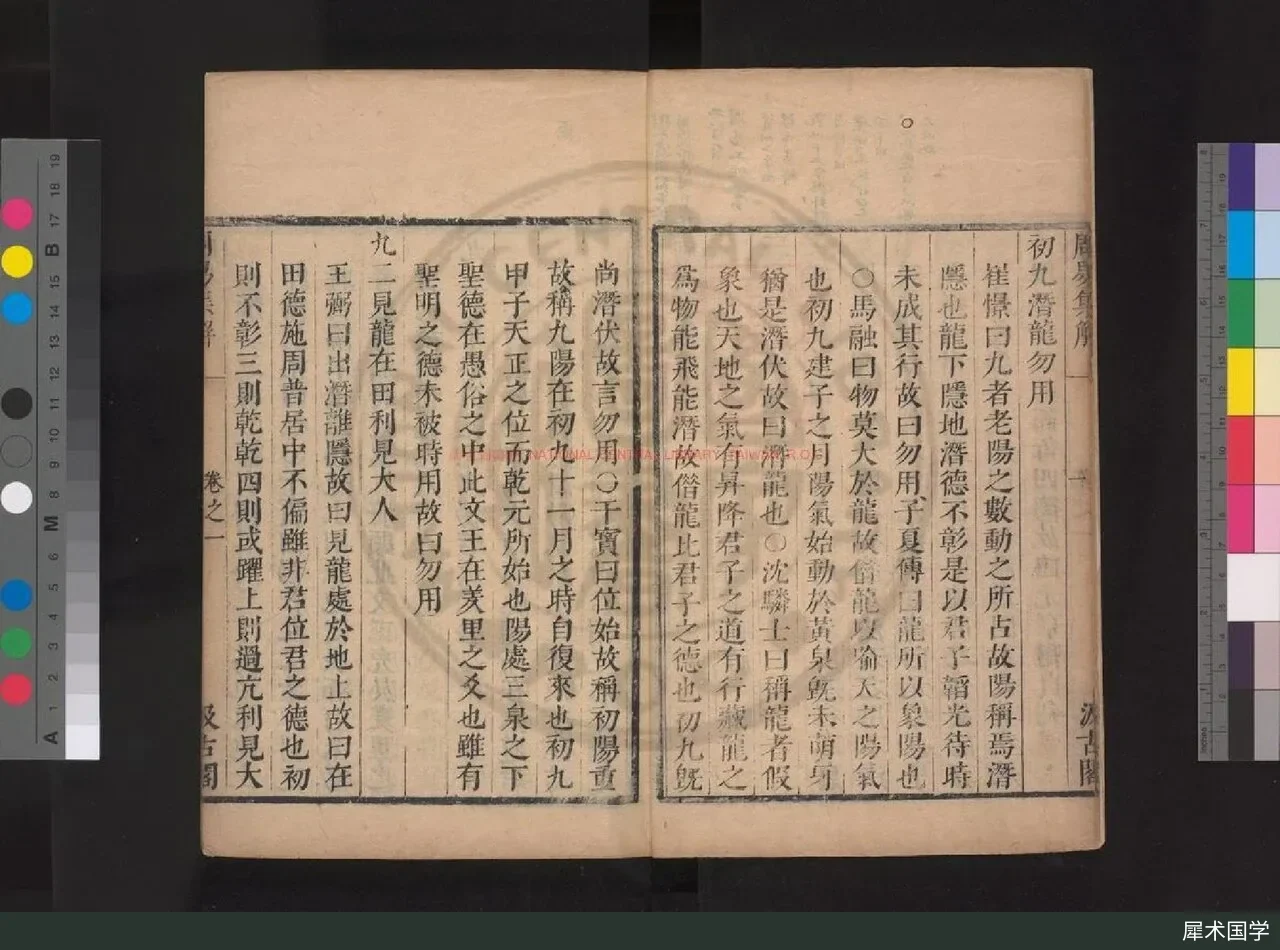
Book image of Mao Jin’s late-Ming Jigu Ge seventeen-juan Zhouyi jijie, lower heart of the page “Jigu Ge.” Held by the National Central Library, Taipei; scan on Wikimedia Commons (File:NCL-00016 周易集解.pdf), public domain.
In format, the Jijie still follows Wang Bi’s arrangement of classic and commentary—Zheng Xuan had attached the Tuan and Xiang to the classic, and Wang Bi further attached the Wenyan after Qian and Kun, the received order—except that it splits the Xugua zhuan and places each portion at the head of the corresponding hexagram. The Siku quanshu zongmu abstract takes this as imitating the Mao Shi practice of capping each poem with its minor preface. According to Liu Junbo, except for Qian and Kun, each hexagram’s statements are preceded by the matching Xugua sentence—e.g. Zhun first cites “Xugua says: There being Heaven and Earth, then the myriad things are born… hence it is followed by Zhun”; the Ten Wings section at the end still keeps the full Xugua, which Gao Yu calls “Xugua preserved twice.” Thus at the start of each hexagram the reader sees why the previous and next hexagrams succeed each other. Zhu Mujie’s preface also notes that Li Dingzuo’s explanations often avoid Tang taboo characters.
On printed editions, according to the Ruzang editorial note, the earliest known is a Northern Song Qingli imprint of the Pingyang clan, with Ji Yongzhang’s preface of Qingli jiashen (1044); the original carving no longer survives. In Jiajing 36 of the Ming (1557) Zhu Mujie printed from a Song copy obtained from Li Kaixian (Zhonglu); the heart of the page bears “Jule Tang,” and book catalogues call it the earliest surviving complete text; Mao Jin’s Jigu Ge Jin dai mishu edition descends from Zhu’s. In Qianlong 21 of the Qing (1756) Lu Jianzeng printed the Yayutang congshu edition from a Song text; in Jiaqing 10 (1805) Zhang Haipeng’s Xuejin taoyuan Zhaokuang Ge edition first followed Jigu Ge, then corrected against Yayutang. The ten-juan line also continued: the Wanli-period Mice huichan edition collated by Hu Zhenheng and others is in ten juan; catalogues further publish a fragmentary Song ten-juan imprint held overseas (juan 5–10 survive). Among modern collations, volume 2 of the Peking University Ruzang Essential Edition (Peking University Press, July 2009) takes the relatively clean Yayutang text as base, the Zhaokuang Ge as collation copy, with reference to the Wenyuange Siku quanshu, punctuated by Zhang Wenzhi.
Return to the preface’s “Yet can the Way of the Yi be stuck one-sidedly in Heaven or in man?” In an age when the officially compiled Zhengyi dominated, Li Dingzuo set up another reference: putting Wang Bi’s notes back among many commentators so that under one classic phrase the reader sees glossing, image-taking, and analogy to human affairs together. Preserving Han Yi is this book’s most certain value; whether it constitutes a school of its own, scholars still disagree. In this author’s view, reading the Zhouyi jijie first as a selective, ordered collected commentary, then looking closely at Yu’s and Xun’s images, better reveals Li Dingzuo’s design in compiling the book.
References
-
(Tang) Li Dingzuo. Zhouyi jijie (Siku quanshu text), opening Abstract, Original Preface to the Zhouyi jijie, and Ming Zhu Mujie’s Preface to the Zhouyi jijie, after the photolithographed Wenyuange Siku quanshu, vol. 7; Wikisource: 周易集解 (四庫全書本)
-
Li Junxiu. “Introduction to Volume 2 of the Ruzang Essential Edition: Zhouyi zhengyi and Zhouyi jijie.” Peking University Center for Compiling and Studying the Ruzang, 15 July 2019: ruzang.pku.edu.cn
-
Gao Yu. “On Li Dingzuo’s Zhouyi jijie.” Originally in Zhouyi Studies 2007, no. 6; reprinted on Philosophy China: philosophychina.cssn.cn
-
Liu Junbo. “The Format of the Zhouyi jijie and Its Thought on the Yi.” Journal of Chongqing Three Gorges University 2019, no. 1 (vol. 35): PDF
-
Shuge (old site). Edition introduction to the Zhouyi jijie, 3 September 2017, later supplemented: old.shuge.org
-
Xishu Chinese Classics · When minds meet, craft appears in the writing
-
Information compiled and published by Scholay all-in-one academic platform. Please report for takedown if this infringes your rights.
-
Also published on Enter Scholar, a scholars’ community for the intelligent age.