The Zhengshi three-script stone classics were an official text of the classics, set up at the Imperial Academy in Luoyang in the Zhengshi years of Cao Wei. They are known for being cut in three scripts together: ancient script, seal script, and clerical script. Fragments and rubbings that survive keep the words and the line layout of the Book of Documents and the Spring and Autumn Annals. The large fragment unearthed in Luoyang in 1922, and Ma Heng’s work of joining the pieces, made the form of the stones and their value as texts clearer.
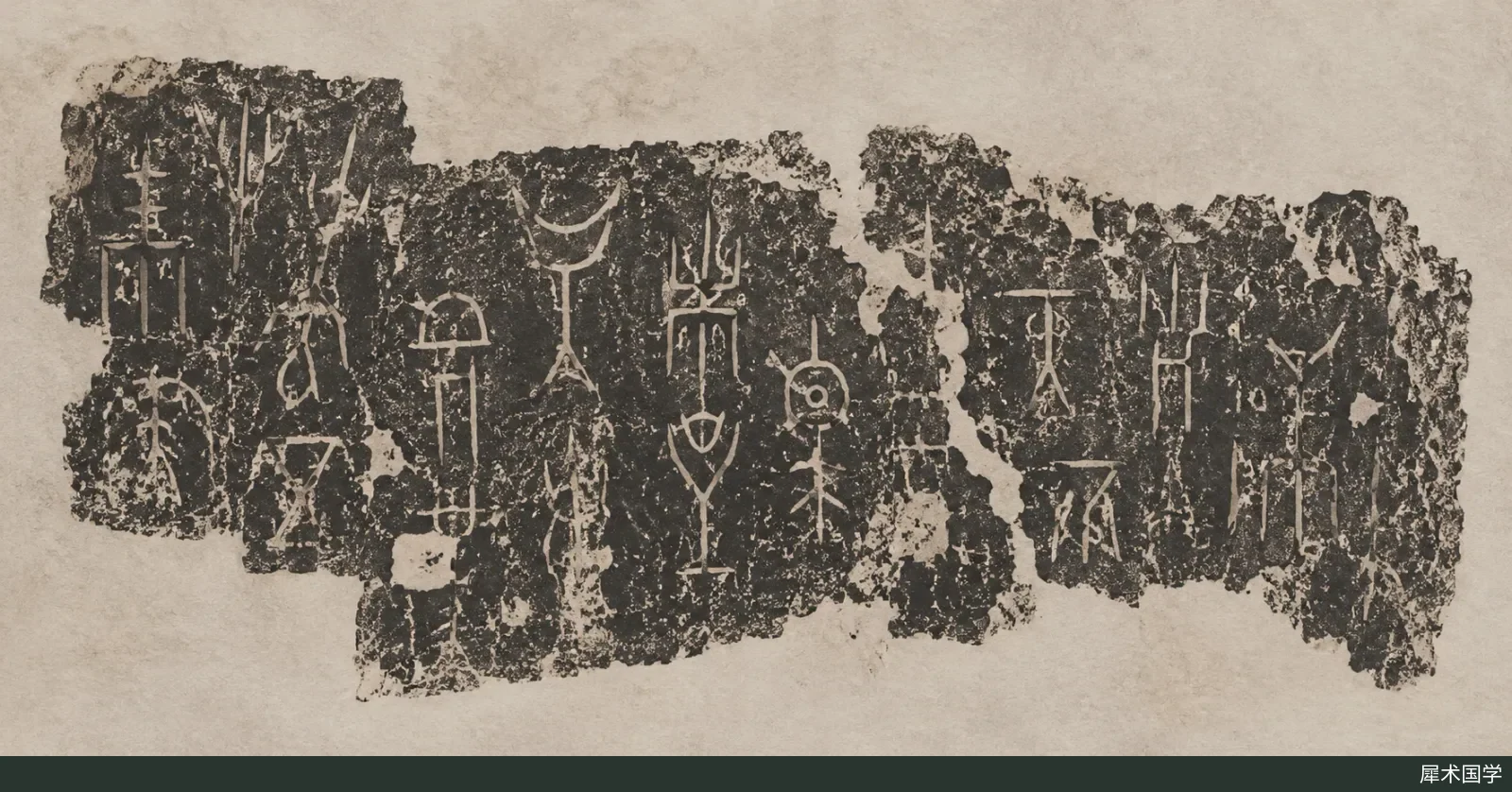
An AI-generated image. It is not a photograph of a surviving fragment.
Why they were cut, and how the three scripts are set
The Zhengshi stones are also called the Wei stone classics and the three-script stone classics. The museum of the Institute of History and Philology, Academia Sinica, records the cutting as the second year of Zhengshi in Cao Wei, 241. Together with the Han Xiping stones and the Tang Kaicheng stones, they are called the three great stone classics of ancient China. The Wei stones stood at the Imperial Academy in Luoyang. They were an official text. The classics are mainly the Book of Documents and the Spring and Autumn Annals. The museum’s account also includes part of the Zuo Tradition. Ma Heng’s Outline of the Wei stone classics, using the Record of the Western Expedition, the Record of the Monasteries of Luoyang, the bibliographic treatise of the Sui History, and other records, takes the number of classics as two, the Documents and the Annals. Whether the Zuo commentary was also cut is not consistent in the records. Fragments joined in modern times are mainly the Documents and the Annals.
The three scripts mean that each character of the classic is set with ancient script, small seal, and clerical script. Ma Heng holds that the Wei stones put the ancient script on top and use seal and clerical as the explanation, and that they belong to the ancient-script tradition of the classics. From the fragments he concludes that the Documents has 34 lines to a stone, the Annals 32, twenty characters to a line, three scripts to a character, sixty characters in all, with boundaries across and down, and three scripts to a cell. The part of the Documents before Gaoyao mo uses another layout: in one cell the ancient script is on top and seal and clerical sit side by side below, in a triangular arrangement, thirty-seven cells to a line.
Old books do not agree on how many stones there were. The Commentary on the Water Classic says 48. The Record of the Western Expedition says 35. The Record of the Monasteries of Luoyang says 25. Ma Heng, arranging them by the number of characters, leans toward 25. On the writer, Jiang Shi of the Northern Wei attributed them to Handan Chun. Ma Heng, after putting the old accounts together, holds that the writer cannot be settled, and that the three scripts are not from one hand.
The large Luoyang fragment, and where the pieces are kept
In the winter of 1922 a large fragment of the Wei stone classics was found at Zhugedang, east of Luoyang city. The front is cut with Wu yi and Jun shi from the Documents. The back is cut with parts of the Annals for the reigns of Dukes Xi and Wen. The 34 lines on the front and 32 on the back, as Ma Heng records them, match the line counts he had drawn for the two classics. On the day it was found, the rubbing maker Zhao Daochuan rushed the first rubbings. Ma Heng’s colophon says twelve copies were taken. The next day stonemasons split the stone in two and some lines were lost. Rubbings from before the split are especially valuable for that reason.
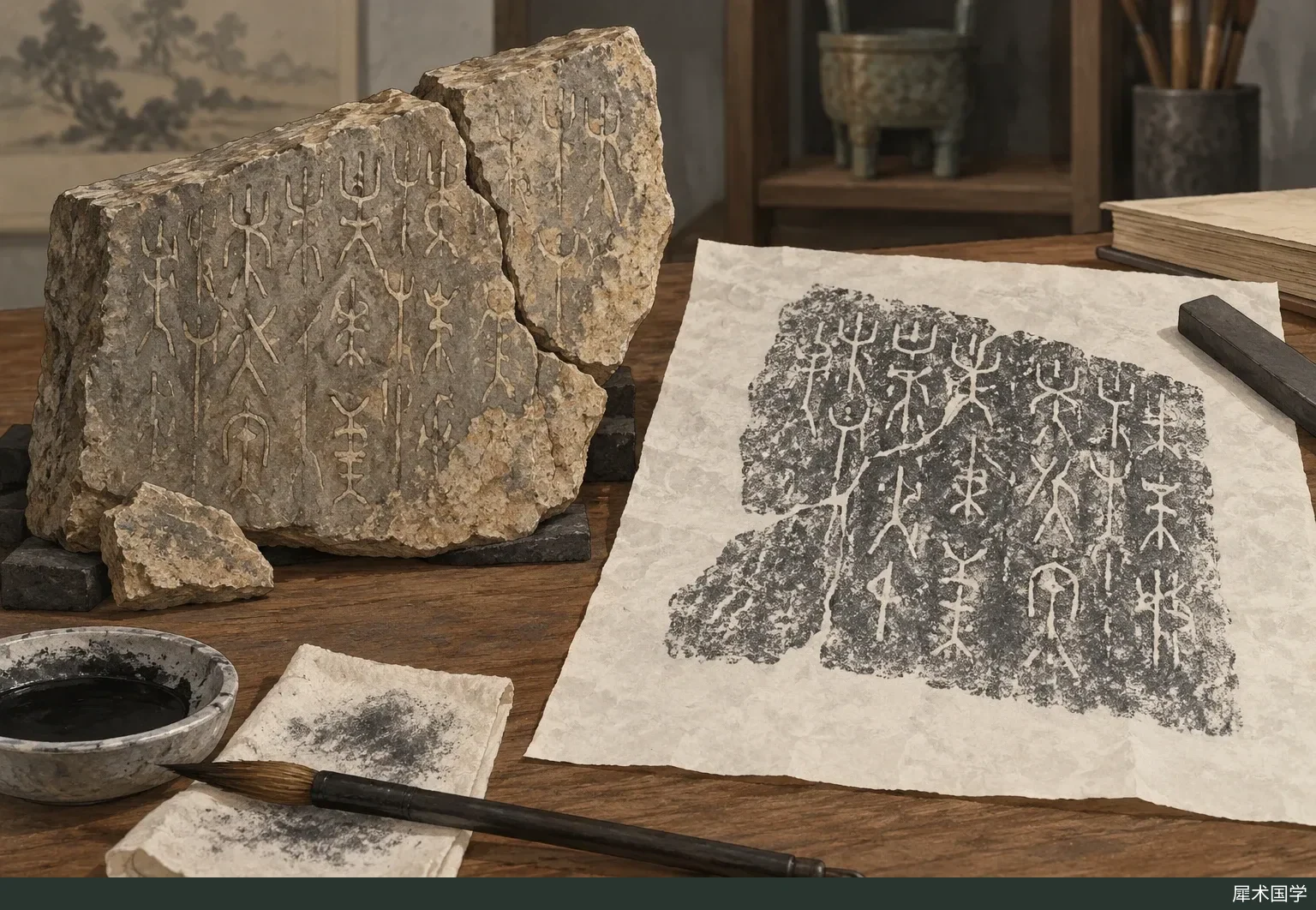
An AI-generated schematic, not a photograph of the stone or of a historical rubbing.
A fragment of Jun shi found at Longhutan at the end of the Guangxu reign fits directly under this stone. After the split, the original pieces were kept at the Luoyang Museum in Henan and the National Museum of China in Beijing. An unsplit rubbing of the front in the Institute of History and Philology keeps part of the text of Wu yi and Jun shi. An early unsplit rubbing of the Annals in the Fu Ssu-nien Library of the institute also has an inscription by Luo Zhenyu from the winter of the guihai year.
Ma Heng’s joined rubbings, and their value as texts
Ma Heng went to Luoyang three times and obtained one of the early unsplit rubbings of the large fragment. He also collected and remounted rubbings of smaller pieces and joined the old and new fragments. The Recent rubbings of the remaining stones of the three-script classics of the Documents and the Annals from the Three Kingdoms, given by Ma Heng and kept at the Palace Museum, reflects that work. Wang Guowei’s colophon is on the rubbing of the front. Ma Heng counted about 2,576 characters of the Wei stones found up to that time, and he pointed out that the triangular layout of the first stones of the Documents had not been known before.
Ma Heng’s research is in writings such as An outline of the Wei stone classics, with illustrations, and in manuscripts such as a catalogue of rubbings of the Wei stone fragments. Wang Su’s survey of the arrangement of Ma Heng’s research materials on the Wei stones sorts what was published and what was not. Wang Guowei’s Study of the Wei stone classics also uses the newly found fragments. The three scripts set together let a reader compare ancient character forms with the seal and clerical explanations, and compare the Documents and Annals text on the stones with later received editions. Wang Guowei’s colophon takes up the relation between the Wei stones and the Mei edition of the Documents, which shows what the fragments mean for the study of how the classics were transmitted.
References
-
Museum of the Institute of History and Philology, Academia Sinica: the early unsplit rubbing of the Wei three-script stone classics.
-
The same museum: a fragment of the Documents from the Wei three-script stone classics.
-
Wang Su: a survey of the arrangement of Ma Heng’s research materials on the Wei stone classics.
-
Palace Museum: recent rubbings of the remaining stones.
-
Wikimedia Commons: a rubbing of the three-script stone classics.
-
Compiled and published by Scholay. For a takedown request, send feedback.
-
Also published at Enter Scholar.
