How to choose open courses on the Shangshu
Project overview
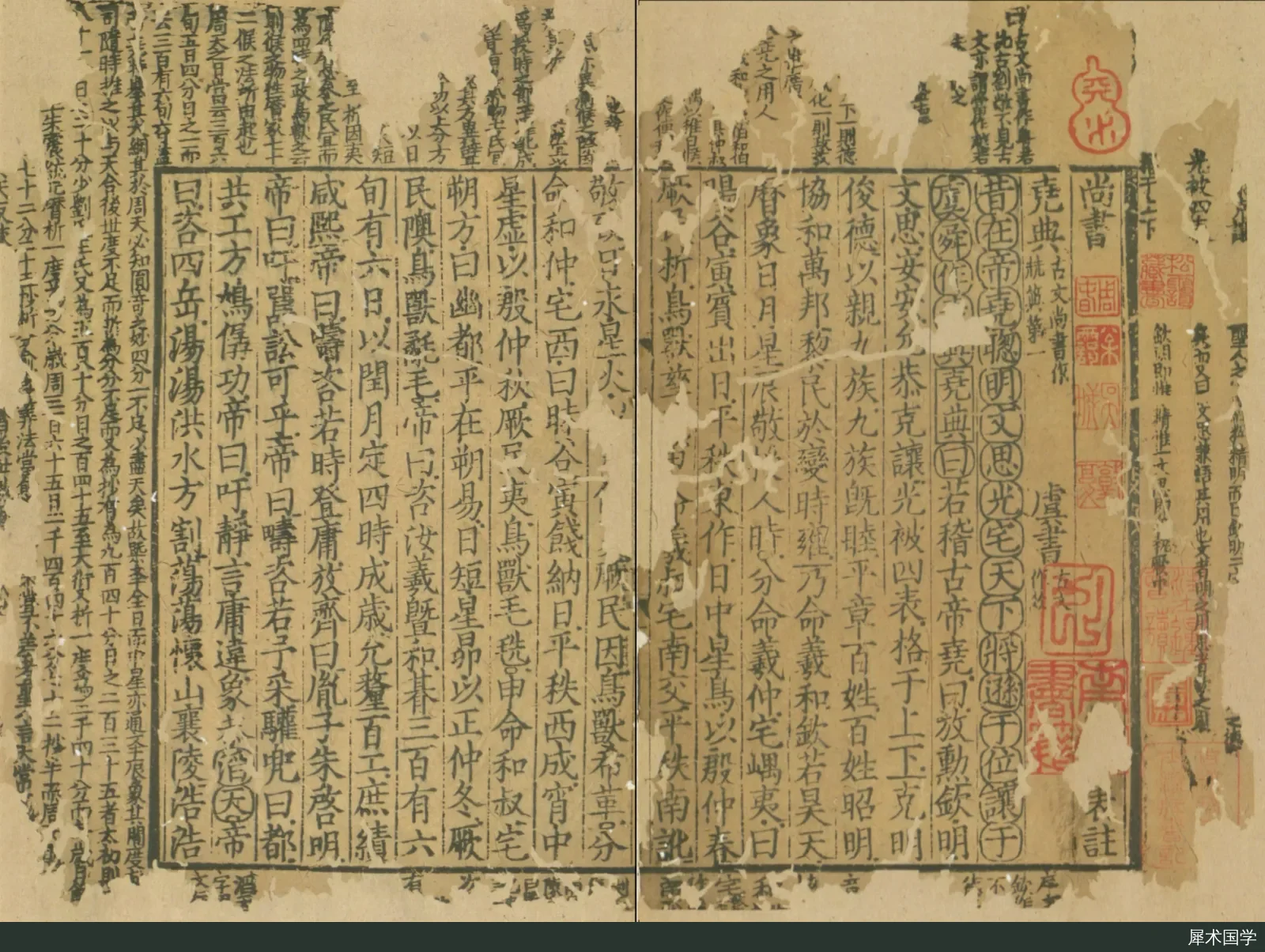
Opening leaves of Jin Lüxiang’s Shangshu biaozhu, showing the start of the Yaodian. Per Wikimedia Commons, this edition was carved in 1279 and is held by the National Central Library, Taiwan. Image source: Wikimedia Commons (uploaded by White whirlwind); license: public domain.
This article is a guide to open courses and MOOCs on the Shangshu (Book of Documents). Sources were checked on 28 October 2026 (Beijing time). The recommended main entry is Shandong University’s Shangshu introduction on China University MOOC; three short videos on “Shangshu: narrating the Three Dynasties to make the kingly way clear” from Shanxi University’s The Five Classics and Traditional Chinese Values, hosted on NetEase Open Course, can serve as a brief supplement; the “Shangshu” section in Jilin University’s Introduction to Chinese Classical Learning, classics studies (part 2), works as an index inside a survey course. Rounds, enrollment, and certificate policies for each course follow what the pages showed at the time of checking. Podcast lectures are covered elsewhere and are not expanded here.
The Shangshu’s place in the literature and difficulties for beginners
The Shangshu is one of the Confucian Five Classics. The Shandong University course page overview states that the received Shangshu has 58 chapters, about half titled with dian, mo, xun, gao, shi, or ming; the narrative runs from the legendary Yao and Shun down to Duke Mu of Qin in the mid–Spring and Autumn period, with early Zhou history as the main focus, and most of the surviving texts are records of rulers’ speeches. The diction is archaic; added to that are the division and merger of New Text and Old Text chapter lists, and authenticity disputes over some chapters in the transmitted corpus, so beginners who go straight to the bare text easily lose their way. A sound order is to follow one systematic course first to clarify chapter provenance and the scholarly history, then return to a critical edition for chapter-by-chapter reading. New Text / Old Text questions have long been contested; this article only notes them and draws no conclusion.
Recommended course: Shandong University, Shangshu introduction
Shandong University’s Shangshu introduction runs on China University MOOC; the course page is https://www.icourse163.org/course/SDU-1002616007[1] . Per the course overview, it “intends systematically to explore and introduce the scholarly lineages of Shangshu studies, and selectively to lecture on and read a number of chapters,” balancing intellectual history with selected close reading. Per a 2018 notice on the website of Shandong University’s Advanced Institute of Confucian Studies, it belongs to the classics-section courses in Nishan Academy’s “Classics of Chinese Learning MOOC series,” alongside introductions to the Shijing, Zhouli, and Zuozhuan. The bibliography on the course page—from Kong Yingda et al., Shangshu zhushu (Ruan Yuan’s Shisan jing zhushu), and Cai Shen’s Shujing jizhuan, through Yan Ruoqu’s Shangshu guwen shuzheng, Sun Xingyan’s Shangshu jin guwen zhushu, and Gu Jiegang and Liu Qiyu’s Shangshu jiaoshi yilun—is itself a usable Shangshu reading list. The lead instructor and course-team names did not appear in the page text captured for this pass and remain to be verified; whether an open term is running and whether enrollment is open must be checked on the page, likewise to be verified.
On certificates, the course page’s current note is: from Autumn 2021 the platform offers only electronic certified certificates; students who complete study and assessment and meet the grade standard may apply online with payment during the application window, must complete real-name verification, and fees are non-refundable once the certificate is generated. The exact price is not stated on the page and remains to be verified. A past-term page for the same course also lists grading: unit homework 30%, final exam 70%, 80 and above excellent, 60–80 pass; new terms may adjust, follow the term you enroll in. Payment occurs only at the certificate-application step; readers who do not want a certificate can put their effort into listening and reading the classic.
Short-video supplement: three Shangshu lectures in Shanxi University’s Five Classics course
NetEase Open Course hosts Shanxi University’s The Five Classics and Traditional Chinese Values in 24 videos: first three introductory lectures, then Shangshu, Yijing (two lectures), the Three Rituals (two lectures), Shijing, and Chunqiu, each lecture split into three videos. Videos 4–6 are “Shangshu: narrating the Three Dynasties to make the kingly way clear,” parts 1–3, about 11:01, 11:01, and 10:47 respectively, a little over half an hour in all. The course blurb says it “mainly lectures on the main contents and thought of the Five Classics,” reading them from the angle of traditional values rather than chapter-by-chapter exposition. It suits building a rough sense before a MOOC, or review afterward. The video pages do not show the instructor’s name; whether login is required and whether there are quizzes or certificates were not verified, so it should not be treated as a follow-along path as complete as a MOOC.
The Shangshu unit inside a survey course
Jilin University’s Introduction to Chinese Classical Learning, taught by Dou Keyang, runs on XuetangX; the National Higher Education Smart Education Platform also has a course page (https://higher.smartedu.cn/course/6786ebf2225d72705e5dc1a9[5] ). On the verification day that page showed the term running 23 July 2026–12 January 2027, status “in session.” Chapter 3 of the syllabus, “Classics studies (part 2),” opens with “3.1 Shangshu,” flanked by sections on Shijing, Yijing, the Three Rituals, Chunqiu, and so on; the course blurb also says the brief history of classics studies “focuses on New Text and Old Text scholarship.” This is a Shangshu unit inside a survey course, not a dedicated Shangshu course, useful for placing the Shangshu in the Five Classics system and in New Text / Old Text scholarship. The number and length of videos for that section are not listed on the platform page, and certificate policy was not verified; both remain to be verified.
For English-language learners, one may also note Sichuan International Studies University’s Introduction to Chinese Culture and Selected Classical Texts on the University MOOCs for Foreign Languages in Chinese Higher Education (UMOOCs). The course is taught in English; the blurb says it covers classics including the Yijing, Shangshu, Xunzi, Zhuangzi, and Daodejing, suited to readers in classical translation or teaching Chinese as a foreign language. The Shangshu is only one part; this article does not recommend it as the main path. The course page showed the most recent round as the 13th offering (23 December 2024–9 February 2025), free; whether it continues afterward remains to be verified.
Limits of use and items yet to be verified
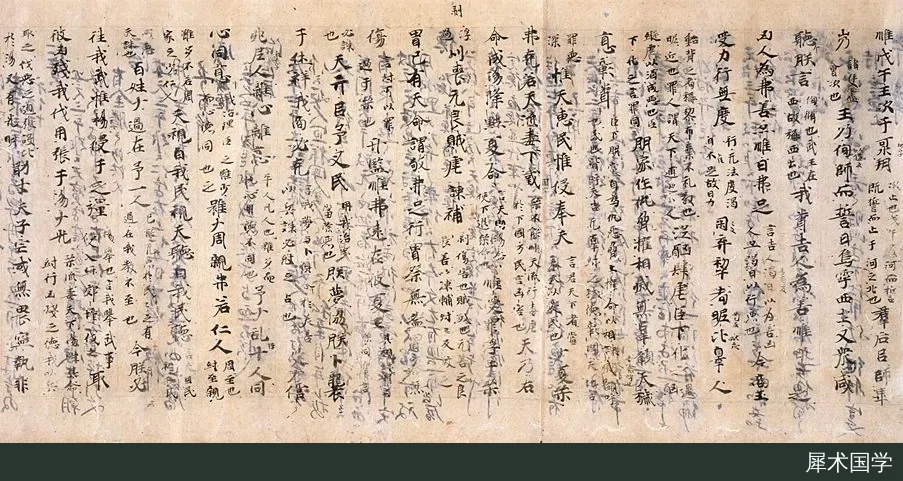
Fragment of Guwen Shangshu, juan 6. Per Wikimedia Commons, a seventh-century manuscript held by the Tokyo National Museum. Image source: Wikimedia Commons, author unknown; license: public domain.
A few points when using these courses. First, MOOCs open by term; rounds, dates, and enrollment links change, and what this article records is only the page state on 28 October 2026. Second, China University MOOC certified certificates require real-name verification and paid application; price follows the application page. Third, courses can only select chapters to lecture; reading the whole book still needs a critical edition, for example Sun Xingyan’s Shangshu jin guwen zhushu and Gu Jiegang and Liu Qiyu’s Shangshu jiaoshi yilun listed in Shandong’s bibliography; on New Text and Old Text chapter lists and chapters suspected of later origin in the transmitted corpus, compare different commentators and do not trust only one school. Fourth, for the Shandong teaching team, the NetEase instructor, and certificate policies not verified here, follow each platform’s pages.
Why it is useful
For readers who want a systematic entry to the Shangshu, these materials can form a shallow-to-deep path: first use NetEase’s three lectures (about half an hour) for the Shangshu’s place among the Five Classics and its general sense; then follow Shandong University’s Shangshu introduction for the lineages of Shangshu studies and selected chapter reading; when classics-history background is needed, check the “Shangshu” section in Jilin University’s Introduction to Chinese Classical Learning. The bibliography on Shandong’s course page can serve directly as a further reading list. Learners who need a certificate should first confirm the term and payment rules; those who only want to read can put the weight on lectures paired with a critical edition.
References
-
China University MOOC: Shandong University, Shangshu introduction course page, https://www.icourse163.org/course/SDU-1002616007 (checked 2026-10-28)
-
China University MOOC: Shandong University, Shangshu introduction past-term page, https://www.icourse163.org/course/SDU-1002616007?tid=1206147208 (checked 2026-10-28)
-
Advanced Institute of Confucian Studies, Shandong University: “Shandong University launches the nation’s first online micro-major,” 2018-09-09, https://rxgdyjy.sdu.edu.cn/info/1194/5104.htm
-
NetEase Open Course: Shanxi University, The Five Classics and Traditional Chinese Values, “Shangshu: narrating the Three Dynasties to make the kingly way clear” video page, http://www.163.com/opencourse/detail/video-SHGTCPFJN-XHGTCPHH3 (checked 2026-10-28)
-
National Higher Education Smart Education Platform: Jilin University, Introduction to Chinese Classical Learning course page, https://higher.smartedu.cn/course/6786ebf2225d72705e5dc1a9 (checked 2026-10-28)
-
University MOOCs for Foreign Languages in Chinese Higher Education (UMOOCs): Sichuan International Studies University, Introduction to Chinese Culture and Selected Classical Texts, https://moocs.unipus.cn/course/5087 (checked 2026-10-28)
-
Xishu Chinese Classics · When minds meet, craft appears in words
-
Information compiled and published by the Scholay academic one-stop platform; report infringement for takedown.
-
Also published on Enter Scholar, a scholars’ community for the intelligent age

