Exegetical method and influence of Cheng Yi’s Yi commentary
Cheng Yi’s Yi zhuan explains the Zhouyi by meaning-principle, yet does not abandon hexagram images and line positions. He seeks intent from the wording and turns the classic’s changes into principles for self-cultivation and conduct; compared with Wang Bi, both prize the meaning behind the text, yet they diverge on understanding the mind of Heaven and Earth. Later Zhu Xi both esteemed and criticized it, and Ming compilations of classical learning show how Cheng’s commentary entered a shared interpretive frame.
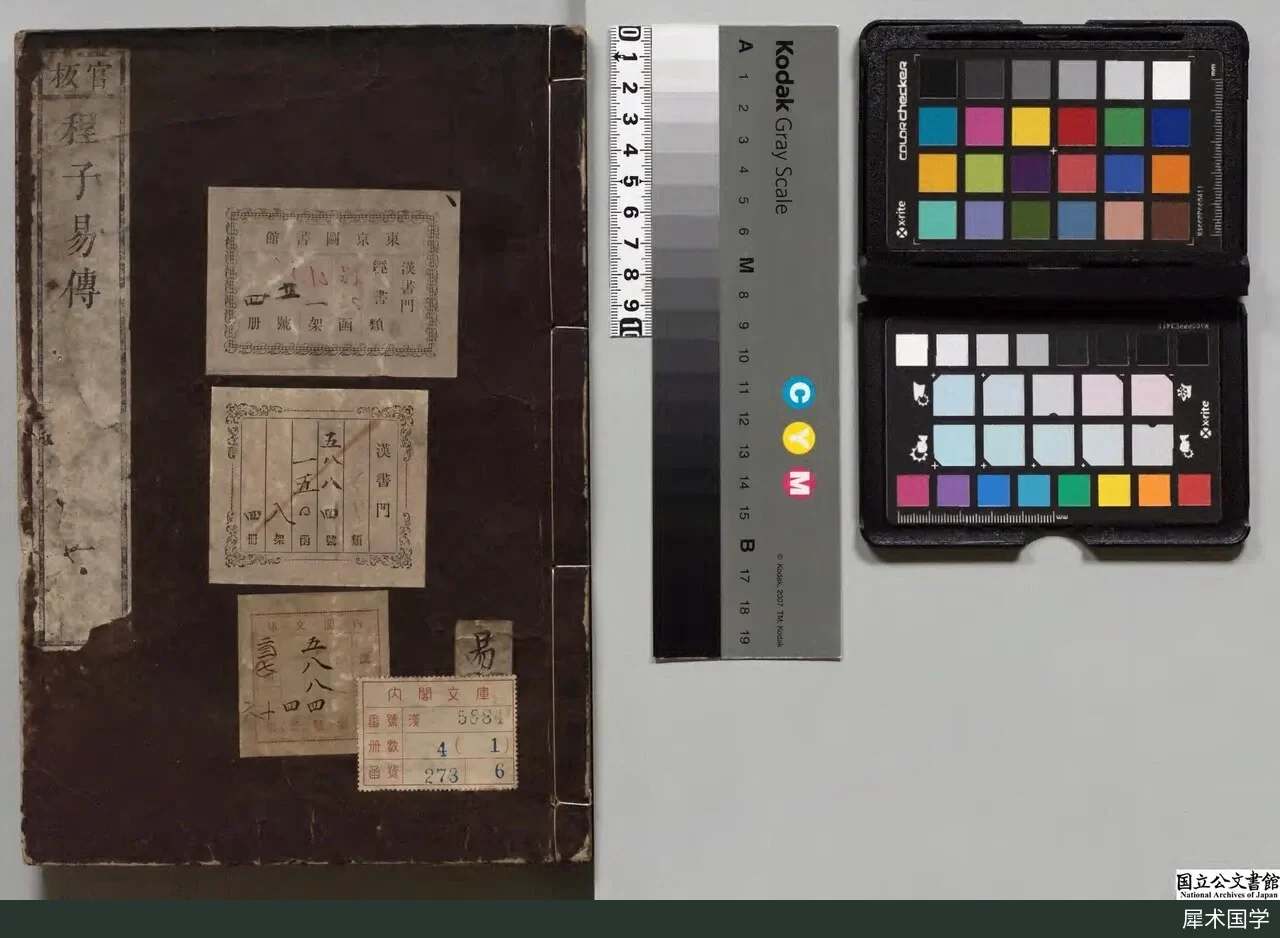
Cover of the first fascicle of Cheng Yi’s Yichuan Yizhuan, revised by Xu Bida, held by the National Archives of Japan, shelf mark 273-0006, Tenpō 13 printing, original PDF p. 1. Source: Wikimedia Commons leaf and archive back-link; marked public domain. This shows a traditional edition, not the punctuated Er Cheng ji.
1
Reading Cheng Yi’s Yi zhuan, first distinguish it from the Zhouyi classic and its wings themselves. What this article calls Cheng’s commentary is Cheng Yi’s interpretive work Zhouyi Chengshi zhuan, also called Yichuan Yizhuan; the classic text and the Tuan, Xiang, and other wings are what he interprets.
The Yi zhuan xu proposes “infer from the wording and examine the hexagram,” and says “there has never been one who failed to grasp the wording yet could penetrate its intent.” Meaning-principle exposition here has a starting point: first understand the hexagram and line statements, then from the wording examine the hexagram’s situation and change; one cannot skip the words and talk of the great Way. The preface’s “what is most subtle is principle; what is most manifest is image. Substance and function share one source; the subtle and the manifest have no gap” shows that subtle principle and manifest image communicate, and are not two unrelated domains. The quotation above follows the Siku transcription of the Yichuan Yizhuan xu[1], located by title.
The explanation of Qian initial nine especially shows this. On the classic “the submerged dragon—do not use,” Cheng Yi uses “principle has no form, hence one borrows the image to make the meaning plain” to explain why images are taken, then uses the dragon’s concealment to discuss advance, retreat, and cultivation while the sage is not yet prominent. He does not delete the dragon image; he leads it toward how a person should act in a given situation. That is this article’s summary of his method, not a claim that the classic text has only this layer of meaning. Source: Siku juan 1, Qian initial nine[1].
Therefore “sweeping away forced image-number readings” is best understood as criticism of strained allegory, not expanded into a total rejection of image-number. In the Bi hexagram notes Cheng Yi opposes explaining Bi as derived by change from Tai and offers his own account of Qian–Kun generating change; the same passage still discusses hexagram body, line change, and taking images. That is a choice among interpretive paths, not a cancellation of hexagram images themselves. Whether his own taking of images fully supports the meaning he states must still be judged case by case. Source: Siku juan 2, Bi[1].
2
Comparing Cheng Yi and Wang Bi, saying only that both belong to meaning-principle Yi learning easily hides the real divergence. A more concrete method is to read the same wing passage side by side. The Fu · Tuan zhuan says “in Return one sees the mind of Heaven and Earth,” a line of the Zhouyi wing, not a thesis posed by either commentator.
Wang Bi’s note opens with “Return means returning to the root,” and says that though Heaven and Earth have the ten thousand things and all manner of change, “utter stillness and utter emptiness are their root.” “Stillness” here is not an everyday stretch of rest opposed to motion; he deliberately says “stillness is not the counterpart of motion,” to mark the ground on which the ten thousand changes rest. The source is the electronic transcription of Zhouyi zhengyi juan 3, Fu[2], which lists Wang’s note and Kong Yingda’s subcommentary separately; further elaboration in the subcommentary must not all be counted as Wang’s own words. The discussion here concerns the classic-and-wing portions Wang annotated, not other wing chapters continued by Han Kangbo.
Cheng Yi explains the first return of one yang as Heaven and Earth’s mind that gives life to things, expressly criticizing earlier scholars who understood it only from stillness, and stressing “the tip of motion.” At initial nine, “not far, then return,” he again takes return as returning to the good, illustrating self-cultivation by correcting what is not good as soon as it is found. Linking the principle of giving life with moral practice is an important difference from Wang Bi’s reading of Fu. Source: Siku juan 2, Fu Tuan and initial nine[1].
Neither is content to explain thing-images in isolation; both aim to state the principles the hexagrams and lines express. Nor should the difference be cast as Wang Bi talking only xuanxue while Cheng Yi alone speaks ethics. Wang’s initial-nine note likewise treats self-cultivation and timely return. A safer judgment is that on the ground of the mind of Heaven and Earth and how it unfolds into human affairs, the two have different centers of gravity; this paired reading can reveal the difference but cannot replace comparing their whole books.
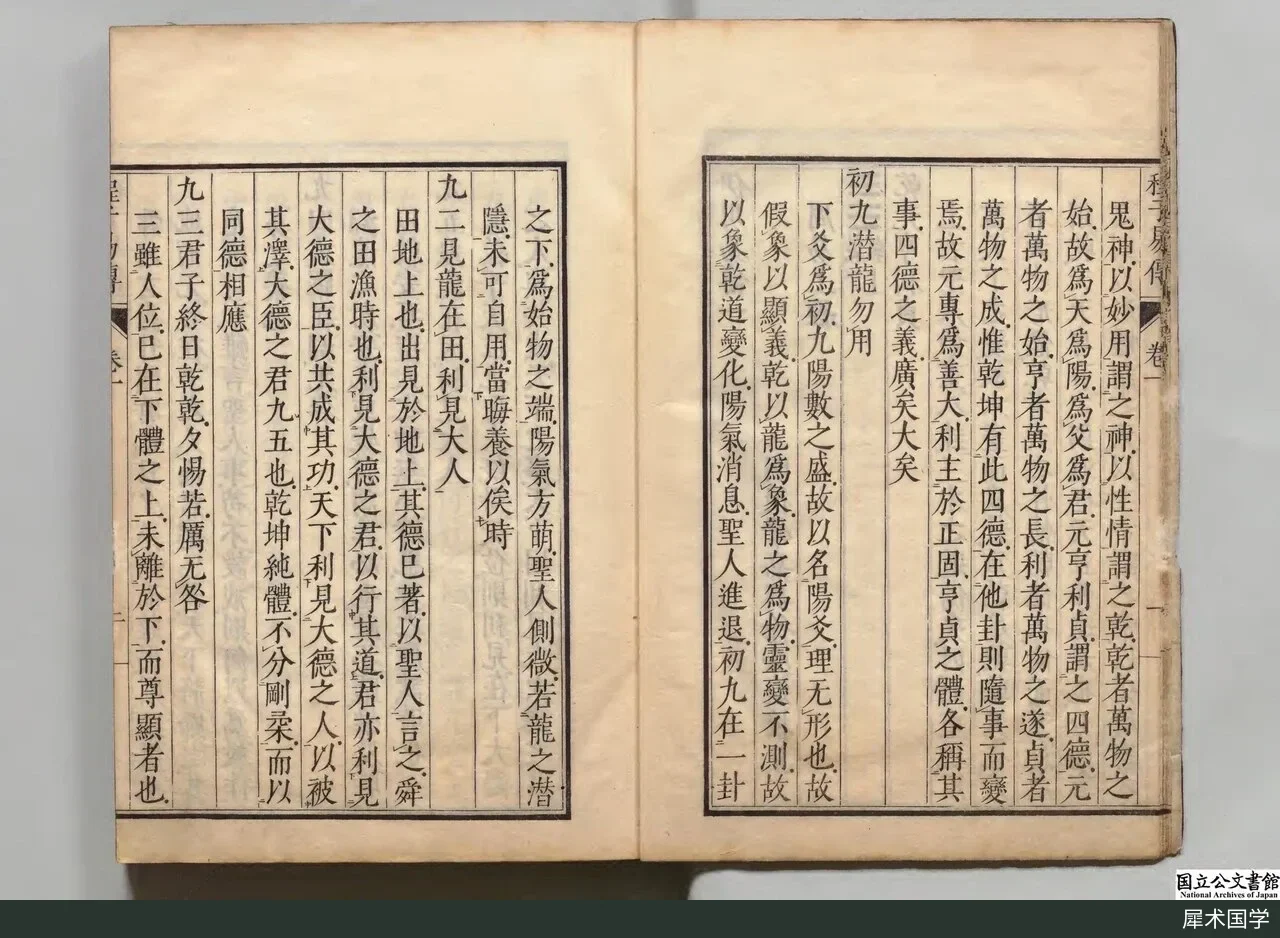
Inner page of the same collection’s first fascicle of the Yichuan Yizhuan, Qian hexagram, including the note “principle has no form, hence one borrows the image to make the meaning plain,” original PDF p. 9; leaf numbers of the original were not separately fixed from this. Cheng Yi, revised by Xu Bida, Tenpō 13 printing, National Archives of Japan, 273-0006. Source: Wikimedia Commons; public domain.
3
This section is limited to two threads visible in materials already read: Zhu Xi’s evaluation of Cheng’s commentary, and later compilations’ absorption of Cheng–Zhu readings. The related body of Yixue zhexue shi has not yet been checked; no judgment below is attributed to Zhu Bokun, nor is the whole Song–Ming transmission summarized from it.
Cheng’s commentary’s Song influence can first be seen in how Zhu Xi read it. The entries under “Chengzi Yi zhuan” in Zhuzi yulei juan 67 both esteem its precision of meaning and practical speech, and hold that those principles need not everywhere equal the classic’s original sense. Reception here is not transcription: Cheng’s commentary becomes an object of study and discussion, and also an object for further questioning the boundary between taking images and explaining the classic. The electronic transcription has clear OCR errors; this article only summarizes paragraphs already read and does not build fine points on misread graphs. Source: related entries in juan 67[3].
The Ming thread appears in Hu Guang and others’ imperially ordered Zhouyi chuanyi daquan. Qing Siku editors note in that book’s abstract that it drew on Yuan Yi works by Dong, Hu, and others, among them Dong Zhenqing, who took Cheng and Zhu as main. That at least shows Cheng Yi’s influence also continued through later compilations, Cheng–Zhu joint discourse, and classical education, and cannot be measured only by whether individual scholars directly inherited him. One layer of distance must be kept: this is Qing scholars’ retrospective account of Ming texts; the abstract’s judgments on examination culture and scholarly climate also cannot be treated without distinction as Ming people’s shared self-description. Source: Siku abstract of Zhouyi chuanyi daquan[4].
On these materials, Cheng’s commentary matters in keeping hexagram-and-line explanation continually entering discussion of self-cultivation, conduct, and the principle of Heaven and humanity; later readers both draw on it and redraw the bounds of its interpretation. Reception, criticism, and institutional transmission in Song–Ming Yi learning should be examined separately, not lined up as a disagreement-free chain of inheritance.
References
-
Cheng Yi: Yichuan Yizhuan, Siku edition, opening Yichuan Yizhuan xu, juan 1 Qian, juan 2 Bi and Fu. Actual reading was an electronic transcription made from the Yingyin Wenyuange Siku quanshu, volume 9; that photo-reprint’s concrete impression and year were not fixed in this pass; locate by title, juan, and hexagram/line, without inventing paper page numbers. Preface; juan 1 transcription; juan 2.
-
Wang Bi, commentary; Kong Yingda et al., subcommentary: Zhouyi zhengyi juan 3, Fu. Actual reading was the Wikisource electronic transcription; that page does not adequately name a modern collator, publisher, and year, so it is not identified as any one modern punctuated edition. Fu notes and subcommentary.
-
Li Jingde, ed.: Zhuzi yulei juan 67, “Chengzi Yi zhuan” entries. Actual reading was the Shidian Guji electronic transcription; the modern base edition used on that page remains to be verified; OCR errors were not used as quotations. Juan 67.
-
Hu Guang et al.: Zhouyi chuanyi daquan, Siku edition, opening abstract. This article uses only the Qing editors’ abstract text and does not treat the abstract as Hu Guang’s own words; concrete photo-reprint publication details were not verified. Full abstract.
-
Edition-check note: the designated check text Er Cheng ji (Cheng Hao and Cheng Yi, punctuated by Wang Xiaoyu, Zhonghua Book Company, 1981) has been checked in the library catalog; the related body of that edition has not yet been read, and the quotations above do not claim collation against it. Zhu Bokun’s Yixue zhexue shi, Peking University Press edition, has been checked in the catalog; middle volume, 1988, pp. 199–205 appear in Peng Yaoguang’s paper-site references—here only as a lead yet to be verified, not as a basis for summarizing Zhu Bokun’s views from unread content. First publication dates of the classical web pages above were none of them confirmed; search or scrape time is not used as a substitute.
-
Xishu Chinese Classics · When minds meet, craft appears in words
-
Information compiled and published by the Scholay academic one-stop platform; report infringement for takedown.
-
Also published on Enter Scholar, a scholars’ community for the intelligent age