When Wang Bi says “getting the meaning and forgetting the image” (deyi wangxiang), he is not urging readers to skip the classic text and talk about principle out of thin air. In Zhouyi lüeli · Mingxiang, he first explains how to observe the image through words and the meaning through the image, then criticizes interpretations that cling to fixed material images and lose the moral principle. Reading this against the fish-and-trap metaphor in the Zhuangzi and the discussions of Cheng Yi and Zhu Xi shows that the real issue is how a reader uses words and images without being bound by them.
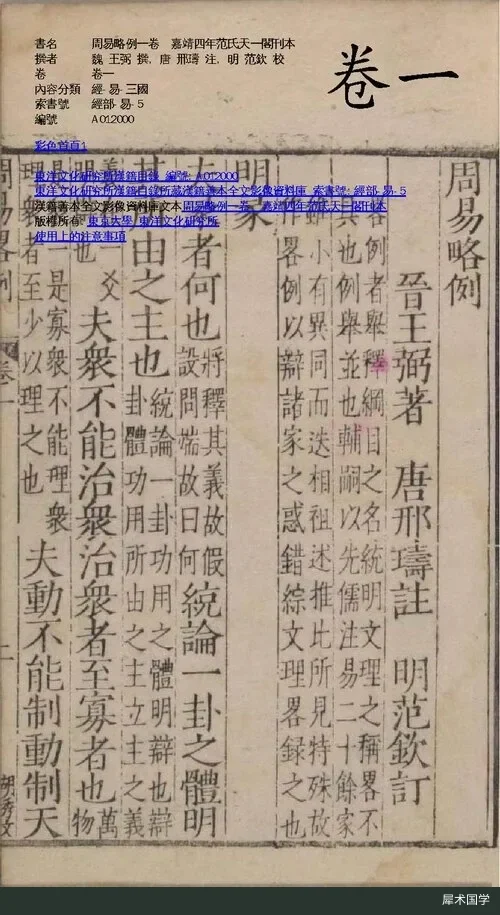
The text and notes of Mingxiang
The direct source of “getting the meaning and forgetting the image” is Wang Bi’s Zhouyi lüeli · Mingxiang, not the Zhouyi classic itself. The core passage reads: “Thus words are that by which the image is clarified; once the image is obtained, the words are forgotten. Images are that by which meaning is preserved; once the meaning is obtained, the image is forgotten.” It continues: “Obtaining the meaning lies in forgetting the image; obtaining the image lies in forgetting the words.” The quotation was checked against the electronic full text of Mingxiang; the edition leaf is from the Institute for Advanced Studies on Asia, University of Tokyo, holding of Zhouyi lüeli in one juan, by Wang Bi, with Tang notes by Xing Shu and Ming collation by Fan Qin, shelfmark A012000, juan 1 Mingxiang. Original text[2]
To read this passage, the first half must be kept with it: “Words arise from the image, so one may follow words to observe the image. Images arise from meaning, so one may follow the image to observe the meaning.” On this basis, this article takes Wang Bi not to cancel the path of interpretation but to state its purpose. Words and images guide understanding; if the forms already used are treated as the final attainment, one stops at the level of tools.
In terms of editions, Wang Bi’s main text must also be distinguished from Xing Shu’s notes. A stretch in the electronic full text that explains the word–image relation through qian, long, and the like should not all be attributed to Wang Bi without checking; this piece cites only identifiable Wang Bi main text. Unverified modern critical page numbers are not supplied.
Hero caption: University of Tokyo Institute for Advanced Studies on Asia holding of Zhouyi lüeli juan 1; the catalog lists it as “Jiajing 4 Fan-family Tianyi Ge imprint,” collated by Fan Qin with notes by Xing Shu; Commons PDF preview page 1 is used, retaining the catalog text in that preview. Source: Wikimedia Commons; license: Public Domain (PD-scan).
Criticism of fixed image-taking
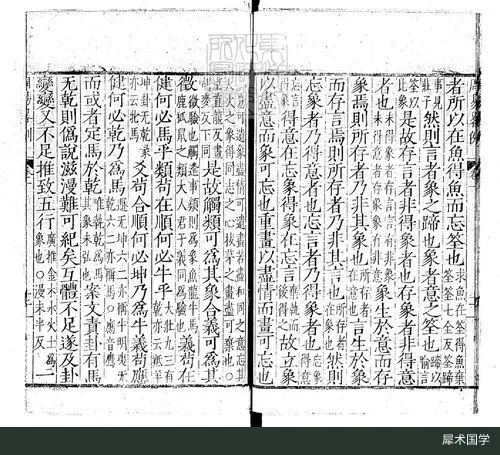
Mingxiang grounds its criticism in concrete interpretive practice: “If the meaning lies in firmness, why must it be a horse? If the category lies in compliance, why must it be an ox?” Wang Bi opposes fixing a correspondence between a given material image and a given hexagram, then forcing every stretch of the classic to fit that table. His criterion is “by touching the category one may take it as image; by matching the meaning one may take it as evidence”: whether it fits the meaning to be expressed here comes before whether the material image matches a fixed assignment. Mingxiang[2]
He continues: “When overlapping trigrams (huti) are not enough, they turn to hexagram change; when change is still not enough, they push on to the Five Phases. Once the origin is lost, ingenuity only grows worse.” This passage can serve as direct evidence for how he answered the Han image-and-number (xiangshu) tradition, but it does not list the criticized Han commentators one by one. This piece therefore does not stretch these words into a full polemic against any single person, nor claim on that basis that all Han Yi studies used one and the same method.
More precisely, what Wang Bi questions is a practice that keeps adding interpretive links without being able to clarify the classic’s meaning. He even allows that one may “sometimes hit” (huo zhi)—that is, coincide by chance—but chance coincidence cannot guarantee that the interpretation has a principled ground. Thus “forgetting the image” targets clinging to material images and letting the image stand in for meaning; it cannot be equated with abolishing every image.
Body caption: the same University of Tokyo holding, juan 1 Mingxiang, Commons PDF preview page 12, showing “those who preserve the image are not those who have obtained the meaning” and the criticism of overlapping trigrams, hexagram change, and the Five Phases, large-character main text beside double-column small notes. Shelfmark A012000; source; Public Domain (PD-scan). Preview page order is not presented as original leaf numbers.
Words, images, meaning, and the Zhuangzi metaphor
“Word—image—meaning” has two directions that are opposite yet connected. In expression, meaning is presented through the image, and the image is clarified through words; in reading, the reader begins from words and seeks the image in order to observe meaning. Thus meaning is what understanding is to reach, the image is the way it is presented, and words make the image intelligible. The “meaning” here must be understood with concrete hexagrams, lines, and arguments; it cannot simply be replaced by the reader’s own impressions. Zhouyi lüeli · Mingxiang[2]
Wang Bi uses the rabbit snare and the fish trap as comparisons: “Words are the snare of the image; the image is the trap of meaning.” This has a clear textual link to the end of Zhuangzi · Waiwu: “Words are that by which one is after meaning; once meaning is obtained, words are forgotten.” That chapter also uses getting the fish and forgetting the trap, getting the rabbit and forgetting the snare; the electronic text read here writes quan as 荃, while the Mingxiang electronic text writes 筌. The two spellings as found are kept separately; no judgment is drawn from them about which ancient text is better. Zhuangzi · Waiwu chapter 26[3]
The difference is that Wang Bi organizes the metaphor into a three-layer relation in classical interpretation: words help grasp the image, and the image helps grasp meaning; no layer may be mistaken for the next. On this reading, “forgetting” is not loss of memory but no longer clinging to a fixed expression. The condition is always that understanding has already been reached; one cannot use “forgetting words” or “forgetting the image” as a reason to skip reading the classic and discerning meaning.
What can be confirmed here is the borrowing of metaphor and wording; these lines alone cannot fill in a concrete line of teacher–disciple transmission. The Zhuangzi electronic page does not state its base text or editor; this piece locates by chapter title and does not claim to have completed collation among Guo Xiang’s notes, Cheng Xuanying’s subcommentary, and modern critical editions.
Later interpretations and divided evaluations
Cheng Yi’s preface to the Yichuan Yizhuan says: “There are those who get the wording and do not reach the meaning; there has never been one who fails to get the wording and yet can penetrate the meaning.” He also says: “What is most subtle is principle (li); what is most manifest is the image. Substance and function share one source; the subtle and the manifest have no gap.” This shows that he likewise requires reaching meaning through wording, while stressing the link between principle and image. What is quoted here is the preface at the head of the Siku quanshu edition, not Cheng Yi naming and criticizing Wang Bi; reading the two side by side is this article’s comparison of methods, not a claim that Cheng Yi directly inherited or wholly opposed “getting the meaning and forgetting the image.” Yichuan Yizhuan preface[4]
Zhu Xi’s remarks touch Wang Bi more directly. In Zhuzi yulei juan 66, “Yi II,” there is the line that “when it came to Wang Bi using Lao–Zhuang to interpret, later people took it only as principle,” then judged “also not so.” The passage criticizes both Wang Bi’s direction of interpretation and later people’s understanding of the result; it cannot be expanded into a line-by-line rebuttal of every sentence in Mingxiang. This piece only locates by that juan and does not reopen this site’s already published Zhu Xi Yi studies feature, nor treat its narrative about antiquity’s making of the Yi as proven historical fact. Zhuzi yulei juan 66[5]
Tang Yongtong’s reading places the problem further in the relation between xuanxue method and literary theory. The full transcription of Tang Yongtong’s “Wei–Jin Xuanxue and Literary Theory” on Aisixiang, under his name, clearly distinguishes the instrumental role of words and images from the content understanding is to reach: tools must not be taken as ends, yet tools cannot be casually abolished. Thus the essay stresses “getting the meaning and forgetting words” while also noting that “words and images cannot be discarded,” and uses this line of thought to explain Wei–Jin and Southern–Northern Dynasties literary theory. What appears here is Tang Yongtong’s interpretation of Wang Bi’s thought and its influence, not Wang Bi’s own statement about later literature, and one cannot conclude from it that every related literary theory came directly from Wang Bi. Full transcription of Tang Yongtong, “Wei–Jin Xuanxue and Literary Theory”
Sources and limits for this section: the transcription page marks the original as Zhongguo zhexueshi yanjiu 1980 no. 1; the page update time is 18 August 2023; that update time is not the original publication date. What was read this time is a web transcription, not yet collated against the journal leaf; original page numbers, editorial notes, and the essay’s place in various editions of Wei–Jin xuanxue lungao remain unverified. The Commercial Press official catalog separately confirms Wei–Jin xuanxue lungao, first edition June 2020, with a table of contents including “The Debate on Words and Meaning” and “Wang Bi’s New Meanings of the Zhouyi and Lunyu”; this piece does not present the transcription as quotations from those two essays, nor apply that edition’s page numbers. Publisher catalog[6]
References
-
Wang Bi, with notes by Xing Shu and collation by Fan Qin: Zhouyi lüeli in one juan, juan 1 Mingxiang. University of Tokyo Institute for Advanced Studies on Asia, shelfmark A012000, Classics · Yi 5; Commons catalog lists “Jiajing 4 Fan-family Tianyi Ge imprint.” This article’s leaves use PDF preview pages 1 and 12; page order is not original leaf numbers; publication data follow the catalog and no exact date is further calculated. Catalog, images, and license note. Public Domain (PD-scan).
-
Wang Bi: Zhouyi lüeli · Mingxiang, Wikisource electronic text. Used to check passages on words, images, meaning, and overlapping trigrams, hexagram change, and the Five Phases; notes must be distinguished from main text. The page does not state modern editor, publisher, or base-text year, so unverified modern page numbers are not listed. Full text.
-
Zhuangzi · Waiwu chapter 26, Wikisource electronic text, end passage on fish trap, rabbit snare, and getting meaning while forgetting words. The page does not state base text, editor, publisher, or year; this piece locates by chapter and is not used as evidence from Guo Xiang’s notes or Cheng Xuanying’s subcommentary. Full text.
-
Cheng Yi: Yichuan Yizhuan, Siku quanshu edition, head preface Yichuan Yizhuan xu, from Wikisource electronic text. The preface is dated Yuanfu 2; that is the preface’s own year, not the electronic edition’s publication date. Modern transcription editor and facsimile publication data are unclear. Preface.
-
Zhu Xi’s words, compiled by Li Jingde: Zhuzi yulei, juan 66 “Yi II,” from Wikisource electronic text, citing the entry that begins with “when it came to Wang Bi using Lao–Zhuang to interpret.” The page does not state a modern critical edition, so location is by juan and entry opening only; other editions’ page numbers are not applied. Juan 66.
-
Commercial Press: official catalog for Wei–Jin xuanxue lungao, listed as first edition June 2020, 585 pages, ISBN 978-7-100-18091-7. Used only to verify edition and contents; not used as evidence for Tang Yongtong’s evaluative wording; the page’s own release date is unclear. Publisher catalog.
-
Information compiled and published by the Scholay academic one-stop platform; report infringement for takedown.
-
Also published on Enter Scholar, a scholars’ community for the intelligent age