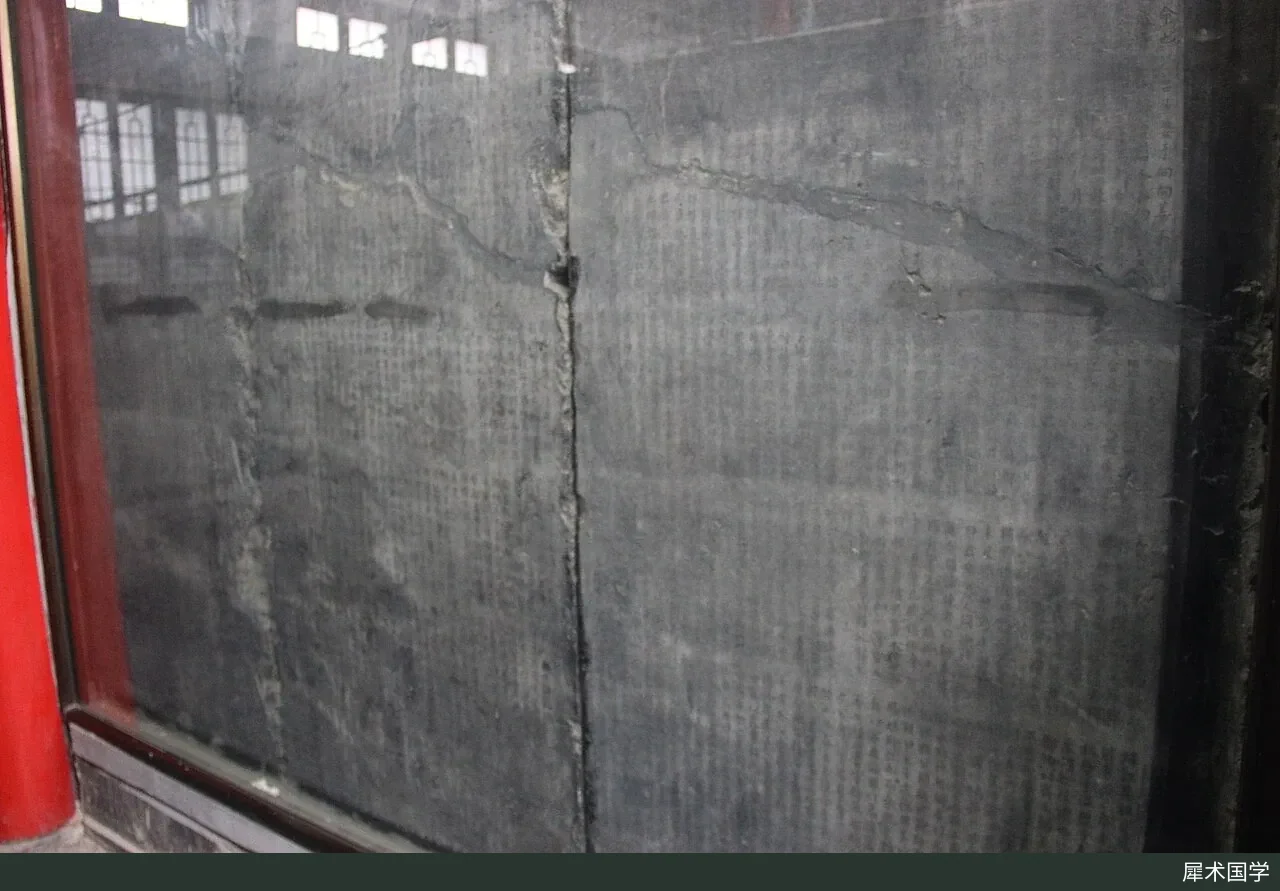
Stele display in the Xi’an Beilin Museum. Photo: Gary Todd; source: Wikimedia Commons; license: CC0 1.0.

The Kaicheng Stone Classics are the Confucian classics collated by court order under Tang Emperor Wenzong and carved on stone steles. Carving began in the twelfth month of Taihe 7 and was finished in Kaicheng 2 (837). They comprise twelve classics including the Zhouyi, Shangshu, and Shijing, plus Wujing wenzi and Jiujing ziyang, on 114 stones and 228 faces. As the Tang official fixed text of the classics, they preserve an early standardized form of the transmitted corpus; the original stones are now in the Xi’an Beilin Museum.
Date of carving, physical form, and the twelve classics
The Xi’an Beilin Museum’s 2014 piece “End of the Ancient Text, Ancestor of the Present Text” (by Chen Genyuan and Bai Ning) records that carving of the Kaicheng Stone Classics began in the twelfth month of Taihe 7 under Emperor Wenzong—equated by the museum with 834 CE—and was completed in Kaicheng 2 (837); the stones take their name from the era name at completion. The museum’s chronology calls them another large-scale stone classical corpus after the Eastern Han Xiping Stone Classics and the Cao-Wei Zhengshi Stone Classics. The full set has 114 steles, carved on both sides for 228 faces, about 650,000 characters of classical text; according to a 2024 Confucius Research Institute holdings note, the originals are displayed in Exhibition Hall 1 of the Xi’an Beilin Museum.
The classics carved, in order, are twelve: Zhouyi, Shangshu, Shijing, Zhouli, Yili, Liji, Chunqiu Zuozhuan, Chunqiu Gongyang zhuan, Chunqiu Guliang zhuan, Xiaojing, Lunyu, and Erya. Besides the classical texts, two character books that standardize graphs in the classics—Wujing wenzi and Jiujing ziyang—are carved after the Chunqiu Zuozhuan. Carving text and character books together shows that the project fixed both the wording of the classics and their graph forms.
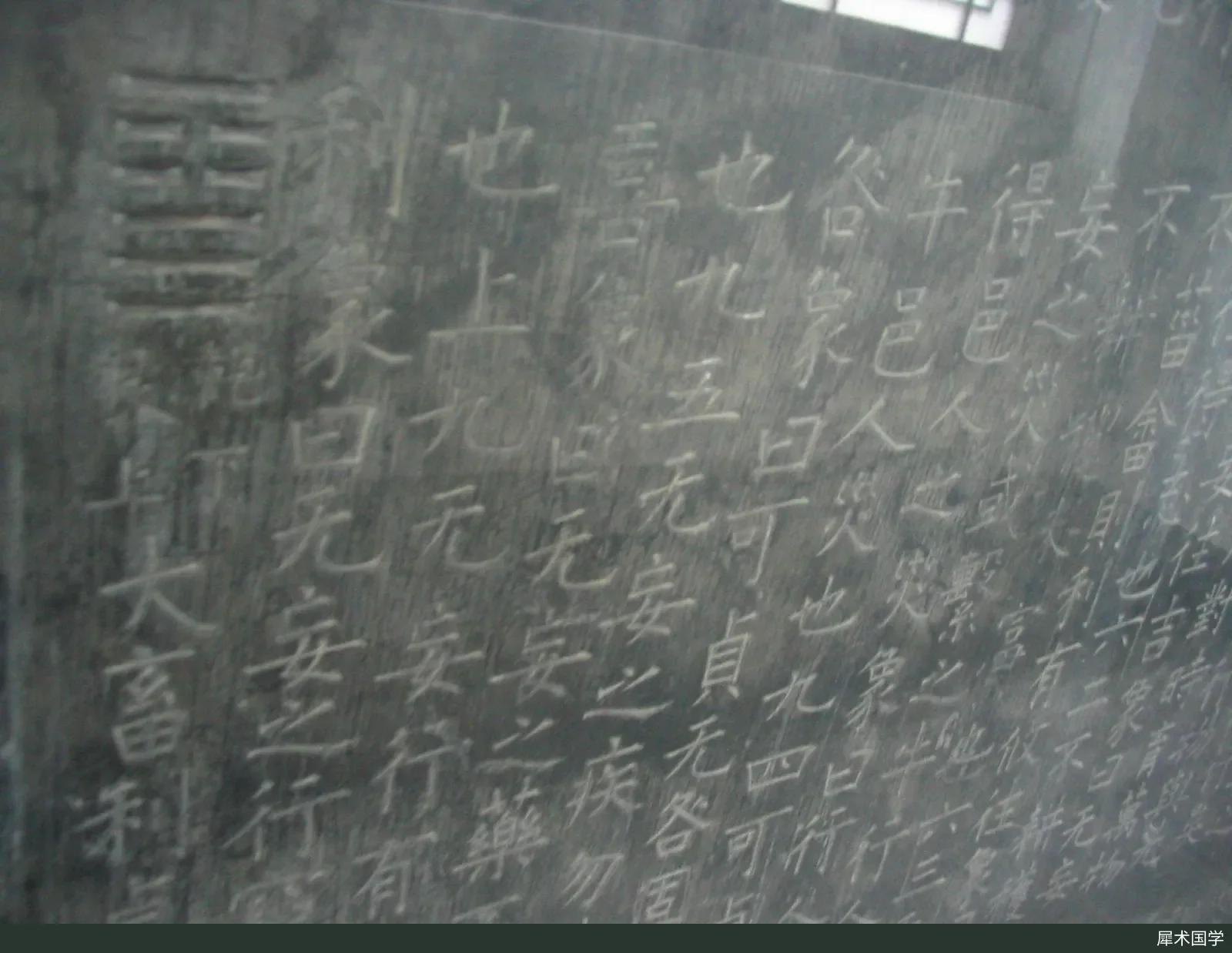
Detail of the Tang Stone Classics Zhouyi in the Xi’an Beilin, from the end of hexagram Wuwang through the opening of Daxu. Photo: Felix Andrews (Floybix); source: Wikimedia Commons; license: CC BY-SA 3.0.

In terms of the classical canon, the Kaicheng Stone Classics mark a stage in the evolving Confucian corpus. The Confucius Research Institute note traces that process: before the Tang one spoke of the “Five Classics” or “Seven Classics”; under the Tang civil examination in the classics a “Nine Classics” system took shape; the Kaicheng stones added Lunyu, Xiaojing, and Erya beyond the Nine Classics—still called “Nine Classics” in name, but already twelve in substance, and the first joint carving of these twelve. At that time the Mengzi was not yet among the classics; the Mengzi now seen in the Beilin is a Qing supplement, which together with the Tang carving is called the “Thirteen Classics.”
Establishing the text and value for collation
The immediate aim of the Kaicheng Stone Classics was a fixed text. The Confucius Research Institute, summarizing the sources, notes that before carving, Confucian classics were full of copyists’ errors, and doctors of the classics merely inherited one another’s mistakes and could hardly correct them. Emperor Wenzong accepted the proposal of Hanlin Expositor Zheng Tan, following the Eastern Han precedent of carving the Xiping Stone Classics, gathered senior Confucians to collate the classics, fix wording and script style, and “establish the Nine Classics on stone walls, together with the Xiaojing, Lunyu, and Erya, totaling 159 juan, and forty juan of character models,” as the official textbook text carved at the Imperial Academy for students to correct and supply omissions. In a manuscript age, a classic could vary with the copyist; carving a collated text on stone raised a standard that anyone could check and rub. As rubbings spread, the official text spread with them.
The Qing scholar Yan Kejun praised the Kaicheng Stone Classics as “end of the ancient text, ancestor of the present text”—the title of the Beilin Museum’s 2014 publication report. As this author understands them, those eight characters have two layers: the Kaicheng stones gathered the classical text as it had circulated in manuscript and fixed it officially, closing the manuscript era of the classics; later printed classical texts largely followed this official text, so it became a source to which the transmitted editions can be traced. For that reason, when collating today’s classical texts, the Stone Classics edition is often used as a witness earlier than Song imprints.
The Shangshu best shows this bridging role. The Confucius Research Institute note points out that the Kaicheng Shangshu is the Ancient-Script Shangshu presented by Mei Ze of the Eastern Jin and ascribed to Kong Anguo’s commentary. With subcommentaries by Liu Xuan and others and Lu Deming’s Shiwen, that line gradually overtook the Zheng Xuan commentary current since the Eastern Han; when Yan Shigu collated the Five Classics at the start of the Tang he took the Kong commentary as base, and Kong Yingda and others, ordered to compile the Shangshu zhengyi, also took it as the standard—so the Kong commentary became the official school classic and was carved on the Stone Classics. The note holds that later editions of the Shangshu in effect take the Kaicheng Stone Classics as base: the stone text both inherited earlier versions and opened later printings. For the complete classical text, the Stone Classics Shangshu is among the earliest fixed stone texts available today.
When using the Kaicheng Stone Classics to collate, first distinguish which graphs are original Tang carving. The steles now in the Beilin are not wholly as in Kaicheng: the great Guanzhong earthquake of Jiajing 34 of the Ming toppled 40 of them, and the 1938 restoration corrected and rejoined broken places; the Qing-supplemented Mengzi is a new carving assembled from Stone Classics graph models and is not Tang official classical text. When citing Stone Classics variants, note the date of the rubbing used and which stele, lest later joins or assembled graphs be taken for Tang carving.
From Wuben Ward to the Xi’an Beilin
The Kaicheng Stone Classics originally stood in the Imperial Academy in Wuben Ward of Tang Chang’an. According to the Beilin Museum chronology, in Tianyou 1 of the Tang (904), when Zhu Wen forced Emperor Zhaozong to move the capital to Luoyang, Han Jian, garrisoning Chang’an, shrank the city for defense, taking the former imperial city as the new city; Wuben Ward was left outside, and the Stone Classics were abandoned in the suburbs. The Song Jingzhao fu xin yi shijing ji bei recounts that under the Later Liang, Liu Xun, holding Chang’an, was urged by his aide Yin Yuyu to move the stones into the city lest enemy troops smash them for arrowheads when they approached the walls; the stones were then moved to the western corner of the Tang Department of State Affairs. The chronology dates this move to Kaiping 3 (909).
In Yuanyou 2 of the Northern Song (1087), Transport Commissioner Lü Dazhong moved the Kaicheng Stone Classics, the Shitai Xiaojing, and other steles to “the north wall of the prefectural school”—today’s Xi’an Beilin site. The Beilin Museum chronology takes this move as founding the Beilin, which may thus be dated to that year; the Jingzhao fu xin yi shijing ji bei composed by Li Chi and erected in Yuanyou 5 (1090) records the event. Later repairs followed; the worst damage was the Guanzhong earthquake of Jiajing 34 of the Ming (1556 in the chronology), which toppled 40 of the 114 stones.
In Kangxi 3 of the Qing (1664), under Shaanxi Governor Jia Hanfu and Xu Jiye and others, graphs taken from the Kaicheng Stone Classics were assembled to carve the seven chapters of the Mengzi—17 stones, 36,500 characters—and joined to the Stone Classics as the “Thirteen Classics.” In the 1938 Beilin restoration, Zhang Musheng of Yao County corrected and rejoined earthquake breaks, also amending 31 stones with misaligned columns and 48 with lacunae, removed the stele crowns, and reinforced the whole with reinforced concrete. In 2014 the Xi’an Beilin Museum, Shaanxi Cultural Heritage Imitation Co., and Cultural Relics Press planned a large collectible Kaicheng Stone Classics, listed as a “National Ancient Book Collation and Publication Subsidy Project,” compiled and collated by Beilin specialists from fine Republican rubbings in the museum’s holdings and photolithographed on handmade Xuan paper from Jing County, Anhui; according to the Confucius Research Institute, this deluxe edition incorporates the Kangxi-supplemented Mengzi—18 cases, 117 fascicles—and the Institute received a gift set in 2015.
References
-
Chen Genyuan and Bai Ning. “End of the Ancient Text, Ancestor of the Present Text—Grand Publication of the Tang Kaicheng Stone Classics”. Xi’an Beilin Museum website, 2014-06-13.
-
Xi’an Beilin Museum. “Chronology”. Xi’an Beilin Museum website, page undated.
-
Cui Weifang. “Holdings Recommendation | Kaicheng Stone Classics”. Confucius Research Institute website, 2024-12-31.
-
Xishu Chinese Classics · When minds meet, craft appears in the writing
-
Information compiled and published by Scholay all-in-one academic platform. Please report for takedown if this infringes your rights.
-
Also published on Enter Scholar, a scholars’ community for the intelligent age.