Project overview
Mirador is an open-source web viewer for IIIF, with more than one window. It can put page images from different repositories in one workspace, and after zooming, panning, or rotating them they can be looked at side by side. That suits comparing the layout, character forms, and leaves of different editions of an old book. The project site has a demo: https://projectmirador.org/demo/.
An IIIF manifest describes a digital object and its canvases, images, and metadata. In a Mirador instance that supports it, load the manifest a collection provides, open several windows, and browse by book, gallery, or scroll. Item-level and canvas-level metadata, and a table of contents, help locate a leaf. The workspace can be arranged on a grid or freely, and its state can be imported and exported so a comparison can be continued. The site lists support for IIIF Image and Presentation v2 and v3, and for Authentication, Search, and Collection. The Presentation v3 path also supports audio and video. Existing OpenAnnotation and W3C Web Annotation can be viewed. Creating an annotation needs a plugin.
Someone integrating it can install with npm install mirador or yarn add mirador. A simple page can load the UMD file named in the official README and start it with Mirador.viewer({ id: 'mirador' }). The README also has embedding notes and an example of plugin integration, and it warns that in production a CDN latest can move across major versions. Heavy customization and plugins need front-end development. Using a collection’s images also needs an IIIF endpoint that can be reached.
The project is under the Apache-2.0 license. The copyright notice is Copyright 2023 The Board of Trustees of the Leland Stanford Junior University. A software license is not a license to redistribute the collection’s images. Use of the images still has to follow the providing institution’s terms. The v4.3.0 release notes require MUI 9. A host fixed on MUI 7 or 8 can move to MUI 9, or stay on Mirador 4.2.6 for now. An embed that does not pin MUI itself is usually not affected directly, but plugin dependencies still have to match.
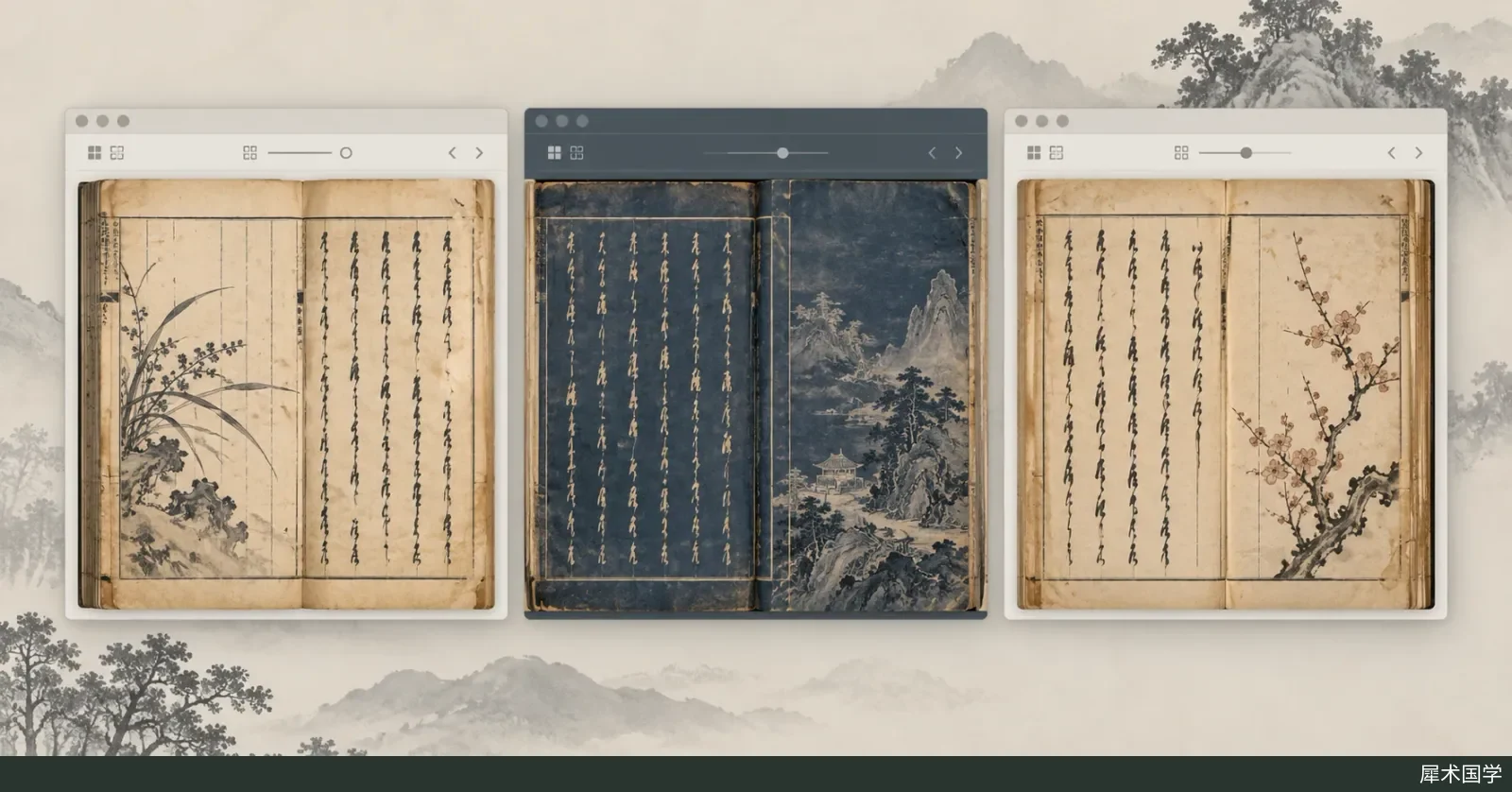
AI-generated schematic: rare-book page images viewed side by side in several windows. The picture is not a real collection and not the software interface.
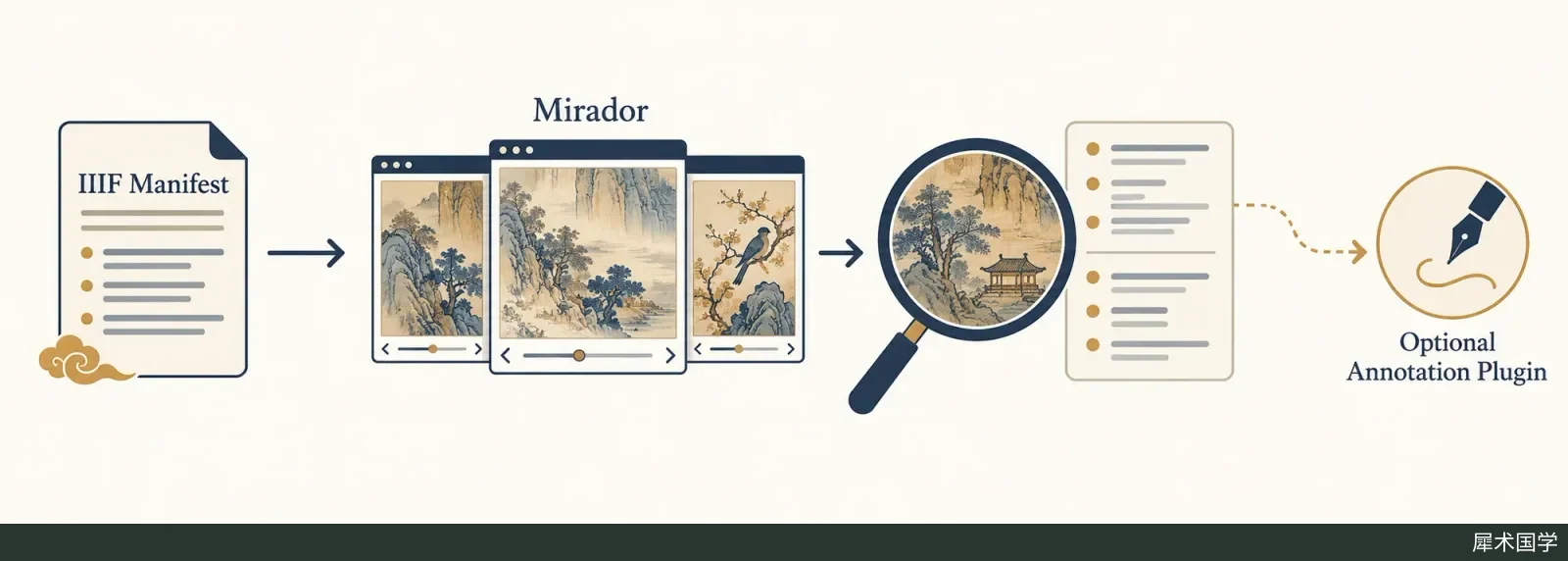
AI-generated schematic: the path from an IIIF manifest to multi-window viewing, metadata, and an optional annotation plugin. The picture is not the software interface.
Practical value
For reading old books, several windows side by side can put different printed leaves of the same passage together, so line layout, taboo characters, variant text, and details of the block can be seen. Metadata and a table of contents help keep the collection and the leaf located. Mirador’s job is viewing and comparing. It does not replace full-text search, and it is not a downloader. A citation should still record the title, the juan, the edition, and the collection. Use of the images follows that collection’s license.
References
- Xisi Guoxue.
- Compiled and published by Scholay. For a takedown request, send feedback.
- Also published at Enter Scholar.