When reading old books you often need three things at once for a character: how it looks in oracle bone, bronze, and bamboo-and-silk scripts; how it was read in pre-Qin and Middle Chinese; and on which page tools such as the Shuowen and Kangxi Dictionary discuss it. Taiwan’s “Xiaoxue Tang Philology Database” joins these three kinds of material at one query entry: enter a head character and you can get forms, readings, and index jumps into various dictionaries[1]. This article actually looked up “道” once to show what it can find and how to read the results.
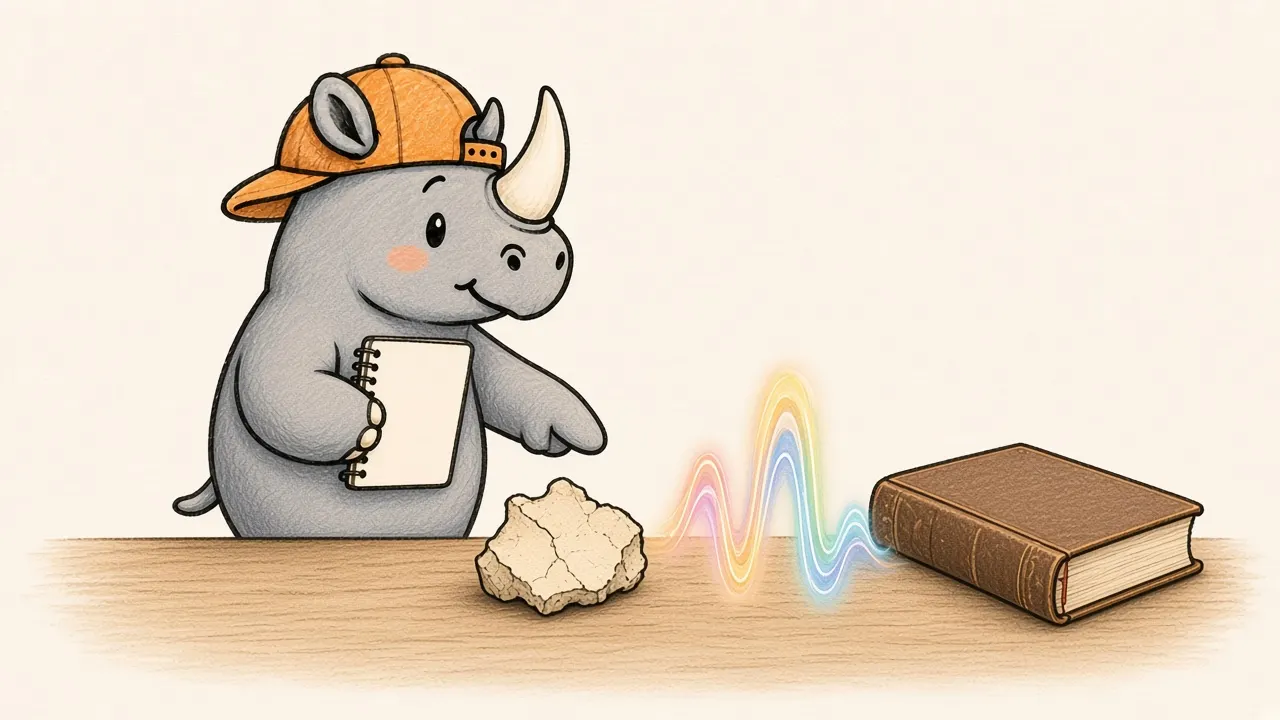
Figure: Scholay original hand-drawn schematic (AI-assisted). For one character you can see ancient forms, pronunciation, and dictionaries together. The character itself is not written on the desk.
Who built it and how much it holds
Xiaoxue Tang was jointly developed by National Taiwan University’s Department of Chinese Literature and Academia Sinica’s Institute of History and Philology, Institute of Information Science, and Digital Culture Center; NTU integrates phonological data, Academia Sinica integrates glyph data and builds the search system, and Academia Sinica’s Digital Culture Center now maintains it[1].
As of the day of query, the holdings page showed: 261,117 glyphs, 1,349,723 reading records, and 366,530 dictionary-index records[2]. Glyphs cover oracle bone, bronze, Warring States script, small seal, and regular script; readings cover Old Chinese, Middle Chinese, early modern, and modern stages[1].
The database mainly has two parts[1]:
| Sub-database | Contents |
|---|---|
| Chinese character forms across ages | Oracle bone, bronze, Warring States script, small seal |
| Chinese character readings across ages | Old Chinese, Middle Chinese, early modern, modern (regional dialects) |
The two parts can link to each other or be used alone. After finding a head character you can also jump to external databases, including Taiwan’s Ministry of Education Dictionary of Chinese Character Variants, the International Computerized Chinese Character and Variant Knowledge Base, and the Chinese University of Hong Kong’s Multi-function Chinese Character Database[1].
Example 1: glyph evolution of “道”
In the glyph field of the “Glyph evolution” sub-database, enter “道”; the results page lists 25 forms, each with source and period[3]. Roughly in time order:
- Western Zhou bronze: Hezi you (early Western Zhou), San shi pan (late Western Zhou);
- Spring and Autumn / Warring States: Houma excavated texts, Zhongshan King ding, Guodian Chu Laozi A, Cheng zhi wen zhi, Yu cong II, Zun de yi, Qin Chu Chu wen;
- Shuowen ancient script and small seal;
- Qin–Han clerical: Shuihudi Qin slips, Wushi’er bingfang, Dingxian bamboo slips, Zhanguo zonghengjia shu, Liqi stele, Eastern Han stone-classic Shangshu fragments, Han Ren ming.
Under the forms the page quotes the Shuowen: “道,所行道也。从辵,从𩠐。一达谓之道。” It also cites Gui Fu’s Shuowen jiezi yizheng “𡬹即导” and a note from the Hanyu da zidian[3].
Most useful is the “Related indexes” column. It lists where “道” sits in more than twenty reference works—for example Zhonghua Book Company’s Shuowen jiezi at juan 2 lower, radical 辵, page 42; Zhonghua’s Jinwen bian page 105 line 4; Hubei Education Press Chu xi jianbo wenzi bian (revised) pages 166, 169, 170[3]. If you have the paper tools at hand, you can turn straight to those pages to check.
As of the query day this sub-database held 13,779 head characters and 44,282 glyphs[3].
Example 2: readings of “道” across ages
In the “Old Chinese” sub-database, enter “道”; results fall in three blocks[4]:
| Layer | Result |
|---|---|
| Middle Chinese | Guangyun Xiao she, rising tone Hao rhyme, Ding initial, open first grade, fully voiced; fanqie upper “徒,” lower “晧” |
| Modern Mandarin | Zhuyin ㄉㄠˋ, pinyin dào |
| Old Chinese | Wang Li, Dong Tonghe, Zhou Fagao, and Li Fanggui all place it in the You rhyme group; Western and Eastern Han systems also in You |
The Old Chinese column places side by side initial and final reconstructions by Karlgren, Wang Li, Dong Tonghe, Zhou Fagao, and Li Fanggui; notations differ—e.g. Wang Li’s system has initial d and final u, Li Fanggui’s initial d and final əgwx[4]. Parallel display lets readers see reconstruction disagreements; when citing, name which school you follow.
The across-ages readings database is framed on the Middle Chinese rhyme positions of the Guangyun’s twenty-odd thousand characters, then adds phonetic data for Old Chinese, Middle Chinese, early modern, and modern stages; early modern includes Yuan Zhongyuan yinyun and Ming Hongwu zhengyun, modern the representative dialect points of major dialect regions[5].
Downloadable materials and licensing
Xiaoxue Tang offers several kinds of downloads[6]:

Figure: Scholay original hand-drawn schematic (AI-assisted). Some materials in the database can be downloaded and taken away. Filenames are not written on the image.
- Xiaoxue Tang phonological data: packaged by pre-Qin, Han, Northern and Southern Dynasties, and Sui–Tang school reconstructions, Middle Chinese rhyme books, early modern rhyme books, and dialect regions. These files are treated as factual records and released under a Public Domain Mark (PDM); no separate license application is needed for use[5].
- Chongxi seal font: a small-seal typeface covering the Shuowen jiezi and Taiwan Ministry of Education common-character lists, 11,596 characters[10]. Forms follow the Da Xu Shuowen; characters not in the Shuowen are transcribed with Shuowen small-seal components; the font may be used free of charge, but wholesale modification is forbidden[7].
For glyph images and glyph-attribute information from the query interface, Xiaoxue Tang waives copyright under CC0 1.0; users may reuse them[8]. The across-ages readings database as a whole remains protected as an edited database; only the separately downloaded phonological data files take the Public Domain Mark[5].
A few usage notes
- The interface is traditional Chinese; beside the query box you can check “automatic simplified–traditional conversion”[10].
- Sub-databases have different entries: for glyph evolution alone, enter “Glyph evolution”; to combine radical, stroke, component, or reading conditions, use advanced search in “Chinese character forms across ages”[9].
- “Related indexes” on result pages give only dictionary page numbers, not the dictionary text itself; check the original with paper books or other databases.
References
- Xiaoxue Tang Philology Database introduction, Academia Sinica
- Xiaoxue Tang holdings status
- Xiaoxue Tang glyph evolution
- Xiaoxue Tang Old Chinese
- Download Xiaoxue Tang phonological data and licensing
- Xiaoxue Tang download page
- Chongxi seal font introduction
- Xiaoxue Tang copyright notice
- Xiaoxue Tang beginner guide
- Xiaoxue Tang Philology Database home