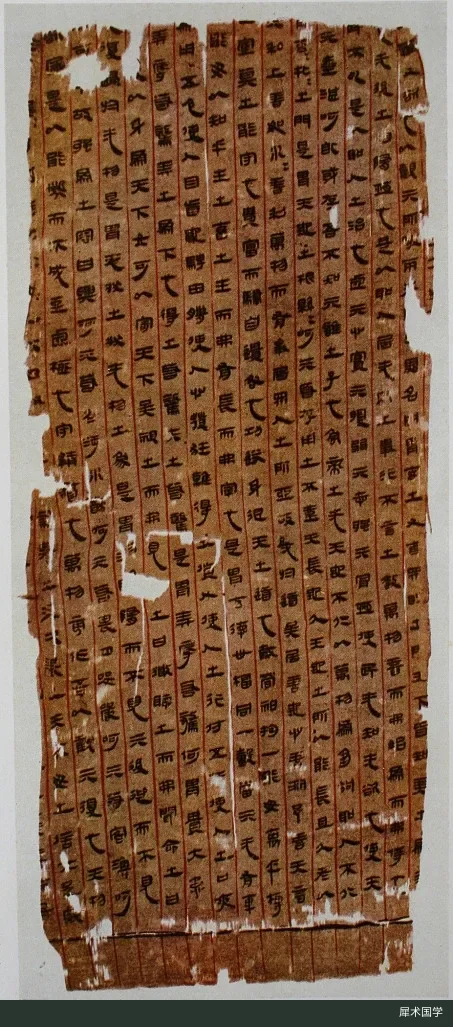
Figure: Detail of a silk manuscript from Mawangdui Tomb 3. This piece is a Daoist text (Commons lists it as a Laozi manuscript), not the Zhouyi; it shows the format and script of the same find. Hunan Museum; plate from Mawangdui Han mu boshu (1), Cultural Relics Press, 1980. Source: Wikimedia Commons, public domain.
The silk Zhouyi from Changsha Mawangdui Tomb 3, excavated in 1973, was copied no later than 168 BCE. Its sixty-four hexagrams are arranged in eight “palaces,” opening with Jian (Qian) and closing with Yi, unlike the Wang Bi order that begins with Qian–Kun and ends with Weiji; more than thirty hexagram names also differ in writing. The same find includes Yi commentary chapters absent from the received corpus—Er san zi wen, Yi zhi yi, Yao, and others. This article follows the collation volumes in summarizing these differences and usable editions.
Excavation, dating, and collation history
Mawangdui Tomb 3 was excavated in 1973. All silk books from the tomb came from a rectangular lacquer box numbered 57 in the eastern side compartment; the box measures 59.8 × 37 × 21.2 cm, divided into five compartments, with most silk folded into the larger middle one. A wooden tablet in the same tomb records “twelfth year, second month, yisi new moon, wuchen,” and, with lacquerware inscribed “household of the Marquis of Dai,” scholars date the burial to year 12 of Emperor Wen’s former era (168 BCE). That year is only the terminus ante quem for copying. From taboo characters and dates across the corpus, the Hunan Museum infers that Mawangdui silk books as a whole were copied roughly between about 221 and 168 BCE; materials seen for this article give no separate copy date for the Zhouyi classic and commentary alone.
Collation began with the Mawangdui Han Tomb Silk Book Collation Group formed in 1974. In the 1980s Cultural Relics Press issued volumes (1), (3), and (4) of the planned six-volume Mawangdui Han mu boshu; the other three never appeared, and the Zhouyi was not among those published. The Sixty-Four Hexagrams transcription later appeared in Wenwu 1984 no. 3; transcriptions of the Yi commentary chapters were scattered through Daojia wenhua yanjiu and other outlets in the 1990s. Only with Zhonghua Book Company’s 2014 Changsha Mawangdui Han mu jianbo jicheng, edited by Qiu Xigui, were Mawangdui bamboo and silk plates first published complete and together; per Zhonghua dushu bao, that collation newly joined or rejoined more than 100 fragments of the Zhouyi classic and commentary.
Eight-palace hexagram order versus the received order
The received text, as in Wang Bi’s annotated edition, divides the sixty-four hexagrams into an upper classic of thirty and a lower of thirty-four, opens with Qian and Kun, closes with Jiji and Weiji, pairs adjacent hexagrams mostly by inversion or opposition, and uses the Xugua zhuan to string them into one moral-principle line. The silk Zhouyi is copied on a single sheet, so sequence can be read directly—yet it is another system: it begins with Jian (Qian), continues with Fu (Pi), and ends with Yi.
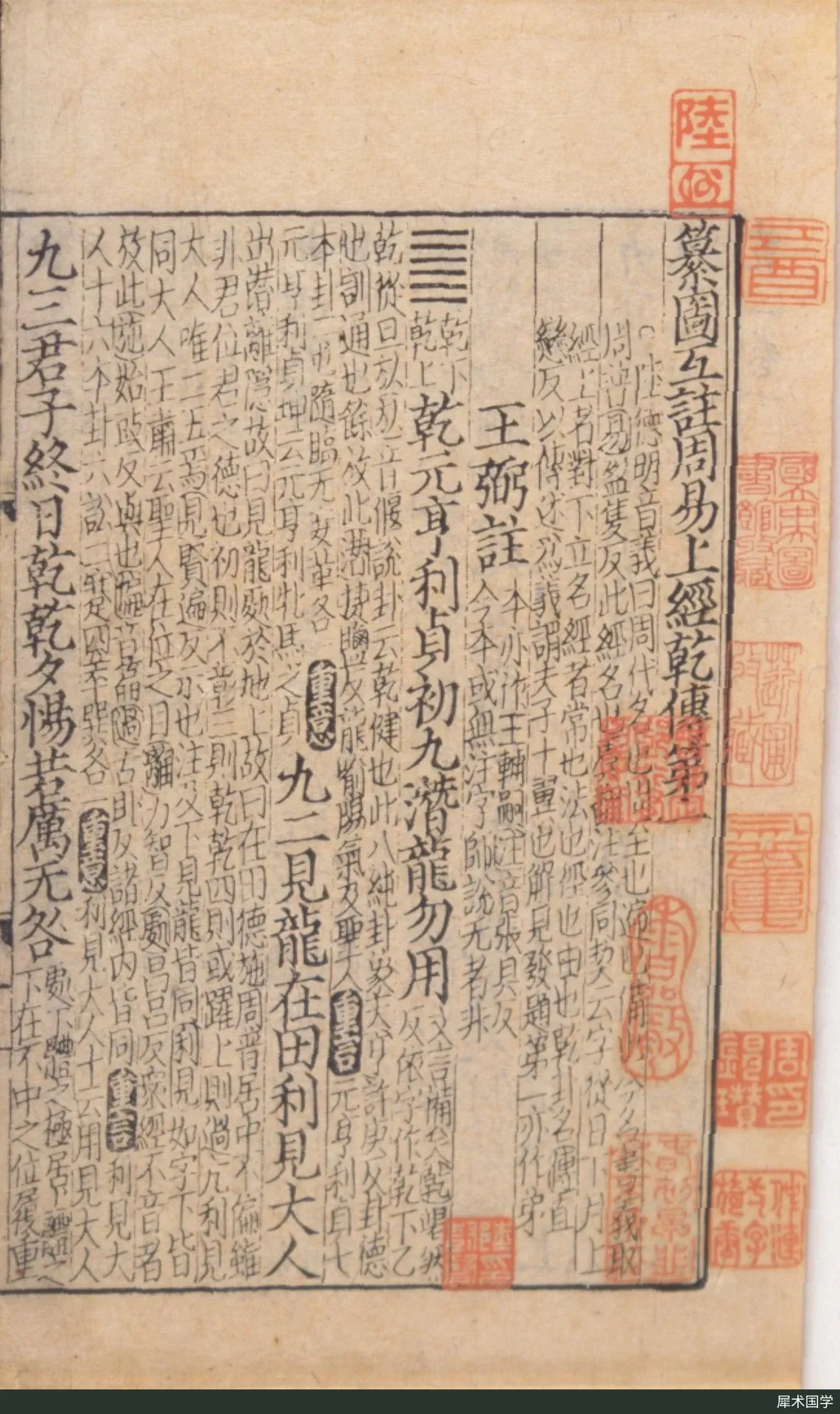
Figure: Song woodblock leaf of the Zhouyi, 17.7 × 11.9 cm, National Central Library, Taipei—representative of the received imprint tradition scholars used before the silk find; Commons does not name the exact edition or commentator. Source: Wikimedia Commons (originally Taiwan Digital Archives), public domain (PD-Art).
Following Li Shangxin’s summary, the silk order can be seen in three steps. First, the eight trigrams serve as eight palaces, in the palace order Jian, Gen, Gan, Chen, Chuan, Duo, Luo, Suan—that is, Qian, Gen, Kan, Zhen, Kun, Dui, Li, Xun. Second, in each palace the upper trigram of all eight hexagrams is that palace’s trigram. Third, the lower trigram cycles through Jian, Chuan, Gen, Duo, Gan, Luo, Chen, Suan (Qian, Kun, Gen, Dui, Kan, Li, Zhen, Xun), except that the pure hexagram with identical upper and lower is moved to first place in its palace. Thus the Jian palace runs Jian, Fu (Pi), Yuan (Dun), Li (Lü), Song, Tongren, Wumeng (Wuwang), Gou (Gou); the final Suan palace opens with Suan (Xun) and closes with Yi.
Li Xueqin summarizes the logic as resting on two bases, “yin–yang theory” and “doubled-trigram theory”: the first four palaces of the upper-trigram order are yang trigrams and the last four yin, while the lower-trigram order alternates yin and yang (cited from Li Shangxin). Note that scholarship habitually calls this structure “eight palaces,” but it is not the same arrangement as Han Jing Fang’s eight-palace hexagrams derived by line change; the two should not be conflated. Whether the silk order or the received order is earlier, and whether the silk order is only one transmission or one copyist’s arrangement, remains debated. Liao Mingchun notes that the same tomb’s silk Er san zi wen, when citing the Changes, follows the received hexagram order instead—so classic and commentary order within this find are not uniform.
Examples of hexagram-name variants
More than thirty silk hexagram names differ in writing from the received text. Yang Xian, citing Deng Qiubai’s Boshu Zhouyi jiaoshi, counts 29 identical and 35 different, and holds that the different names share the same or close ancient pronunciation and refer to the same hexagrams. The count depends on whether variant graphs and traditional/simplified forms are included; citations should note source and counting rules. The table below samples often-discussed cases.
| Received name | Silk name | Palace |
|---|---|---|
| Qian | Jian | Jian palace |
| Pi | Fu | Jian palace |
| Dun | Yuan | Jian palace |
| Wuwang | Wumeng | Jian palace |
| Gou | Gou | Jian palace |
| Gen | Gen | Gen palace |
| Bi | Fan | Gen palace |
| Gu | Ge | Gen palace |
| Kan | Xi Gan | Gan palace |
| Xu | Ru | Gan palace |
| Zhen | Chen | Chen palace |
| Yu | Yu | Chen palace |
| Kun | Chuan | Chuan palace |
| Tai | Nai | Chuan palace |
| Qian | Xian | Chuan palace |
| Lin | Lin | Chuan palace |
| Dui | Duo | Duo palace |
| Xian | Qin | Duo palace |
| Ge | Le | Duo palace |
| Sui | Sui | Duo palace |
| Li | Luo | Luo palace |
| Jin | Jin | Luo palace |
| Kui | Guai | Luo palace |
| Xun | Suan | Suan palace |
| Xiaoxu | Shao shu (also Shao yi) | Suan palace |
| Zhongfu | Zhongfu | Suan palace |
These variants can be read in three rough classes. First, near-homophone loan graphs, as Gen/Gen, Chen/Zhen, Lin/Lin, Gou/Gou. Second, added or dropped radicals, as Xian/Qian, Sui/Sui, Ru/Xu, Jin/Jin. Third, differences among transcriptions themselves: for Xiaoxu, Deng Qiubai records “Shao shu,” while another circulating transcription (base text unnamed) has “Shao yi”; the silk graph needs checking against the Jicheng plates. The relation of “Chuan” to “Kun” involves archaic graph forms and is not pursued here. This writer’s practice is: when reading silk names, first restore them by loan to the received names, then discuss moral principle—less easy to misread.
Yi commentary chapters and main collation editions
The Hunan Museum, following the Hanshu · Yiwen zhi classification, places seven pieces of the silk Zhouyi system in the Six Arts category: Sixty-Four Hexagrams, Er san zi wen, Xici, Yi zhi yi, Yao, Miouhe, and Zhaoli. Only the Xici has a received text for collation; the others are absent from transmitted literature. Chapter titles themselves are disputed: Liao Mingchun, following Zhang Liwen, renames Er san zi wen as Er san zi and Yi zhi yi as Zhong; Yu Haoliang once split Er san zi wen into two chapters, which Liao rejects because both halves cross-explain Qian and Kun line statements and should not be separated. On content, Liao holds that Er san zi wen’s way of explaining the Changes approaches the “the Master said” passages in the Wenyan and Xici; the Yao chapter “the Master in old age loved the Changes” is important evidence on Confucius and the Changes, and Liao has supplied restorations at lacunae in that chapter. These are collators’ views; citations should be checked against later transcriptions such as the Jicheng.
For use, the following editions may be consulted (publication data from presses, institutions, or bibliography pages):
- Changsha Mawangdui Han mu jianbo jicheng, Qiu Xigui, ed.; compiled by Hunan Museum and the Center for Research on Chinese Excavated Classics and Paleography, Fudan University; Beijing: Zhonghua Book Company, 2014, seven vols., ISBN 9787101101683. Transcription and notes for Zhouyi jingzhuan are in vol. 3; arranged plates in vol. 1; raw plates in vol. 7. Catalogs disagree on month of publication (June and September both appear); follow the copyright page.
- Changsha Mawangdui Han mu jianbo jicheng (revised edition), Qiu Xigui, ed.; compiled by Hunan Museum and the Fudan center; Zhonghua Book Company, July 2024, ISBN 9787101166989. Volume structure matches the first edition; original and revised collator for Zhouyi jingzhuan is Chen Jian. Prefer the revised edition when citing transcriptions.
- Zhang Zhenglang, Mawangdui boshu Zhouyi jingzhuan jiaodu, arranged by Li Ling; Zhonghua Book Company, 2008, ISBN 9787101060584. Color facsimile of Zhang’s transcription and collation manuscripts from the project, with silk photographs, covering Sixty-Four Hexagrams through Zhaoli.
- Liao Mingchun, Boshu Zhouyi lunji, Shanghai Ancient Books Publishing House, December 2008 (some catalogs January 2009), in the series Contemporary Yi Studies, ISBN 9787532550395. Part six collects seven transcriptions: Yijing from p. 184, Er san zi p. 190, Xici p. 193, Zhong p. 196, Yao p. 199 (per the book’s contents).
- Earlier transcriptions: Mawangdui Han Tomb Silk Book Collation Group, Sixty-Four Hexagrams transcription, Wenwu 1984 no. 3; Liao Mingchun, “Mawangdui silk Zhouyi classic and commentary transcription,” in Xuxiu Siku quanshu, Classics · Yi, vol. 1, Shanghai Ancient Books, 1995 (per Liao’s Boshu Zhouyi lunji afterword).
- English translation: Edward L. Shaughnessy, I Ching: The Classic of Changes, the First English Translation of the Newly Discovered Mawangdui Texts of I Ching, New York: Ballantine Books, 1997.
Start and end pages for Zhouyi jingzhuan in Jicheng vol. 3 were not checked against a physical copy for this article; follow the printing in hand.
References
-
Zhonghua Book Company: Changsha Mawangdui Han mu jianbo jicheng book detail page, posted 29 October 2014. Zhonghua Book Company
-
Center for Research on Chinese Excavated Classics and Paleography, Fudan University: “Publication of Qiu Xigui, ed., Changsha Mawangdui Han mu jianbo jicheng (revised edition),” 2 September 2024. Fudan center
-
Branch library, Department of Philosophy (and Religious Studies), Peking University: “New books bulletin 2: Changsha Mawangdui Han mu jianbo jicheng (revised edition, 7 vols.).” PKU Philosophy branch library
-
Wang Hongbo and Guo Qian: “Mawangdui Han tomb bamboo and silk first published complete,” Zhonghua dushu bao, 5 November 2014, p. 1. Guangming Online
-
Hunan Museum: “An unprecedented find in the archaeology of texts—highlights of the Mawangdui Han tomb silk books,” undated. Hunan Museum
-
Hunan Museum: gallery item (dated wooden tablet from Tomb 3). Hunan Museum
-
Dangdai Zhongguo jianboxue yanjiu, part 2, “3. Discovery of the Mawangdui silk books.” Chinese Social Sciences Yearbook Database
-
Li Shangxin: “Silk Zhouyi hexagram order and cosmology,” Philosophy China Net reprint, 13 July 2015. Philosophy China Net
-
Yang Xian: “A brief analysis of the silk Zhouyi” (hexagram-name table after Deng Qiubai, Boshu Zhouyi jiaoshi). Center for Zhouyi and Ancient Chinese Philosophy, Shandong University
-
Liao Mingchun: “Contents of Boshu Zhouyi lunji,” Jianbo Confucian Studies Net, 18 March 2009. Jianbo net
-
Liao Mingchun: “Afterword to Boshu Zhouyi lunji,” Jianbo Confucian Studies Net, 18 March 2009. Jianbo net
-
Zhang Zhenglang: bibliographic data for Mawangdui boshu Zhouyi jingzhuan jiaodu. Douban Reading
-
Wikipedia: Mawangdui Silk Texts (Shaughnessy English translation bibliography). Wikipedia
-
Information compiled and published by Scholay academic one-stop platform; report infringement for takedown.
-
Also published on EnterScholar, a scholars’ community for the intelligent age