Reading the Tsinghua bamboo Shifa
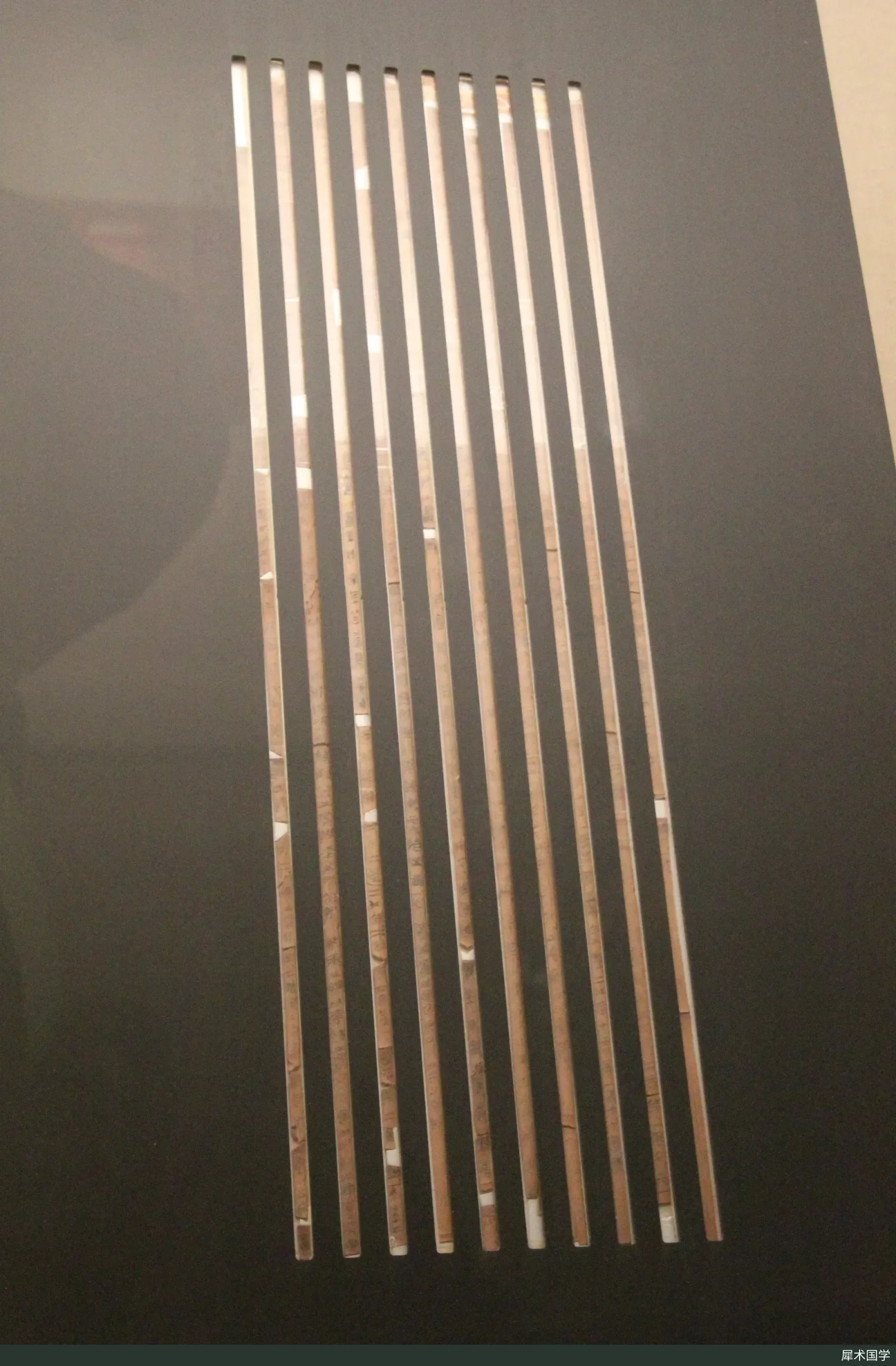
Warring States Chu bamboo slips, Hubei Provincial Museum Chu gallery (not the Tsinghua Shifa; shown to illustrate Warring States Chu slip form). Photo: Gary Todd; source: Wikimedia Commons; license: CC0 1.0.
The Tsinghua bamboo Shifa is published in Qinghua daxue cang Zhanguo zhujian (Si), edited by the Center for Excavated Texts Research and Protection, Tsinghua University, and Li Xueqin as editor-in-chief (Zhongxi Book Company, December 2013, two volumes), together with Biegua and Suanbiao. The Tsinghua slips entered Tsinghua University in July 2008; they were looted and had circulated abroad, so the exact findspot is unknown. The editors, weighing all considerations, judged them to come from Chu territory; radiocarbon dating of a blank fragment yielded 305±30 BCE. That figure is the approximate date of copying; Li Xueqin specially notes that it is not the date when the content was composed.
First the text itself. Per the editors, Shifa comprises 63 slips, each numbered 1–63 at the lower end; on acquisition they still formed a roll, so the binding order is not in doubt; the whole text is written in columns with illustrations and tables, in a format like a silk manuscript. The content is principles and methods of milfoil divination, with many hexagram examples written in numerals. Li Xueqin summarizes several conspicuous features: consultation topics fall into “seventeen charges”; every example is two six-line numeral hexagrams side by side; numerals are mainly “one” and “six,” with “one” yang and “six” yin, plus yang five and nine and yin four and eight; only the names of the eight trigrams appear—never the sixty-four hexagram names, and no hexagram or line statements are quoted; trigram names are close to the received Guicang, e.g. Kan as “劳,” Zhen sometimes as “来.” A rhymed passage at the end Li reads as “各当其卦,乃扐占之,占之必扐,卦乃不忒,” taking the slip graph “力” as “扐” and linking it to Zhouyi · Xici shang “归奇于扐以象闰,” arguing that Shifa uses milfoil manipulation. The text and readings above are cited from two pieces by Li Xueqin (“Shifa, Biegua, and Suanbiao,” Zhongguo wenhua bao, 14 January 2014; “Five understandings and five questions on the Tsinghua Shifa,” originally Jinan daxue xuebao 2016.5); this article did not check the plates of the edition directly.
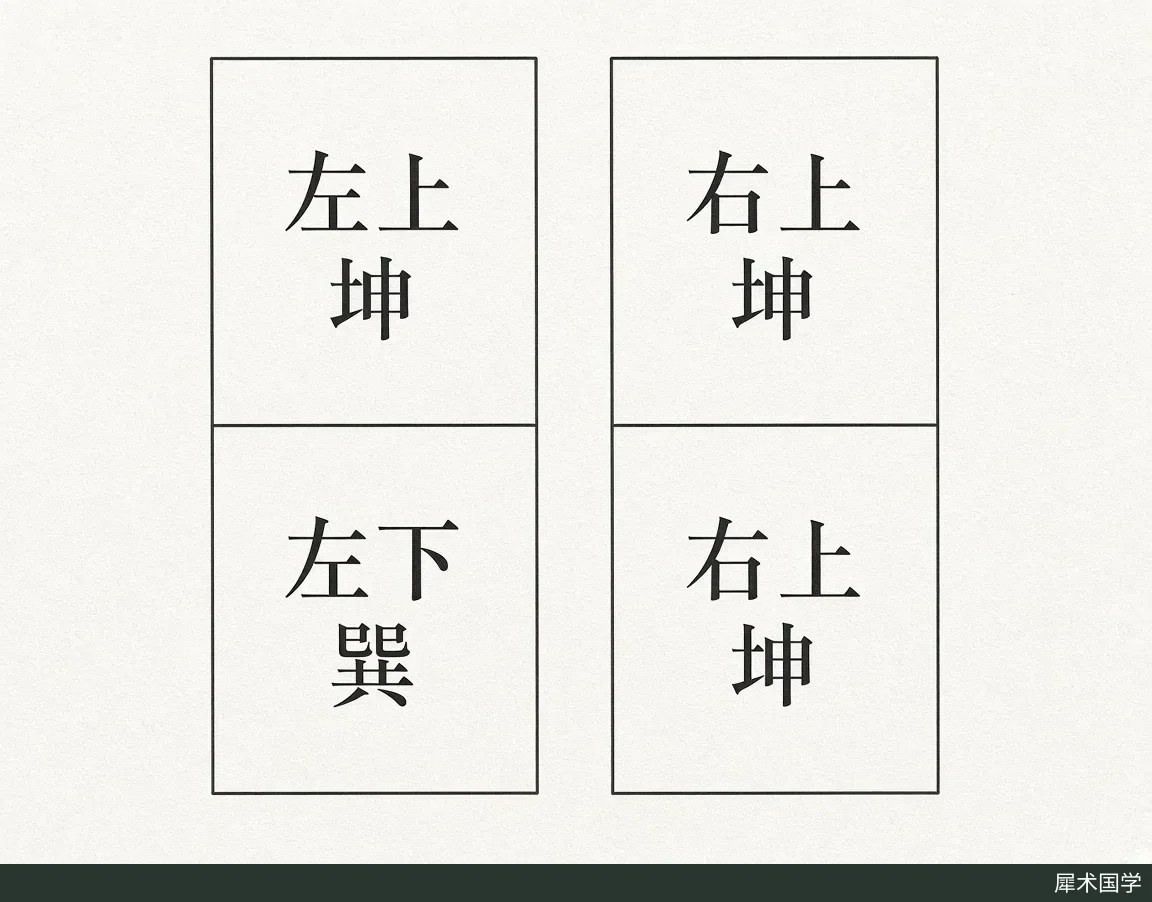
Next, how researchers read these examples—the core concept is the “four positions.” Li Xueqin holds that two six-line hexagrams side by side equal four three-line trigrams in four positions; Chu divination slips insist on side-by-side writing even on very narrow slips, which should relate to this “four positions” idea. Wu Xiaoxin’s “Numeral hexagrams in Chu divinatory slips and the interpretation principles of the Tsinghua Shifa” (Shenzhen daxue xuebao (renwen shehui kexue ban) 33.3 [2016]) further explains: the four positions are upper right, lower right, upper left, and lower left of one example set; the left and right hexagrams are not a Zhouyi-style original and resulting hexagram pair; to judge auspiciousness one looks at which trigrams occupy the four positions, then combines year, month, and day of the consultation, and factors such as male/female, left/right, zhaomu, “number out,” and “number in” of the trigrams. Her example is the first set in the Xiang section: upper right, lower right, and upper left are all Kun, lower left is Xun; the slip says “凡享,月朝纯牝,乃飨”; her reading is that when consulting about sacrificial offering and obtaining this hexagram, one should sacrifice at the beginning of the month with unmarked female victims. Wu also distinguishes two kinds of material: numeral hexagrams in Tianxingguan, Baoshan, and Geling Chu slips are records of actual consultations; those in Shifa are examples for explaining interpretive rules.
Placing Shifa back in the Yi tradition, differences and links are both clear. The difference is the path of interpretation: Li Xueqin notes that examples in the Zuo zhuan and Guoyu usually quote Zhouyi hexagram or line statements, whereas Shifa relies not at all on those statements but on how trigrams are arranged in the four positions. The link is in understanding the trigrams: Wu Xiaoxin notes that Shifa treats Qian, Zhen, Kan, and Gen as male and Kun, Xun, Li, and Dui as female, following the “Qian–Kun and the six children” of the Shuogua; Li Xueqin also notes that the Shifa trigram-position diagram largely matches the “later Heaven” eight-trigram directions of Shuogua chapter 5, and that the “human-body diagram” largely matches Shuogua chapter 9. The difference is that in the position diagram Kan (劳) and Li (罗) are exactly reversed from later Heaven. Li first thought this a drawing error; later he found it so throughout the text and concluded it was no slip of the brush, but the reason remains unsettled. From the relation of the position diagram to the Shuogua he further “boldly conjectured” that Shifa is later than the Shuogua—his personal conjecture, not a scholarly consensus.
Shifa also leaves many open questions. Li Xueqin himself listed several: whether Shang and Western Zhou numeral hexagrams and Chu slip numeral hexagrams form one continuous line still needs argument; why “one” in the Shifa numeral–earthly-branch table should be “seven” written as “one” remains unexplained; what the Kan–Li reversal means; whether the yin–yang line drawings of the received Zhouyi evolved from numerals “eight” and “six” and when they stabilized—which again bears on how one views traditional claims about the Yizhuan. Wu Xiaoxin counts 114 numeral hexagrams in Shifa and suggests they are the copyist’s selection and synthesis, while noting other causes cannot be ruled out. On these points it is better to keep plural views than to rush to a verdict.
The following is this author’s reading, for reference only. What most deserves notice in Shifa is not that it offers a “more accurate” method of divination, but that it shows: in Warring States Chu there was at least one set of interpretive rules that did not rely on Zhouyi hexagram and line statements but centered on trigram configuration—sharing much trigram knowledge with the Shuogua, yet taking another interpretive path. When we read Zuo zhuan and Guoyu examples, we habitually use original and resulting hexagrams and hexagram/line statements to understand how ancients used the Yi; Shifa reminds us that this was only one branch of contemporary Yi practice. How widely these rules circulated then, and how they were operated in detail, present materials cannot yet decide; the auspicious–inauspicious judgments in the slips are rules of an ancient divinatory book, not proven facts. Readers who want to go further should check the edition’s plates and transcriptions directly.
Sources:
- Center for Excavated Texts Research and Protection, Tsinghua University site: Qinghua daxue cang Zhanguo zhujian (Si) published, 14 January 2014 (submitted by Li Biyan, Zhongxi Book Company).
- Li Xueqin: Shifa, Biegua, and Suanbiao, Zhongguo wenhua bao, 14 January 2014, reprinted on the Tsinghua University site.
- Li Xueqin: Five understandings and five questions on the Tsinghua Shifa, originally Jinan daxue xuebao 2016.5, reprinted on the Institute of History, CASS site.
- Wu Xiaoxin: Numeral hexagrams in Chu divinatory slips and the interpretation principles of the Tsinghua Shifa, Shenzhen daxue xuebao (renwen shehui kexue ban) 33.3 (2016): 58–63.
References
-
Information compiled and published by the Scholay academic one-stop platform; report infringement for takedown.
-
Also published on Enter Scholar, a scholars’ community for the intelligent age