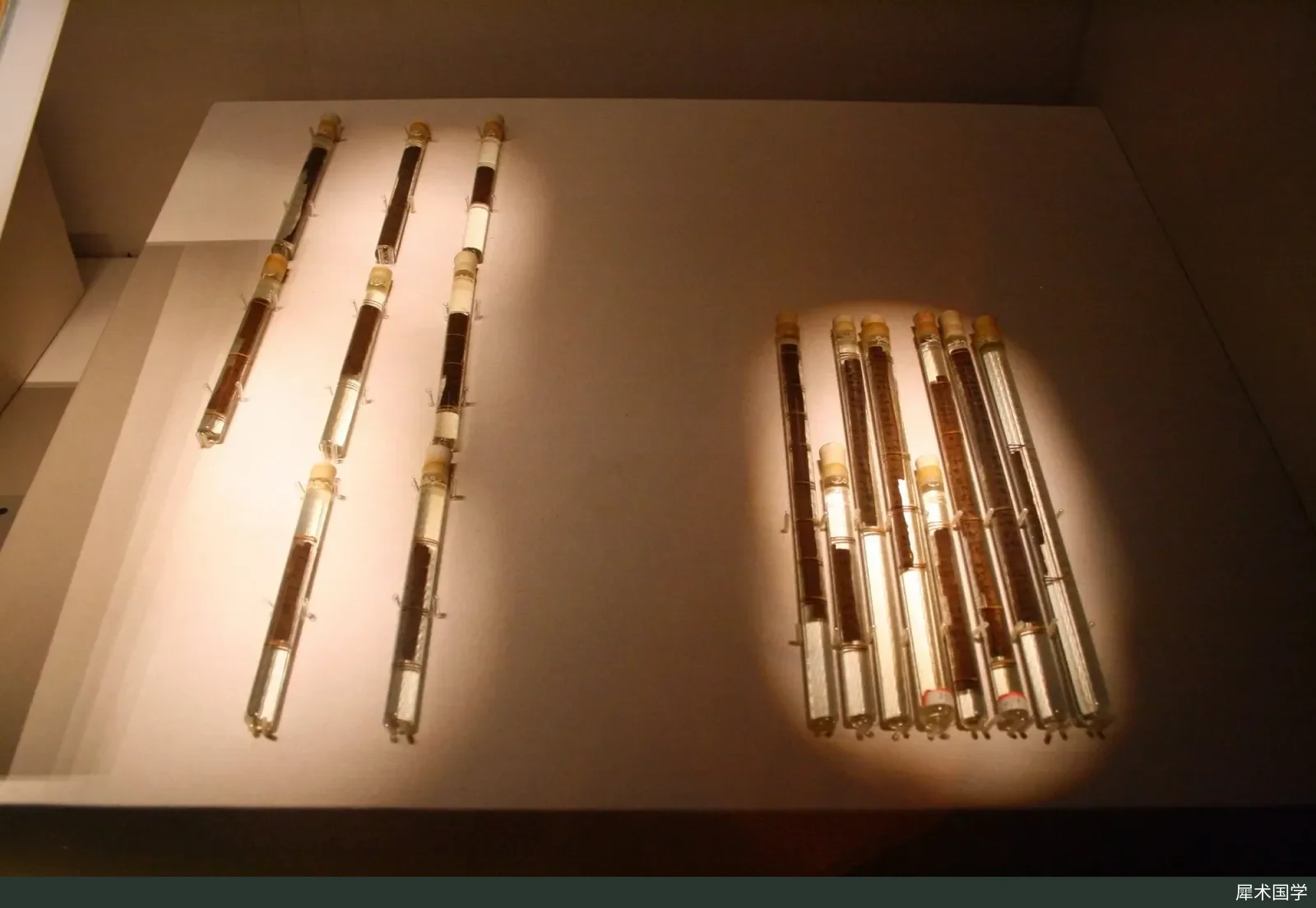
Display of bamboo slips of the Sunzi bingfa from the Yinqueshan Han tombs. Photo: AlexHe34 (1 July 2011); source: Wikimedia Commons; license: CC BY-SA 3.0. According to the same uploader’s note, the Linyi Yinqueshan Han Tomb Bamboo Slips Museum displays only replicas; whether the slips in the photograph are originals could not be confirmed.

In April 1972, among the bamboo slips excavated from Tomb No. 1 at Yinqueshan, Linyi, Shandong, a Western Han manuscript of the transmitted Sunzi bingfa (The Art of War) appeared together with the long-lost Sun Bin bingfa (Sun Bin’s Art of War). Drawing on the excavation report, the collated editions of Bamboo Slips from the Han Tombs at Yinqueshan, and studies by Li Xueqin, Wu Jiulong, and others, this article surveys the discovery, dating, and publication of the slips; compares the slip text of the Sunzi with the transmitted text; and explains how the find answers the old question whether Sun Wu and Sun Bin were one and the same person.
Discovery and dating of the slips
Yinqueshan lies southeast of the old city of Linyi. According to Dong Yifeng of the Shandong Sunzi Studies Association, in April 1972 construction workers found a Western Han tomb there; when the Linyi Cultural Relics Team cleared Tomb No. 1 they found bamboo slips, and together with the Shandong Provincial Museum they then cleared Tomb No. 2. The formal announcement is the report by the Shandong Provincial Museum and the Linyi Cultural Relics Team, “Brief Report on the Discovery of Bamboo Slips of the Sunzi bingfa, Sun Bin bingfa, and Related Texts in Western Han Tombs at Linyi, Shandong” (Wenwu 1974, no. 2; journal databases list the authors as Wu Jiulong and Bi Baoqi). The report records that, besides slips and fragments, the two tombs yielded lacquered wooden objects, pottery, bronze, and coins, and were dated to the early Western Han.
Slip counts must be distinguished by what is being counted. The National Museum of China’s object note says the find comprises 4,942 complete and broken slips, plus several thousand fragments; complete slips are 27.6 cm long, written in ink clerical script, generally about 35 characters per slip. Tomb No. 2 yielded instead the Yuanguang yuannian lipu (calendar for the first year of Yuanguang) of Emperor Wu. For the Sunzi bingfa alone, Zhan Libo in 1974 wrote “over two hundred slips, more than 2,300 characters”; Dong Yifeng gives 233 slips and over 2,700 characters; the National Museum note says “more than 300 slips.” These figures come from different stages of collation and different counting methods (whether broken slips were joined, how fragments were numbered); this article does not treat any one of them as definitive.
Dating likewise needs three layers. For the burial date, Huang Pumin summarizes a range between the first year of Jianyuan under Emperor Wu (140 BCE) and the fifth year of Yuanshou (118 BCE). For the copying date, the editorial team, judging the script as early clerical, estimated copying from the reigns of Emperors Wen and Jing into the early years of Emperor Wu. Composition date is another matter: Li Xueqin noted that bamboo-and-silk texts from the Warring States through early Han are all transmitted copies, so composition and copying must be kept apart. The Yinqueshan slips prove that these books were already circulating in the early Western Han; they do not by themselves show when each chapter was written.
Collation and publication history
According to Liu Chunsheng, in October 1974 the Ministry of Culture formed the Yinqueshan Han Tomb Bamboo Slips Editorial Group, with members including Zhang Zhenglang, Zhu Dexi, Qiu Xigui, Zeng Xiantong, Li Jiahao, and Wu Jiulong. Results first appeared in batches in Wenwu: no. 12 of 1974 printed transcriptions of fragments outside the thirteen chapters of the present Sunzi; no. 1 of 1975 printed the Sun Bin bingfa, then divided into upper and lower parts of fifteen chapters each. The main book editions since then are:
- Yinqueshan Han Tomb Bamboo Slips Editorial Group, ed., Bamboo Slips from the Han Tombs at Yinqueshan [1], Cultural Relics Press, July 1975, thread-bound: plates, facsimiles, transcriptions, and notes for the Sunzi bingfa and Sun Bin bingfa.
- Yinqueshan Han Tomb Bamboo Slips Editorial Group, ed., Bamboo Slips from the Han Tombs at Yinqueshan: Sunzi bingfa (transcription and collation notes), Cultural Relics Press, October 1976, paperback: slightly expanded text, with three research essays appended.
- Yinqueshan Han Tomb Bamboo Slips Editorial Group, ed., Bamboo Slips from the Han Tombs at Yinqueshan [1], Cultural Relics Press, September 1985, hardcover: the Sunzi bingfa, Sun Bin bingfa, Weiliaozi, Yanzi, Liutao, and “Thirteen chapters on defending the law and ordinances,” with revised notes.
- Wu Jiulong, transcription, Transcriptions of the Yinqueshan Han Bamboo Slips, Cultural Relics Press, December 1985: transcriptions of slips from Tombs 1 and 2 in original slip-number order, without joining or annotation, each slip labeled by chapter type.
- Yinqueshan Han Tomb Bamboo Slips Editorial Group, ed., Bamboo Slips from the Han Tombs at Yinqueshan [2], Cultural Relics Press, January 2010, folio hardcover, 321 pp.: fifty chapters of “discourses on government and military affairs,” plus sections on “yin-yang, seasonal ordinances, and prognostication” and “other.”
- Shandong Museum and Chinese Academy of Cultural Heritage, eds., Collected Yinqueshan Han Tomb Bamboo and Wooden Slips (2) (collated by Zhang Haibo) and (3) (collated by Jia Lianxiang), Cultural Relics Press, December 2021: the former contains sixteen chapters of the Sun Bin bingfa, 223 slip numbers; the latter five chapters of the Weiliaozi; both volumes publish color and infrared images.
Changes of edition directly affect how many chapters the Sun Bin bingfa is said to have. The 1975 transcription and the thread-bound edition together printed thirty chapters; the 1985 hardcover kept only sixteen. The editorial note to the 2010 Bamboo Slips from the Han Tombs at Yinqueshan [2] explains that the military chapters formerly placed in the lower part of the Sun Bin bingfa “all lack firm evidence of belonging to Sun Bin’s book”; among them Jiang bai and Bing zhi heng shi, together with political chapters such as Wangdao, appear on the same title board, so all were moved into the second series. Under the original plan, loose slips, title boards, and the Tomb No. 2 calendar were to form a third series, but according to Cultural Relics Press news in 2021 that series never appeared; thereafter the Shandong Museum and others re-collated and published the full material as Collected Yinqueshan Han Tomb Bamboo and Wooden Slips. When citing Yinqueshan texts, one should note whether the basis is the 1975 edition, the 1985 edition, or a collected edition from 2021 onward.
Slip text and transmitted text of the Sunzi compared
In the 1985 edition the Sunzi bingfa has upper and lower parts. The upper part comprises fragments of the thirteen chapters and one chapter-title board; no securely identifiable text of the “Terrain” (Dixing) chapter was found. The lower part contains five chapters—Wu wen, Si bian, Huangdi fa Chidi, Dixing er, and Jian Wu wang—some titles supplied by the editors from the content. Zhan Libo estimated that the surviving slip text is a little more than one-third the length of the Song text. The National Museum note holds that Huangdi fa Chidi, Si bian, and Dixing er respectively explain and develop parts of “Marching the Army” (Xingjun), “Nine Changes” (Jiubian), and “Nine Terrains” (Jiudi). Li Xueqin’s summary is that besides the thirteen chapters the slip text has several lost chapters, and that the order of the thirteen chapters themselves differs from the transmitted text.
Evidence for chapter order comes from that damaged title board. The editorial team read “Fullness and Emptiness” (shixu; transmitted as Xushi), and inferred: in the transmitted text Xushi precedes Junzheng, but on the slips it follows; transmitted Xingjun follows Junzheng and Jiubian, but on the slips it precedes Junzheng; transmitted Huogong precedes Yongjian, but on the slips it follows. The board is badly damaged, and the editors themselves said the meaning of the final line’s two graphs “seven shi” “awaits further study,” so the complete slip order still involves conjecture. Su Peng of Beijing Language and Culture University, arguing from the board, suggested that the passage at the end of transmitted Huogong that has little to do with fire tactics may originally have been a book-closing coda, echoing the opening of Ji—“Warfare is the great affair of the state.” That is one reading; the slip text itself does not say so.
Among wording differences, the most discussed is the “Form” (Xing) chapter. Both slip versions A and B read: “In defense there is surplus; in attack there is shortfall. Those who were once good at defense hid beneath the nine earths and moved above the nine heavens”; the Song Eleven Commentators’ Sunzi reads: “In defense there is shortfall; in attack there is surplus. Those good at defense hide beneath the nine earths; those good at attack move above the nine heavens.” On the slip reading, the same force has surplus for defense and shortfall for attack, and both “hiding” and “moving” describe those good at defense; on the transmitted reading, defense comes from insufficient force and attack from surplus. Among Han quotations listed by Liu Chunsheng, Qianfu lun · Jiubian, Hanshu · Biography of Zhao Chongguo, and Hou Hanshu · Biography of Feng Yi agree with the slips, while Hou Hanshu · Biography of Huangfu Song and Cao Cao’s commentary agree with the transmitted text, so both readings already coexisted by the end of the Eastern Han. Other examples: transmitted Xushi has “troops have no constant posture, water no constant form”; the slips have “troops have no completed posture (shi), no constant form (xing)”; the four graphs “burn the boats and smash the cauldrons” in Jiudi are absent from the slips, from the Wei Martial Emperor’s commentary edition, and from the Seven Military Classics text—Su Peng takes them as a later marginal note that entered the main text.
Yongjian has an even harder extra passage. After the transmitted list “when Yin rose, Yi Zhi was in Xia; when Zhou rose, Lü Ya was in Yin,” the slips continue: “when □ rose, □ Shibi was in Xing; when Yan rose, Su Qin was in Qi.” Su Qin lived in the mid–Warring States period, long after Sun Wu. Citing the notes to Bamboo Slips from the Han Tombs at Yinqueshan [1] as reported by Wang Jiaxiang, these lines “seem to show that the Sunzi came from Sun Wu’s later followers,” while also noting that “some hold these phrases were added by later hands; pending further study.”
Scholars disagree on the value of the slip text. Huang Pumin holds that in many respects it is closer to an earlier form, but also warns that the transmitted text is a fixed edition formed after Liu Xiang, Ren Hong, and others compared multiple ancient copies, so the slip text “can be consulted for reference, but one should not put too much faith in it.” This author’s view is that the slip text is one early Western Han copy: it proves that certain variants already existed in early Han, but it cannot automatically serve as the “original” that settles right and wrong; each variant still needs judgment from context, Han quotations, and the commentary tradition.
The Sun Bin bingfa and the one-person theory of Sun Wu and Sun Bin
The doubt begins in the transmitted sources themselves. The Shiji · Biographies of Sunzi and Wu Qi treats two men: Sun Wu presented his military arts to King Helü of Wu; Sun Bin was a later descendant of Sun Wu, served Qi, and after the Battle of Maling “his military arts were transmitted in the world.” The Hanshu · Treatise on Literature lists among the military writers an 82-chapter Wu Sunzi bingfa and an 89-chapter Qi Sunzi, but the Qi Sunzi was later lost. In Xixue jiyan, juan 46, the Southern Song scholar Ye Shi, noting that the Zuozhuan does not mention Sun Wu, held that “all who speak of Rangju and Sun Wu are sophistic partisans pointing falsely, not fact,” and took the thirteen chapters as “the work of mountain recluses at the end of Spring and Autumn and the beginning of the Warring States.” Qian Mu’s Chronology of Pre-Qin Philosophers, Examination 7 “On Sun Wu,” went further and held that both the man and the book “are likely later fabrications,” and in the entry on Sun Bin wrote that “Sun Bin’s designation comes from his having been kneecapped and left without a given name, so Wu was probably Bin’s name,” noting that the Japanese scholar Saito Ken had the same doubt.
The Yinqueshan slips supply contemporary physical evidence from the same tomb. Tomb No. 1 held two groups of military texts: one matching the transmitted thirteen chapters, whose lost chapter Wu wen begins “The King of Wu asked Sunzi,” and Jian Wu wang twice mentions “thirteen pian (chapters)”; the other unknown from the transmitted corpus, whose Wei wang wen opens “King Wei of Qi asked Sunzi about the use of troops,” and Qin Pang Juan records Sun Bin’s capture of Pang Juan. The first group’s Sunzi converses with the King of Wu; the second’s with King Wei of Qi—exactly matching the Shiji’s Sun Wu in Wu and Sun Bin in Qi, and the Han Treatise’s separate Wu Sunzi and Qi Sunzi. The National Museum’s object note accordingly says the find “confirmed” that each man had a military tradition; Li Xueqin in Lost Bamboo-and-Silk Texts and Intellectual History likewise wrote that the discovery of the Qi Sunzi “at once dispelled doubts about Sun Wu’s existence and the claim that Sun Wu and Sun Bin were one person.”
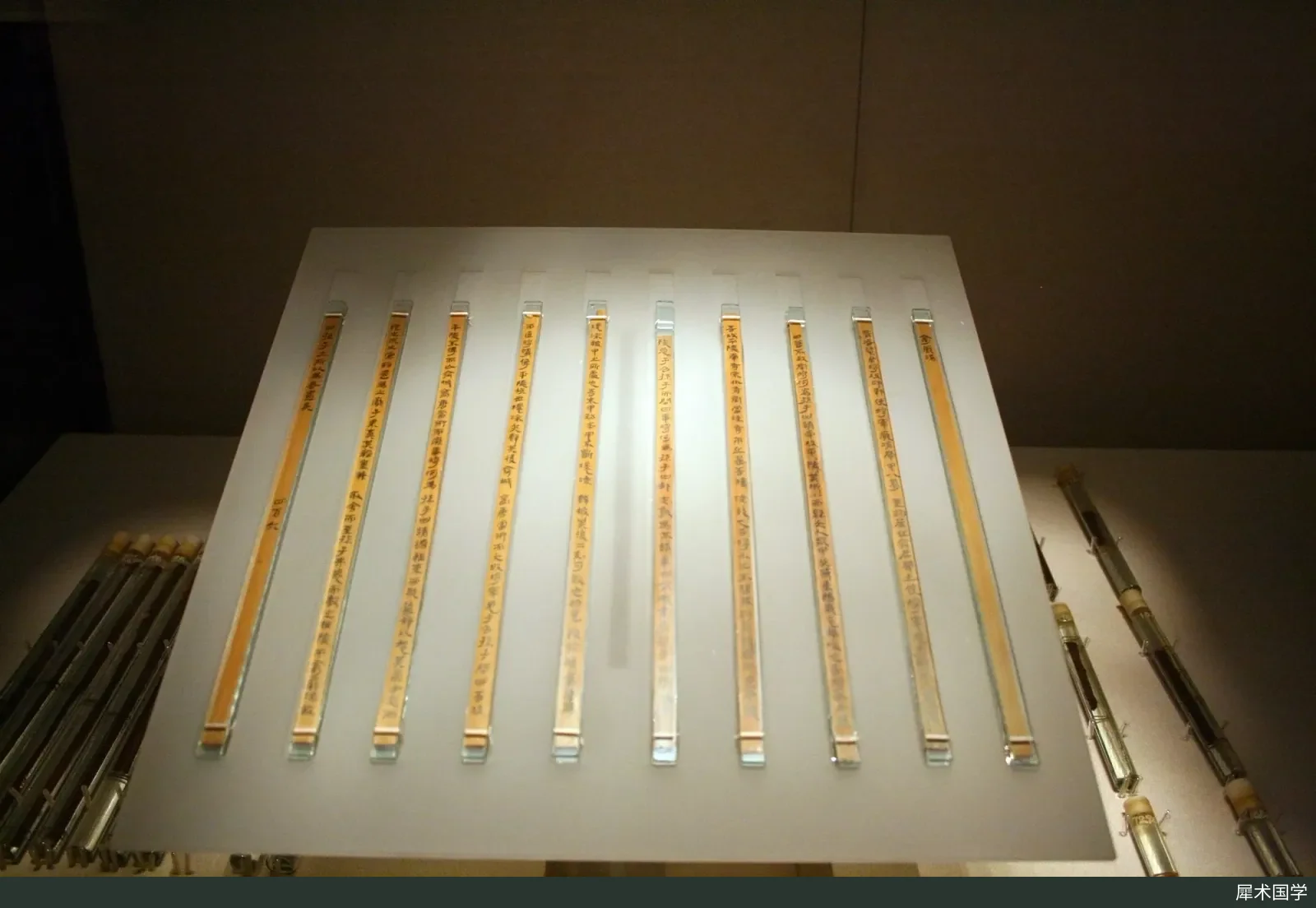
Display of bamboo slips of the Sun Bin bingfa from the Yinqueshan Han tombs. Photo: AlexHe34 (1 July 2011); source: Wikimedia Commons; license: CC BY-SA 3.0. The uploader notes that the collated originals are held at the Shandong Provincial Institute of Archaeology and that the museum retains only replicas; the slips in the photograph may be replicas.

This evidence settles whether Sun Wu and Sun Bin were the same person and whether there was only one book; it does not settle the authorship of every chapter in the present thirteen. The Su Qin sentence in Yongjian, explanatory lost chapters such as Huangdi fa Chidi, and the shift in Sun Bin bingfa chapter lists between the 1975 and 1985 editions all show that these military texts were expanded by later followers, and that today’s chapter divisions include editorial classification. Wang Jiaxiang’s 2002 essay on Bamboo and Silk Studies Net, drawing on Yongjian, argued that the present Sunzi mainly comes from Sun Bin and his followers. That is a minority view, but it reminds the reader: co-burial is enough to distinguish two books; it cannot alone assign every chapter to a single hand.
References
-
Shandong Provincial Museum and Linyi Cultural Relics Team. “Brief Report on the Discovery of Bamboo Slips of the Sunzi bingfa, Sun Bin bingfa, and Related Texts in Western Han Tombs at Linyi, Shandong.” Wenwu 1974, no. 2. CQVIP title record
-
“Transcription of Fragmentary Slips of the Sunzi bingfa from the Yinqueshan Han Tombs at Linyi.” Wenwu 1974, no. 12; Zhan Libo, “Brief Remarks on the Linyi Han Tomb Bamboo Slips of the Sunzi bingfa,” Wenwu 1974, no. 12; “Transcription of the Sun Bin bingfa from the Yinqueshan Han Tombs at Linyi,” Wenwu 1975, no. 1. All Journals title record
-
Yinqueshan Han Tomb Bamboo Slips Editorial Group, ed. Bamboo Slips from the Han Tombs at Yinqueshan [1]. Cultural Relics Press, July 1975 thread-bound; September 1985 hardcover. Douban catalog (1985)
-
Yinqueshan Han Tomb Bamboo Slips Editorial Group, ed. Bamboo Slips from the Han Tombs at Yinqueshan [2]. Cultural Relics Press, January 2010, 321 pp. Fudan Center for Excavated Texts and Paleography publication notice
-
Wu Jiulong, transcription. Transcriptions of the Yinqueshan Han Bamboo Slips. Cultural Relics Press, December 1985. Bibliographic details after “Current State and Issues in Research on the Yinqueshan Han Bamboo Slips”.
-
Shandong Museum and Chinese Academy of Cultural Heritage, eds. Collected Yinqueshan Han Tomb Bamboo and Wooden Slips (2) (3). Cultural Relics Press, December 2021. Cultural Relics Press publication notice
-
Li Xueqin. “Newly Excavated Bamboo and Silk and Intellectual History,” in Lost Bamboo-and-Silk Texts and Intellectual History. Jiangxi Education Press, 2001. Guwenzi Weikan reprint
-
National Museum of China. “Yinqueshan Sunzi bingfa Bamboo Slips.” Museum highlights · excavated objects. NMC website
-
Zhang Qingli. “Perspectives on the Scholarly Value of the Yinqueshan Han Slips of the Sunzi bingfa—An Interview with Professor Huang Pumin, School of Chinese Classics, Renmin University of China.” Chinese Social Sciences Today, 7 December 2018, no. 1591. Chinese Social Sciences Net
-
Liu Chunsheng. “Excavated Literature and the Study of Thought in the Sunzi bingfa.” Originally in Sunzi bingfa Research 2022, no. 1. Wanwei Academic reprint
-
Dong Yifeng. “An Archaeological Discovery That Shocked the World.” Shandong Sunzi Studies Association. Bingdao Net
-
School of Chinese Language and Literature, Beijing Language and Culture University. “Professor Su Peng’s Lecture ‘Four Topics in Collating and Reading the Sunzi bingfa’ Successfully Held” (publication date unverified). BLCU School of Chinese Language and Literature
-
Wang Jiaxiang. “The Author and Date of the Sunzi bingfa in Light of the Yinqueshan Han Slip Sunzi · Yongjian.” Bamboo and Silk Studies Net, 2002. Internet Archive
-
Ye Shi. Xixue jiyan, juan 46, “Sunzi.” Wenyuange Siku quanshu text. Wenlinshe transcription
-
Qian Mu. Chronology of Pre-Qin Philosophers, Examination 7 “On Sun Wu” and the entry on Sun Bin. Quotations after an online transcription; paper edition and page numbers unverified. Transcription
-
Compiled transcriptions of Bamboo Slips from the Han Tombs at Yinqueshan (revised on the 1985 and 2010 collations and Wu Jiulong’s transcriptions). Chinese Text Project. ctext
-
Information compiled and published by Scholay all-in-one academic platform. Please report for takedown if this infringes your rights.
-
Also published on Enter Scholar, a scholars’ community for the intelligent age.