How to choose open courses on the Zhouli
Project overview
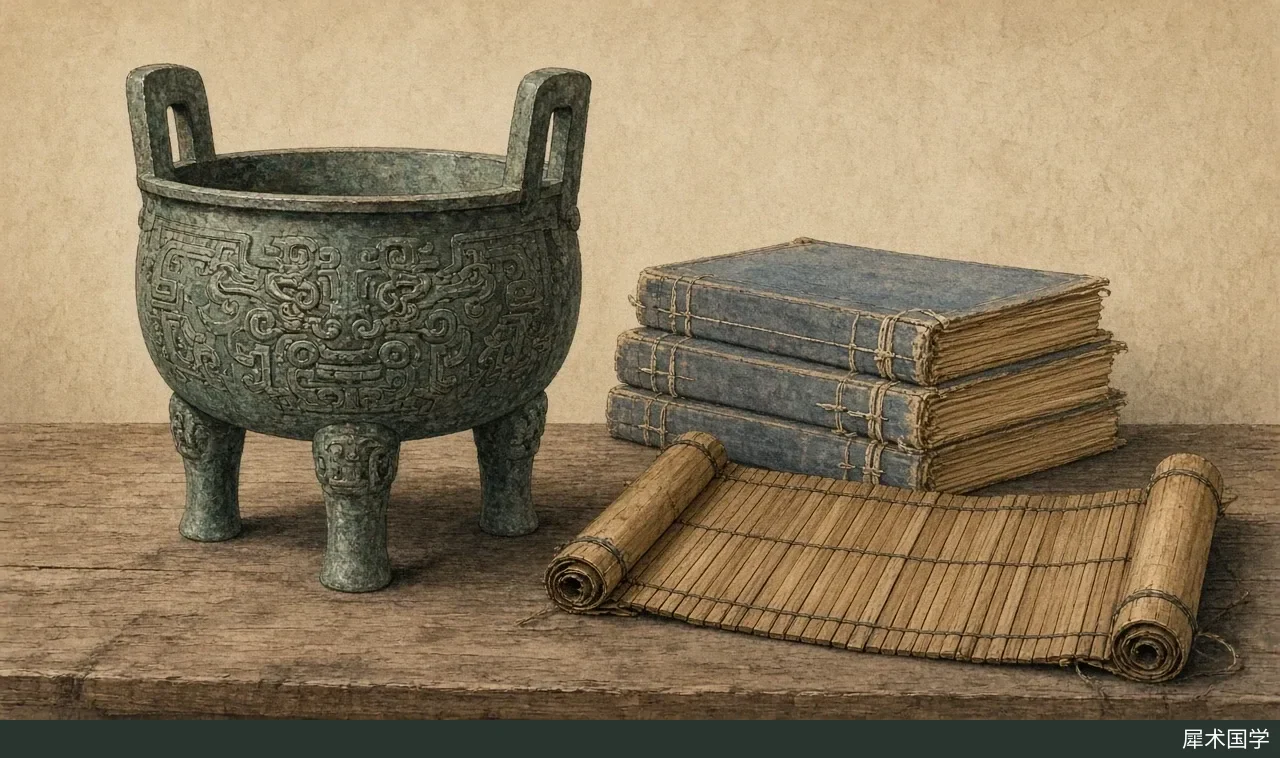
AI-generated schematic: still life echoing Zhou-dynasty bronze ritual vessels and a thread-bound book—not photos of real artifacts or edition leaves.
The “Three Rituals” (Sanli) are the three ritual classics Zhouli, Yili, and Liji: the Zhouli organizes offices and duties under the six bureaus of Heaven, Earth, Spring, Summer, Autumn, and Winter; the Yili records concrete ceremonies such as capping, marriage, village archery, mourning, and sacrifice; the Liji is mostly discourse on ritual meaning. All three are among the Thirteen Classics; Zheng Xuan of the Eastern Han annotated each, and they have since been called the Three Rituals together. Among them the Zhouli is best grounded with a dedicated course: though named a ritual book, it is in practice a master table of offices arranged by the six bureaus—originally 348 offices, 336 extant today—and bare text is hard to read alone; following a lecturer office by office is far more efficient. Dating and authenticity of the Zhouli have long been debated; the traditional attribution is to the Duke of Zhou, while Shandong University’s course page takes “probably compiled in the late Warring States.” Below, with “one dedicated Zhouli course as the main line, one Three Rituals overview as supplement, and two general or selected-text courses as indexes,” we introduce four university courses available on public platforms. Podcast lectures in this site’s “Course resources · Readings and tutorials” column are covered elsewhere; here only university MOOCs.
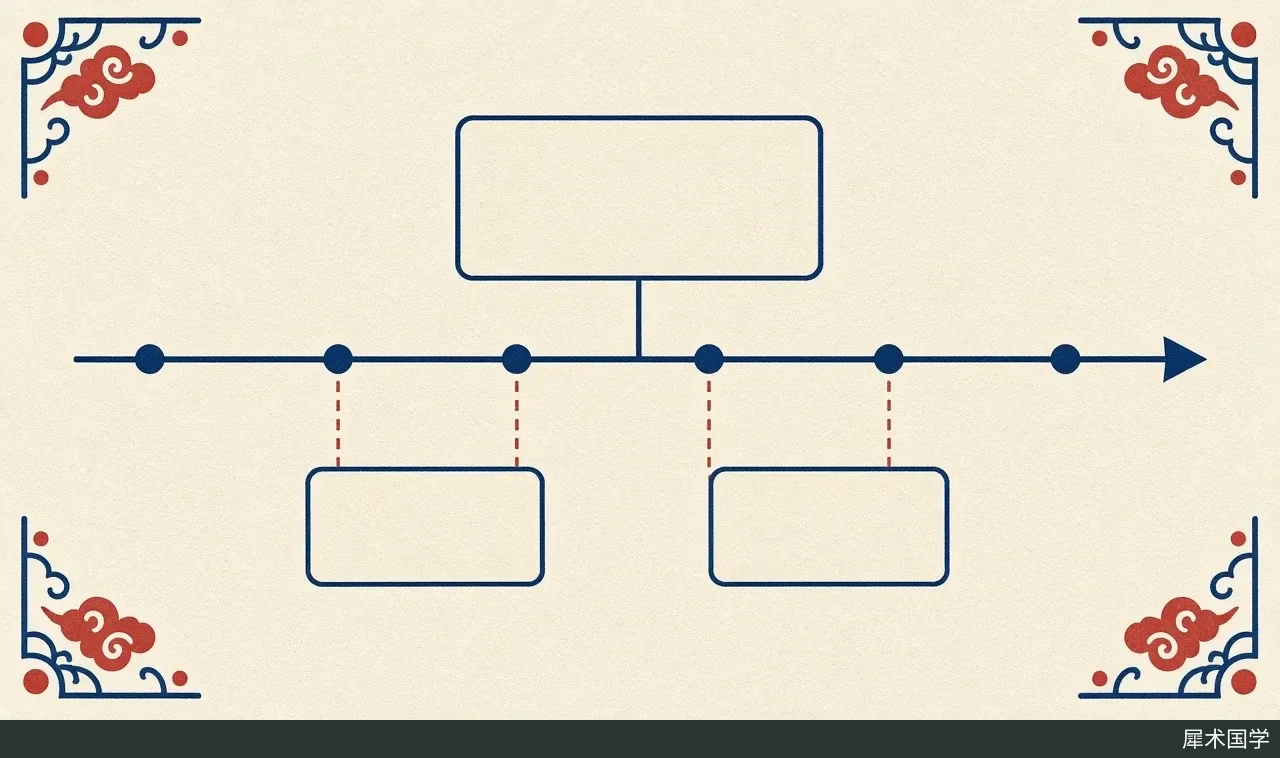
AI-generated schematic: an entry path among Three Rituals MOOCs. The thick main line is Shandong University’s Zhouli introduction; the larger linked node is Tsinghua Peng Lin’s ritual-classics course; two small nodes are BNU’s Thirteen Classics Introduction and Wuhan University Classical Chinese Three Rituals selections. Node size marks role priority only, not hours.
Shandong University, Zhouli introduction
The recommended entry is Shandong University’s Zhouli introduction on China University MOOC (course page https://www.icourse163.org/course/SDU-1002616008[1] ). Eighteen lectures in all. Lectures 1–4 are overview: title, authorship, dating, contents, scholarly value, research history, and representative works. Lectures 5–18 walk through twenty-five selected offices: Heaven’s zaizai, xiaozai, zaifu, shanfu; Earth’s dasitu, xiaositu, xiangshi, zhouzhang, shishi, baoshi; Spring’s dazongbo, dazhu, xiaozhu, dashi; Summer’s dasima, sishi, dapu; Autumn’s dasikou, xiaosikou, shishi, chaoshi, daxingren, xiaoxingren, siyi; and the jade worker (yuren) from the Kaogong ji. Exposition stays with the classical text, drawing on Zheng Xuan, Jia Gongyan, and Sun Yirang, covering office names and things, carriages flags and palaces, mourning and sacrifice, banquets and court visits, and food and meals; the course ends with reading methods and a bibliography. Note that this is selected-office close reading, not a full reading of the classic: the Dongguan was long lost and is replaced in the received text by the Kaogong ji, from which the course takes only the jade-worker office.
When following the course, keep a text with the original at hand so you can match lecture content to the classic and commentaries. The bibliography on the course page can be used in three layers. First, commentaries: Zheng Xuan’s Zhouli zhu in twelve juan; Zheng’s notes with Jia Gongyan’s subcommentary as Zhouli zhushu (forty-two juan in Ruan Yuan’s Shisan jing zhushu); and Sun Yirang’s Zhouli zhengyi in eighty-six juan (punctuated by Wang Wenjin and Chen Yuxia, Zhonghua Book Company, 1987)—most traditional views cited in class come from these three. Second, modern annotated translations: Yang Tianyu’s Zhouli yizhu based on Ruan Yuan, with headnotes, text, notes, and translation per chapter (Shanghai Ancient Books, 2004); Lü Youren’s Zhouli yizhu based on Sun’s Zhouli zhengyi text, with 34 illustrations (Zhongzhou Ancient Books, 2004). Third, Kaogong ji monographs: Wenren Jun’s Kaogong ji yizhu (Shanghai Ancient Books, 1993; revised 2008) and Dai Wusan’s Kaogong ji tushuo (Shandong Pictorial Press, 2003). Suggested listening order: finish the first four lectures for title, dating, and research history, then follow the six-bureau office walkthroughs; after each office, return to an annotated translation and read that office’s full text, separating classic wording, Zheng/Jia commentary, and the lecturer’s own reading.
Tsinghua University Peng Lin’s ritual-classics course
Peng Lin of Tsinghua University’s Ancient Chinese Ritual Civilization—Ritual Classics is listed as a first-class course on the National Higher Education Smart Education Platform; the teaching platform is XuetangX, filed under history. At verification the platform showed this round running 23 July 2026–12 January 2027, 25 weeks, status “in session.” The blurb notes that Yili, Zhouli, and Liji entered the official curriculum after the Western Han and underpinned later ritual codes. The syllabus has ten lectures: ritual as the core of Chinese culture; ritual-music and the complete person; ritual classics; ritual and music education; ritual-music and temperament; filial rites; village archery; coming-of-age; marriage; and the shidian rite—ten sections each, plus a final exam. Its use is to cover the other two rituals that Shandong’s course does not: lecture 3 “Ritual classics” can serve as a Three Rituals overview; later village archery, coming-of-age, and marriage map to Yili chapters such as Xiangshe li, Shi guan li, and Shi hun li. It is not a dedicated Zhouli course, though; the center is elaborating ritual meaning and ceremony, and one goal is guiding learners to practice traditional rites in life—suitable before or between the dedicated Zhouli course to build an overall sense of the Three Rituals.
Thirteen Classics introduction and Classical Chinese Three Rituals selections
In the other two courses the Three Rituals are only a portion, useful on demand. Beijing Normal University’s Thirteen Classics Introduction (course page https://www.icourse163.org/course/BNU-1470430178[4] ) presents each of the Thirteen Classics’ authorship, dating, contents, thought, and research history, including Zhouli, Yili, and Liji; it is positioned as a foundation course for literature, history, and philosophy majors, and also for enthusiasts of classical learning. Its role is to place the Three Rituals in the whole classical system and relate them to the Zhouyi, Shangshu, Shijing, and the three Spring and Autumn commentaries; Pi Xirui’s Jingxue tonglun (Zhonghua, 2017) and Dang Huaixing’s Shisan jing daodu (China Social Sciences Press, 2006) listed on the course page can be read alongside. Wuhan University’s Classical Chinese, taught by Wang Tongshang, Wang Yuewen, Chen Han, and Zhang Wen, runs on iCourse (China University MOOC); at verification this round was 24 August–16 December 2026. Week 8 “Received literature: classics section” assigns four Three Rituals selections: Zhouli · Dasikou, Yili · Shi guan li, Yili · Shi hun li, and Liji · Daxue zhi dao. This is a classical-Chinese selected-text course focused on words, grammar, and exegesis, not the ritual system, but good practice for ritual-book sentences; Zhouli · Dasikou in particular can be read against Shandong University’s Autumn-bureau dasikou lecture.
Course rounds, certificates, and positioning
Three points to clear when choosing. First, rounds change. China University MOOC and XuetangX open by semester rounds; start/end dates on the Smart Education Platform apply only to the current round; after a round ends, homework and exams usually close with it. Second, certificate rules for the same course can differ by round. Shandong University’s Zhouli introduction home page states that from Autumn 2021 China University MOOC offers only electronic certified certificates: students who meet the grade must apply online with payment during the application window, complete real-name verification, and fees are non-refundable once the certificate is generated; yet a summer College Advanced Placement (CAP) round page for the same course says the grade is 30% homework and 70% final, electronic completion certificates are free, paper certificates cost 100 yuan each, and the course can count toward Shandong University Nishan Academy’s “Classical Literature micro-major” honor certificate for any six of the “Classics of Chinese Learning MOOC series.” Learners who need a certificate should schedule from the rules on the chosen round’s page. Third, the four courses are positioned differently: only Shandong’s walks the Zhouli text office by office; Peng Lin’s is a Three Rituals and ritual-meaning overview; Three Rituals content in Thirteen Classics Introduction and Classical Chinese is only a unit or fragment of the whole course and cannot replace a dedicated course.
Why it is useful
The greatest value of this set is turning the usually hard-to-enter Zhouli into a week-by-week reading path. Learners who want a systematic reading of the Zhouli can take Shandong University’s introduction as the main line, pair one annotated translation, listen and read by the six bureaus, and finish with a basic grasp of Zhou office structure and the three commentary traditions of Zheng Xuan, Jia Gongyan, and Sun Yirang. Those who first want the Three Rituals’ relations, or care more about concrete rites such as capping and marriage, can start with Peng Lin’s “Ritual classics” lecture and the coming-of-age and marriage lectures, then return to the dedicated Zhouli course. Students entering classical studies or building a literature-history foundation can use BNU’s Three Rituals sections to place the three books, paired with Pi Xirui’s Jingxue tonglun. Learners weaker in classical Chinese can first practice words and punctuation with Wuhan University Classical Chinese week 8’s four Three Rituals selections; the Zhouli · Dasikou piece also links directly to Shandong’s Autumn-bureau portion. All four courses are reachable on public platforms; learners can take the stretch that matches their goal without finishing every course.
References
-
Shandong University: Zhouli introduction, China University MOOC, https://www.icourse163.org/course/SDU-1002616008
-
Shandong University: Zhouli introduction (summer CAP round page), China University MOOC, https://www.icourse163.org/course/SDU-1002616008?tid=1206621228
-
Tsinghua University · Peng Lin: Ancient Chinese Ritual Civilization—Ritual Classics, National Higher Education Smart Education Platform (teaching platform: XuetangX), https://www.chinaooc.com.cn/course/6786eb52225d72705e5dc010
-
Beijing Normal University: Thirteen Classics Introduction, China University MOOC, https://www.icourse163.org/course/BNU-1470430178
-
Wuhan University · Wang Tongshang et al.: Classical Chinese, National Higher Education Smart Education Platform (teaching platform: iCourse), https://www.chinaooc.com.cn/course/67aa8b91225d72705e0954e6
-
Xishu Chinese Classics · When minds meet, craft appears in words
-
Information compiled and published by the Scholay academic one-stop platform; report infringement for takedown.
-
Also published on Enter Scholar, a scholars’ community for the intelligent age