Most readers opening Xiaoyaoyou ("Free and Easy Wandering"), the first chapter of the Zhuangzi, feel an unmistakable contrast of scale: the colossal Peng bird beats the waters for three thousand li and rides a whirlwind ninety thousand li upward, while the cicada and little dove merely dart between elm and sandalwood branches. Yet the very first line of Western Jin commentator Guo Xiang's (c. 252–312) celebrated Zhuangzi Zhu flips that hierarchy upside down: "Although great and small differ, when set loose in the arena of self-realization, each thing follows its own nature, each task matches its capacity, and each fits its allotted portion (fen); their carefree wandering is one and the same—how could superiority or inferiority enter between them?"[1] Explaining why Guo Xiang turned transcendent freedom into contentment with one's allotment illuminates both the textual history of the Zhuangzi and the political philosophy of Wei-Jin Xuanxue (Dark Learning).
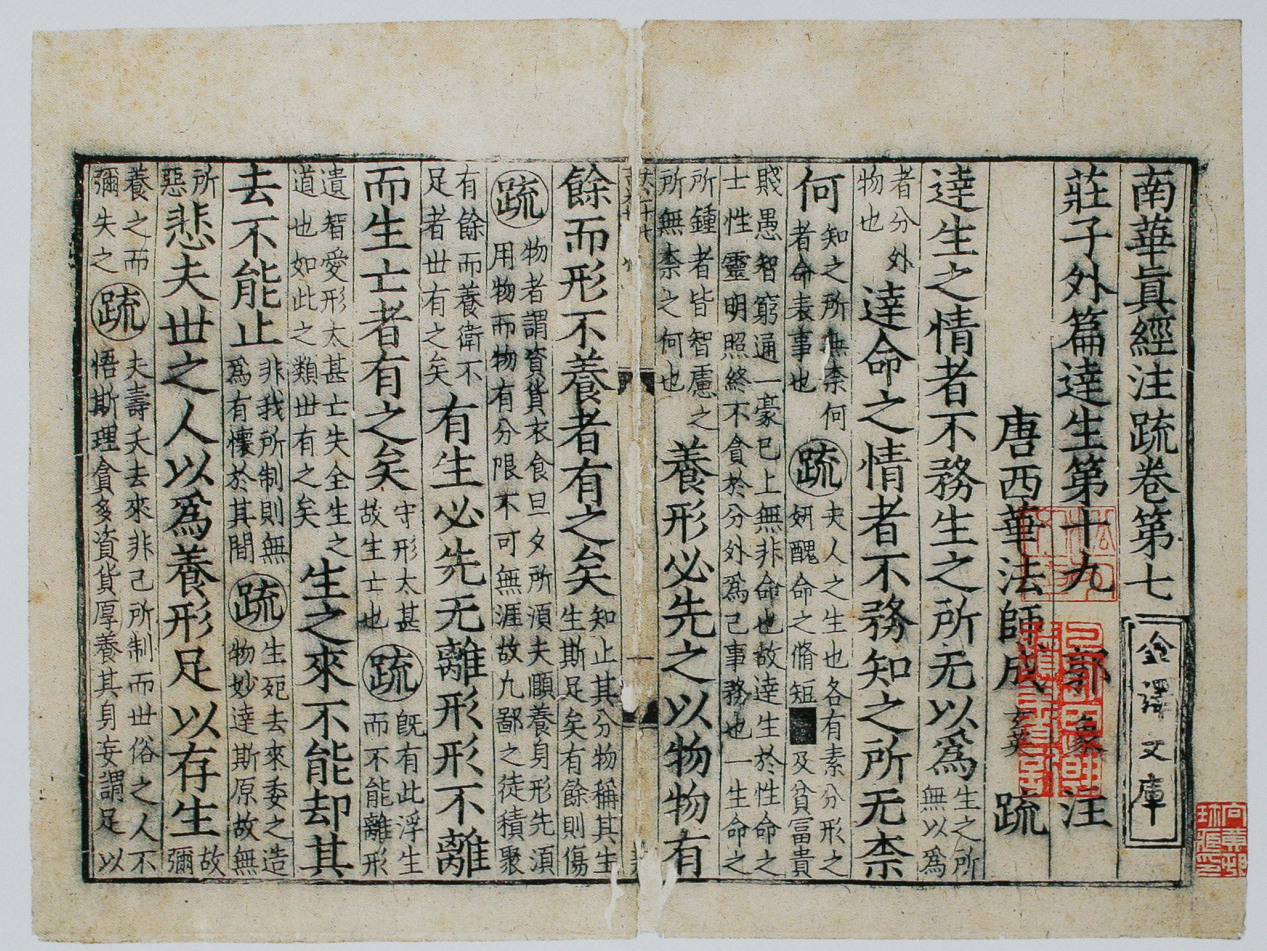
Figure: Song woodblock leaf of Nanhua Zhenjing bearing Guo Xiang's commentary. Unknown author, Wikimedia Commons

The Xiang-Guo dispute and the thirty-three-chapter text
The Zhuangzi known to posterity is literally Guo Xiang's recension. The Han Shu bibliographic treatise listed fifty-two chapters, a longer version still used by early Jin commentators such as Sima Biao. As Tang philologist Lu Deming quotes Guo Xiang in his Jingdian Shiwen preface, Guo dismissed roughly three-tenths of those materials as bizarre interpolations resembling mythographies or dream manuals, paring the book into today's thirty-three chapters—seven Inner, fifteen Outer, and eleven Miscellaneous.[4] Authorship of the commentary itself sparked a famous scandal: both Shishuo Xinyu (Wenxue, entry 17) and the Jin Shu biography report that the Bamboo Grove scholar Xiang Xiu drafted a brilliant Zhuangzi commentary before dying with only two chapters unfinished, whereupon Guo Xiang allegedly appropriated Xiang's manuscript, added Autumn Floods and Supreme Happiness, reworked Horses' Hooves, and lightly edited the rest.[2][3] Comparing surviving Xiang Xiu fragments in Lu Deming's glosses, however, many modern historians treat Guo Xiang less as a mere plagiarist than as a systematic editor who absorbed and expanded Xiang's ideas into a unified philosophical voice.
How solitary transformation leads to fitting one's nature
Whatever its debt to Xiang Xiu, the commentary advances a coherent metaphysical framework crystallized in Guo Xiang's preface: "Above, it knows that the Creator is no thing; below, it knows that things create themselves... thus the sacred vessel transforms solitarily (duhua) in the realm of dark obscurity."[4] Earlier Wei-Jin thinkers such as Wang Bi treated wu (non-being) as the generative root of all things. Guo Xiang abolishes both an external creator and any hypostatized nothingness: every creature arises spontaneously on its own without borrowing its existence from anything else.[4]
Once every being arises through solitary transformation, its size, lifespan, and capacity are simply its innate allotment (xingfen). In Xiaoyaoyou, Guo Xiang argues that the Peng bird's soaring and the quail's hopping, the rose-of-Sharon's longevity and the morning mushroom's brief life, are alike spontaneous (ziran) rather than striven for.[1] The Peng does not crave heights; its vast wings simply require ninety thousand li of wind to stay aloft, while the small bird needs no southern ocean to be completely at ease.[1] Sorrow enters only when small creatures covet what lies outside their allotment.[1] Even when Guo retains the text's contrast between "dependent" (youdai) creatures and the "independent" (wudai) sage, he closes the gap dramatically: "Even the independent cannot be set apart from the dependent, much less can large and small among the dependent be ranked!"[1] The sage is independent precisely by harmonizing with all dependent things so that none loses what it relies upon.[1]
Reconciling court and forest and Zhi Dun's counterattack
This philosophical leveling spoke directly to Western Jin elite politics. Serving as chief clerk to the powerful Prince of Donghai, Sima Yue, Guo Xiang wielded real court authority and knew that radical Daoist withdrawal invited official hostility.[3] Commenting on Emperor Yao's offer to abdicate to the recluse Xu You, Guo turns the original parable on its head: true non-action (wuwei) belongs not to recluses "folding their hands in silence among mountains and forests"—an image he blames for making Lao-Zhuang thought unacceptable to rulers—but to Yao governing effortlessly, for "though the sage stands in the imperial court, his mind is no different from being in the mountains and forests."[1] Tang subcommentator Cheng Xuanying pointedly noted that where Zhuangzi's text elevates Xu You over Yao, Guo's commentary reverses the verdict.[1]
That reconciliation of Daoist spontaneity (ziran) with Confucian social order (mingjiao) met an immediate, incisive challenge in the Eastern Jin. As Shishuo Xinyu (Wenxue, entry 32) and Liu Xiaobiao's annotation preserve, the monk-philosopher Zhi Dun (Zhi Daolin) stepped forward at White Horse Monastery with his Treatise on Carefree Wandering (Xiaoyao Lun): if merely feeling satisfied within one's limits counted as wandering free, Zhi Dun objected, then a hungry man eating his fill or a thirsty man drinking his cup would already possess ultimate freedom; "without supreme sufficiency, how can that be carefree wandering?"[2] True freedom, Zhi argued, belongs to the perfected mind that "treats things as things without being made a thing by them."[2] Centuries later, Ming scholar Wen Zhenmeng echoed a famous quip: "It is not Guo Xiang commenting on the Zhuangzi, but the Zhuangzi commenting on Guo Xiang."[4] Reading the original text, Guo's notes, Cheng Xuanying's subcommentary, and Zhi Dun's critique side by side lets readers see how creative exegesis transformed a Warring States classic into the voice of an entire medieval age.
References
[1] Guo Xiang (commentary) and Cheng Xuanying (subcommentary), Nanhua Zhenjing Zhushu juan 1 (Xiaoyaoyou), Chinese Wikisource, https://zh.wikisource.org/zh/南華真經註疏/卷一 [2] Liu Yiqing, Shishuo Xinyu, Wenxue chapter (entries 17 and 32, with Liu Xiaobiao's commentary quoting Zhi Dun's Xiaoyao Lun), Chinese Wikisource, https://zh.wikisource.org/zh-hans/世說新語/文學 [3] Fang Xuanling et al., Jin Shu juan 50, Biography of Guo Xiang, Chinese Wikisource, https://zh.wikisource.org/zh-hant/晉書/卷050 [4] Guo Xiang's Preface, Lu Deming's Jingdian Shiwen Preface, and Wen Zhenmeng's Preface, in Gujin Tushu Jicheng, Jingjidian juan 435, Chinese Wikisource, https://zh.wikisource.org/zh-hant/欽定古今圖書集成/理學彙編/經籍典/第435卷