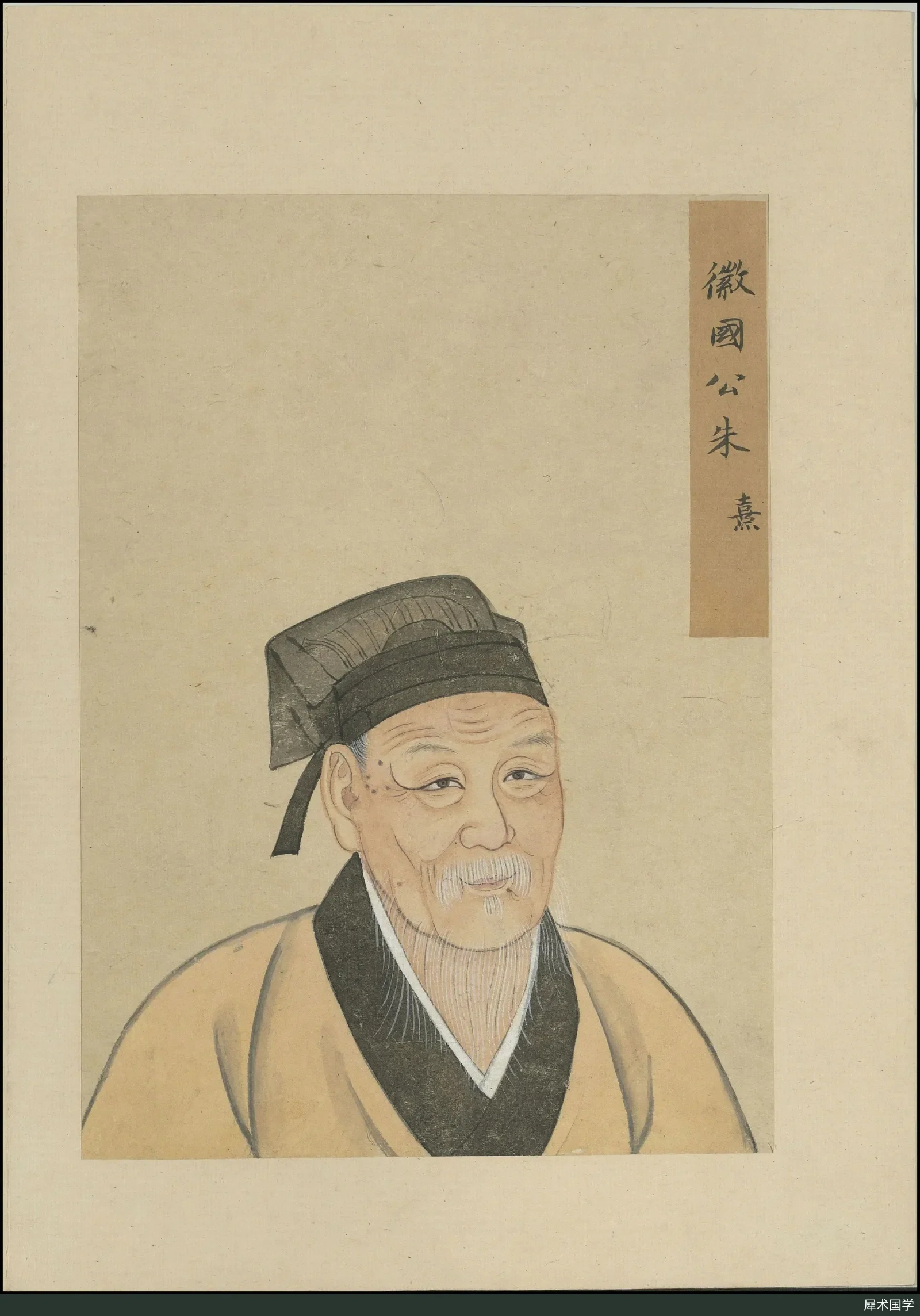
Figure: Portrait of Zhu Xi from the album Half Portraits of the Great Sage and Virtuous Men of Old, anonymous painter; Wikimedia Commons lists it as Yuan dynasty, formerly in the Nanxun Hall collection, now National Palace Museum, Taipei. Source: Wikimedia Commons, public domain (PD-Art).
“The Changes was originally a book of divination” (Yi ben bushi zhi shu) is the most often cited judgment in Zhu Xi’s Yijing learning. The wording appears mainly in disciples’ records in Zhuzi yulei, juan 66 and 67. Drawing on classical texts, the Siku abstracts, and punctuated editions, this article traces the saying’s sources and recorders, its context against Wang Bi and Cheng Yi’s Yi zhuan, the practice of separating classic and commentary in Zhouyi benyi, and divergent readings by Ming–Qing scholars and modern researchers such as Zhu Bokun and Li Xueqin.
The original wording and its recorders in Zhuzi yulei
The claim is not written into the notes of Zhouyi benyi; it clusters in two juan of Zhuzi yulei compiled by Li Jingde of the Song: under “Divination” in juan 66 (“Yi II · Guiding principles, upper, continued”) and under “Master Cheng’s Yi zhuan” in juan 67 (“Yi III · Guiding principles, lower”). The Yulei is a classified compilation of disciples’ separate records; each entry ends with the recorder’s name, and the same idea often appears in different wording from different disciples, so citations should name the recorder. Quotations below are cross-checked against texts on the Chinese Text Project and Wikisource; in Wang Xingxian’s 1986 Zhonghua punctuated edition, the “Divination” entries of juan 66 fall roughly on pp. 1620–1626 (page numbers cited from Ba Zhuangzhuang and Wang Shiping; the original volume was not checked page by page).
The Changes was originally made for divination. The ancients were plain and at first had no literary phrasing, so they drew the hexagrams and lines to “open things and accomplish affairs.” — juan 66, recorded by Mo
The Changes was originally a book of divination; later people took it as stopping at divination. When Wang Bi used Laozi and Zhuangzi to explain it, later people took it as principle alone and no longer as divination—also wrong. — juan 66, recorded by Jie
Why the Changes is hard to read: the Changes was originally a book of divination, yet now one must draw learning from within divination, so it becomes work in two stages. — juan 66, recorded by Hesun
The Yi zhuan is refined in principle and complete in wording, lacking not a hair… yet it does not match the original meaning. The Changes was originally a book of divination; the hexagram and line statements embrace everything, depending on how people use them. Master Cheng only speaks one principle. — juan 67, recorder unnamed
Reading Jie’s entry carefully, Zhu Xi rejects both extremes: treating the Changes as “stopping at divination,” and, after Wang Bi, treating it as “principle alone.” In a long Q&A in the same juan he admits the view is “hard to tell people; they will not believe,” and that “gentlemen formerly came forcefully to argue with me,” showing that even within Zhu’s circle it needed repeated defense and was not the consensus of the day. His reasons fall roughly into three kinds: first, the many “auspicious / inauspicious / regret / distress” phrases in the hexagram and line statements can only be read as divinatory language; second, the Zhouli places the “method of the three Changes” under the Grand Diviner, while teaching the scions of the state and the common people used poetry, documents, ritual, and music—“they never taught with the Changes”; third, if the sages’ intent had been to speak principle, “why not state it directly in a text like the Zhongyong or Daxue, explaining principle to instruct people” (juan 66, recorded by Guang).
Context against Wang Bi and the Yichuan Yi zhuan
The first named target is Wang Bi. In Zhu’s view, Wang “used Laozi and Zhuangzi to explain” the Changes, leading later people to take it as “principle alone”; juan 67, recorded by Li, adds: “Earlier explanations of the Changes mostly spoke of image and number. Only after the Cheng school did people treat it entirely as moral principle.” Taken together, he describes a line of moralization that began with Wang Bi and became general with the Cheng school. This is Zhu Xi’s own history-of-scholarship judgment, not a full appraisal of Wang Bi’s Yi learning.
The real debating partner is Cheng Yi’s Yichuan Yi zhuan. Zhu prized the book highly, calling it “refined in principle and complete in wording,” and saying “what Yichuan saw in his late years was very solid; there is not a single hanging, empty phrase” (juan 67, recorded by Daya). His reservation is methodological: “Yichuan saw a great principle and then forced the classic to fit that principle; that is not explaining the Changes” (juan 67, recorded by Defu). When the disciple Lin Zezhi said Yichuan’s Yi “says too much principle,” Zhu answered that “Yichuan sought too deep,” and noted that although Cheng held the 384 lines should not be read as only 384 affairs, his own method “still only makes 384 kinds of use” (juan 66; juan 67, recorded by Chun and by Yigang).
Zhu’s own contrast is concrete: if line statements are read as divinatory language, “scholars, farmers, artisans, and merchants—every kind of person can use them”; if fixed as one kind of principle, “only examination candidates can use them; others cannot” (juan 66). As this writer reads him, what he fears is not that Cheng’s commentary speaks principle, but that after speaking principle the classic’s meaning is locked into one human situation; “divination” here is more a reading that keeps the classic open, constraining the interpreter’s elaboration.
Separating classic and commentary, and the arrangement of Zhouyi benyi
Paired with the “divination” claim is a reading that separates classic from commentary. Juan 66, recorded by Guang, says: “Students of the Changes must look at each Changes on its own—Fuxi’s Changes as Fuxi’s… Confucius’s Changes as Confucius’s. To force them into one meaning will not do.” Juan 67, recorded by Fangzi, is still more direct: “Confucius’s Changes is not King Wen’s Changes; King Wen’s Changes is not Fuxi’s Changes; and Yichuan’s Yi zhuan is again Cheng’s Changes. So learners should follow the old Yi order, first read the original lines, and then see the original intent.” He also compares reading the Xici before the hexagrams and lines to “looking at the preface and examples of the penal code without looking at the code itself” (juan 66, recorded by Jie).
This claim is realized in the arrangement of Zhouyi benyi. Zhu Xi adopted Lü Zuqian’s Gu Zhouyi: two juan of upper and lower classic, ten juan of the Ten Wings, twelve juan in all, no longer following the Wang Bi tradition of attaching commentary to the classic (Cheng’s commentary itself follows Wang Bi’s text). Under “Zhouyi upper classic,” Benyi states: “In the middle it was rather disordered by the Confucians. In recent times the Chao family first corrected the fault but could not fully match the ancient text. The Lü family further revised it into classic in two juan and commentary in ten, restoring Kong’s old form.” The Siku quanshu zongmu abstract for “Gu Zhouyi, one juan” also says: “Zhu Xi once wrote a colophon for it; later, when he made Benyi, he used this text.”
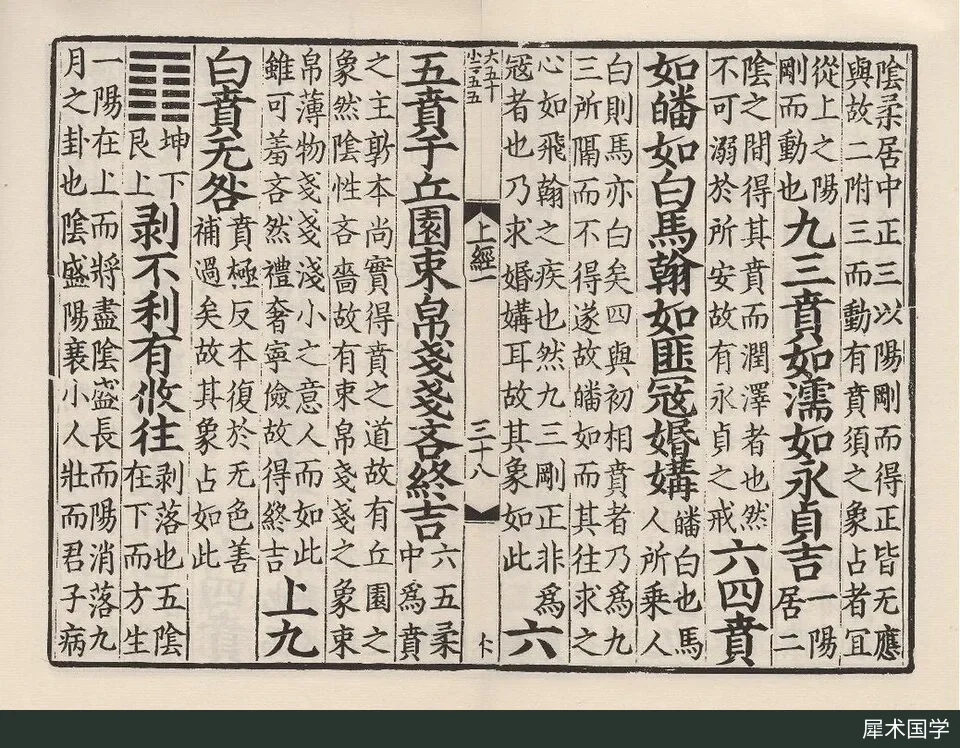
Figure: Leaf from the twelve-juan Song Xianchun 1 (1265) Wu Ge imprint of Zhouyi benyi, scanned from the National Library of China Press Zhonghua zaizao shanben reprint. Source: Wikimedia Commons, public domain (PD-scan).
The twelve-juan arrangement was once lost in Ming circulating editions. Per Gu Yanwu’s Rizhi lu entry “Zhu Xi’s Zhouyi benyi,” when the Yongle Wujing daquan was compiled, Benyi was cut apart and attached after Cheng’s commentary; later candidates abandoned Cheng’s commentary and read only Benyi, and commercial printers deleted Cheng from the Palace Zhuan-yi text, “taking Cheng’s order as Zhu’s order”—Gu lamented that “Zhu’s corrected book could no longer be seen in the world.” The Siku quanshu zongmu adds that cutting Benyi to attach Cheng “had already been done by Dong Kai in the Song, and did not begin with Yongle,” and takes the Xianchun yichou (1265) Jiujiang Wu Ge imprint as the good text; the Ming Cheng Ju four-juan reprint is “in fact still Wang and Han’s old text”—that is, it follows Wang Bi and Han Kangbo’s classic-with-commentary order. Today, when reading Benyi, asking first whether one has the twelve-juan or the four-juan text is the first step toward understanding Zhu’s separation of classic and commentary.
It should be noted that Zhu’s “look at each on its own” still uses the traditional attribution framework: Fuxi drew the hexagrams, King Wen wrote the hexagram statements, the Duke of Zhou wrote the line statements, and Confucius wrote the Ten Wings. Modern history of Yi learning has revised this attribution in many ways; Zhu Bokun, for example, holds that the Yi zhuan took shape in the late Warring States and criticizes “attributing all thought in the Yi zhuan to Confucius as a Han bias of Confucius-reverence” (cited from Wang Shiping). Authorship attributions have changed, but the method of understanding classic and commentary separately has remained.
Ming–Qing evaluations and modern readings
Ming readers were already used to pairing Cheng and Zhu. Wang Yangming’s Chuanxi lu, lower juan, records someone asking: “On the Changes, Zhu Xi emphasizes divination and Cheng’s commentary emphasizes principle—how is that?” Yangming answered: “Divination is principle; principle is also divination.” He did not take sides between the two houses, but widened divination into any practice of “seeking to resolve doubt” (cited from Peng Peng). The Gu Yanwu and Siku passages quoted above care mainly about the survival of Benyi’s ancient arrangement and say little about the “divination” claim itself.
Zhu Bokun’s Yixue zhexueshi gives Zhu Xi a dedicated section in vol. 2, ch. 7, “Development of Yi philosophy in the Southern Song,” whose first heading is “On the classic and commentary of the Zhouyi” (per the Kunlun Press table of contents). Wang Shiping’s survey notes that in vol. 1 Zhu Bokun takes up Zhu Xi’s judgment that “the Changes is a book of divination,” holding that as far as hexagram images and hexagram and line statements alone go, the Zhouyi remains a divinatory book, while the philosophical foundation of Yi learning was laid by the Yi zhuan formed in the Warring States; he therefore advocates studying classic and commentary separately without cutting their transmission. Zhu Xi’s separation of classic and commentary here becomes a method of modern intellectual history. The original wording and page numbers of the Zhu Xi section in vol. 2 have not been checked page by page for this article.
Li Xueqin’s “Kongzi Zhu Xi lun Yi yitong” appeared in Zhuzi xuekan 1990 no. 1 (total no. 2) and was later included as ch. 1, sec. 6 of Zhouyi suyuan. This article could not read the full essay and can only note his focus from another lecture draft: citing Confucius in the Mawangdui silk Yao—“As for the Changes, I put the invocators and diviners after; I observe its moral meaning”—he holds that Confucius “truly and completely distinguished the Changes of techniques from the Changes of moral principle.” If that stands, distinguishing divination from moral principle can be pushed back to Confucius himself and was not Zhu Xi’s invention; Li’s specific judgment on Zhu’s “divination” claim must wait until the original essay is checked.
Lin Zhongjun’s “On Zhu Xi’s reestablishment of the divinatory nature of the Zhouyi and its hermeneutic significance” (Academic Monthly 2020 no. 9) answers a common view: that Zhu’s restoring the divinatory character of the Zhouyi was a regression in philosophical thinking. Lin finds this “too rash”: Zhu meant to correct the bias of “valuing moral principle and slighting divination,” urging that one first read the classic in divinatory discourse and then draw out its principles, without opposing the two. Taking the materials together, “the Changes was originally a book of divination” is best read as a claim about exegetical order and textual arrangement: first seek the classic’s original use as divinatory language, then see how Confucius and later schools elaborated; it gives the Changes a historical placement without denying that there is principle in it. Whether that placement oversimplifies how the classic took shape remains debated.
References
-
[Song] Li Jingde, ed.; Wang Xingxian, punct.: Zhuzi yulei, juan 66 and 67, Beijing: Zhonghua Book Company, 1986. Online texts: Chinese Text Project · juan 66 “Divination”; Wikisource · juan 67
-
[Song] Zhu Xi; Liao Mingchun, punct.: Zhouyi benyi (Selected Yi Classics), Beijing: Zhonghua Book Company, 2009.
-
[Song] Zhu Xi: Zhouyi benyi, twelve juan, Song Xianchun 1 Wu Ge imprint, Zhonghua zaizao shanben reprint, Beijing: National Library of China Press. Wikimedia Commons scan
-
[Qing] Yong Rong et al.: Siku quanshu zongmu, Classics · Yi category, abstracts for “Zhouyi benyi, twelve juan, with reprinted Zhouyi benyi, four juan” and “Gu Zhouyi, one juan.” Shidian guji · Zhouyi benyi abstract; Shidian guji · Gu Zhouyi abstract
-
[Qing] Gu Yanwu: Rizhi lu, entry “Zhu Xi’s Zhouyi benyi.” Chinese Text Project · original-copy Rizhi lu
-
[Ming] Wang Shouren: Chuanxi lu, lower juan, in Wang Yangming quanji p. 102, cited from Peng Peng, “An inquiry into Wang Yangming’s inner logic in explaining the Changes through heart-mind learning,” Rujia wang
-
Zhu Bokun: Yixue zhexueshi (four vols.), Beijing: Huaxia Press, 1995; Beijing: Kunlun Press, 2005. Upper and middle volumes first published by Peking University Press, 1986–1989.
-
Li Xueqin: “Kongzi Zhu Xi lun Yi yitong,” Zhuzi xuekan 1990 no. 1 (total no. 2), Fuzhou: Fujian People’s Press, from p. 20; in Li Xueqin, Zhouyi suyuan, ch. 1, sec. 6, Chengdu: Bashu Press.
-
Li Xueqin: “Zhouyi and Chinese culture” (conference lecture draft), Aisixiang; page undated.
-
Lin Zhongjun: “On Zhu Xi’s reestablishment of the divinatory nature of the Zhouyi and its hermeneutic significance,” Academic Monthly 2020 no. 9. CSSN reprint
-
Wang Shiping: “An outline of twentieth-century Chinese-language histories of Yi learning—with focus on pre-Qin Yi history,” Journal of Chinese Literature, National Taipei University no. 37 (March 2025): 31–68. PDF
-
Ba Zhuangzhuang: “Zhu Xi’s textual characterization of the Changes,” Minxue yanjiu 2019 no. 2. PDF
-
Portrait of Zhu Xi from Half Portraits of the Great Sage and Virtuous Men of Old, National Palace Museum, Taipei. Wikimedia Commons
-
Information compiled and published by Scholay academic one-stop platform; report infringement for takedown.
-
Also published on EnterScholar, a scholars’ community for the intelligent age
