
An AI-generated schematic of an open thread-bound book and writing tools. The writing on the page is illustrative, not a photograph of a real Analects.
What the text says: three sentences, three questions
The first chapter of Xue Er reads:
子曰:「学而时习之,不亦说乎?有朋自远方来,不亦乐乎?人不知而不愠,不亦君子乎?」
The title of the book Xue Er is taken from the opening of this first chapter. The Analects was compiled by Confucius’s students and later followers from the words and deeds of Confucius and his students. The received text has twenty books. The first chapter is only three sentences, and each closes on a question. From delight, to joy, to the junzi, the pattern is similar and the situation being asked about opens out.
The first question is whether, after learning, one finds delight in reviewing or practicing from time to time. The second is whether there is joy when a like-minded friend arrives from far away. The third is whether, when others do not understand one, one can refrain from resentment and keep the attitude of a junzi. All three end with the pattern “is it not…?” The rhythm is open, and it invites the reader to pause: do these feelings and this attitude hold in one’s own life?
The commentarial tradition: how a few words have been read
He Yan’s Collected Explanations of the Analects and Zhu Xi’s Collected Commentaries, among others, give later readers important clues to this chapter. On “shi xi,” traditional explanations often connect the phrase with reviewing and practicing what was learned at the proper time. “Yue” is read as “delight.” “Peng” is often understood as a friend of the same way. “Yun” is anger or resentment. Commentators do not put the weight in exactly the same place. These glosses can be taken as signs into the text. Each character does not have to be pressed into one modern word.
“Zhi,” to know or to recognize, is especially worth attention. In the third question it helps a reader see a problem of understanding between people. That others have not recognized one, and whether one then becomes angry, are two levels. The weight of the sentence is on the second: how a person settles their own attitude in that situation.
A modern development: reading the three questions as one line
Starting from life now, the three questions can be read as an order that moves outward and then returns to oneself. This is a modern development. It does not say that earlier readers were allowed only this reading.
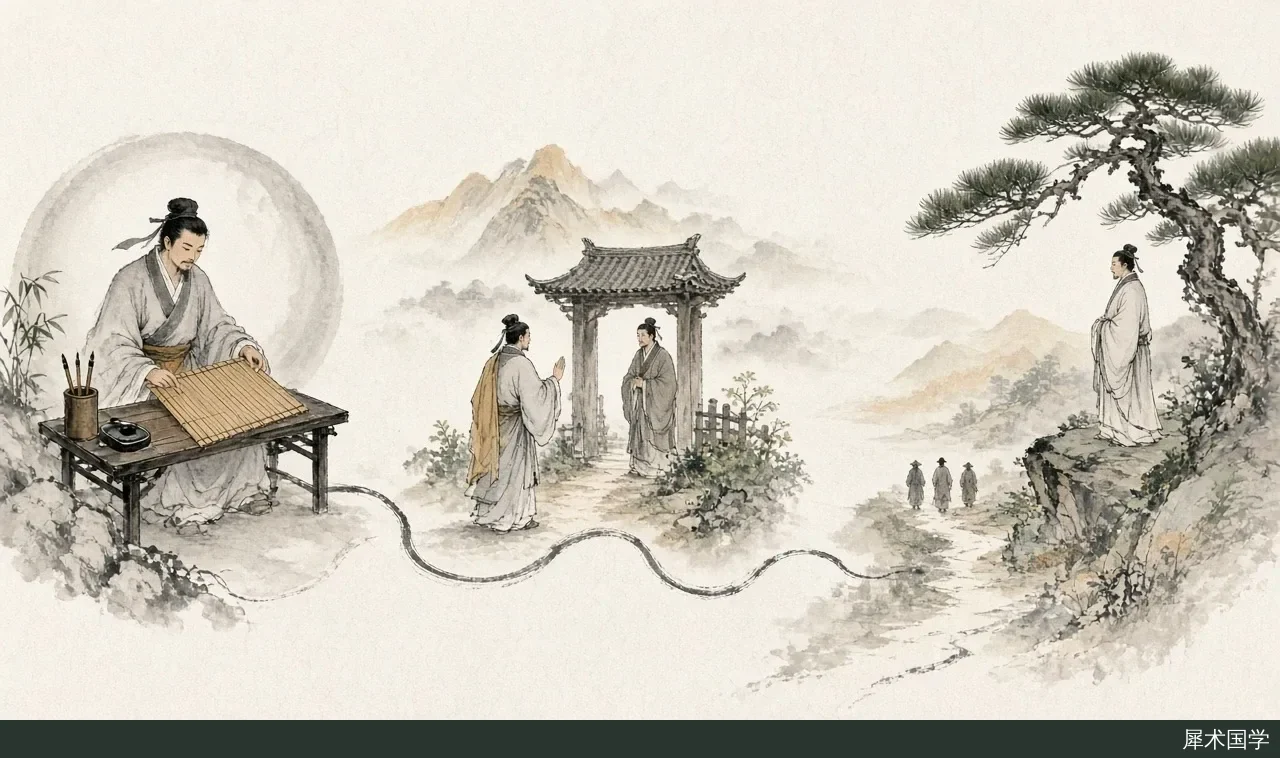
An AI-generated schematic of the three questions, left to right.
The delight of study comes from meeting a thing again and again and slowly finding that one understands a little more than yesterday. It is not always easy, and it does not require every practice to be pleasant. What the first chapter may remind a reader of is to notice the small, real gains in the course of learning.
The joy of friends keeps study from staying a solitary effort. A person willing to talk seriously, one question, one discussion, can make a vague idea clearer. “Far away” says that meeting is not easy, and that the meeting is worth more for that. The friend here does not have to be expanded into every social relation. The point is people who share a concern and test it with each other.
The third question turns to not being understood. It does not ask a person to press down every grievance, and it does not advise giving up explanation. One can still communicate and clarify, and one can admit to being hurt. What is worth practicing is this: when a response does not come when expected, not letting a moment of resentment decide every action.
Read together, the three questions are like three mirrors facing one another: how one studies, how one gets along with people of the same way, and how one meets other people’s regard. Each time the chapter is read, the three questions can be taken back into ordinary days before they are answered, to see where they meet one’s own experience.
References
-
Compiled and published by Scholay. For a takedown request, send feedback.
-
Also published at Enter Scholar.