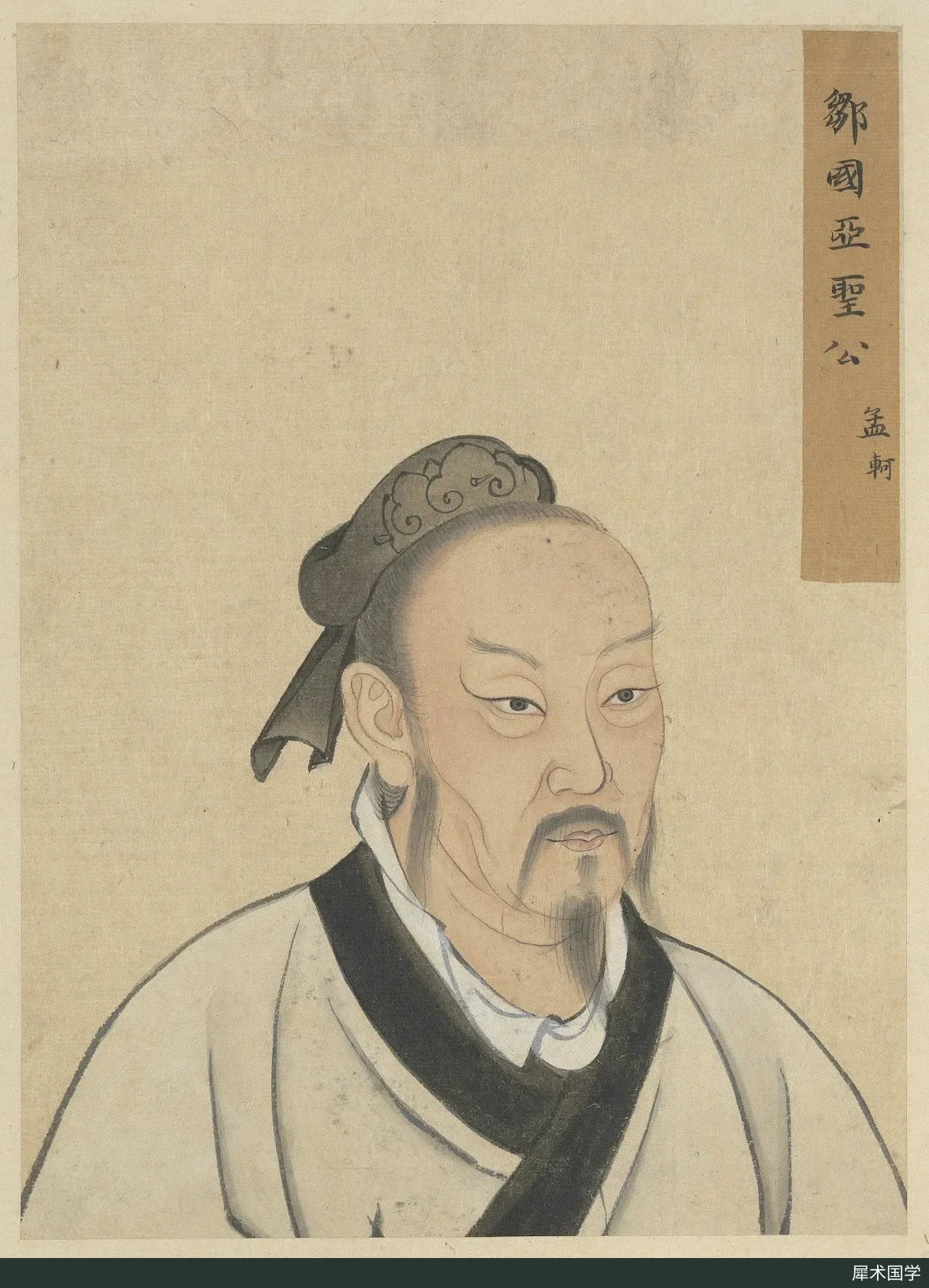
Figure: Portrait of Meng Ke from the anonymous Yuan album Half Portraits of the Great Sage and Virtuous Men of Old, ink and color on paper, National Palace Museum, Taipei (album accession 中-畫-000329). Source: Wikimedia Commons[12]; license: public domain (PD-Art).

This article checks, course by course, seven university offerings that are publicly accessible and that treat the Mencius: two dedicated courses on China University MOOC; three related courses by Huang Chun-chieh on NTU OpenCourseWare and Coursera; and two survey courses on HarvardX and XuetangX that include Mencius units. For each course it lists the institution, instructor, platform, fees, language, and current availability; items that cannot be verified are marked “to be verified.” A suggested entry order appears at the end.
Two dedicated Mencius courses on China University MOOC
China University MOOC lists two university courses titled on the Mencius—one focused on close reading of the text, the other on educational thought. Both introduction pages opened normally on 21 October 2026, but neither displayed a current term start date or a learning fee. The platform service agreement states that courses may be free or paid, and that certified certificates are charged separately, so “fees” below are recorded as to be verified pending what the enrollment page shows after login.
Mencius Close Reading (Peking University)
- Instructor: Wu Guowu, associate professor, Department of Chinese Language and Literature and Center for Ancient Chinese Classics and Archives, Peking University. In the second batch of National First-Class Undergraduate Courses announced by Peking University News on 7 June 2023, this course is listed as an online first-class course with Wu Guowu as lead.
- Platform and language: China University MOOC; Chinese.
- Fees: The course page states only that certified certificates require paid online application; no learning price is marked. Whether auditing is free remains to be verified.
- Current availability: Introduction page accessible; current term start and end dates to be verified.
- Content and prerequisites: Centered on close reading of the Mencius text, analysis of key passages and intellectual structure, with related historical figures and institutional background; prerequisites call for “a certain foundation in classical Chinese reading and some knowledge of ancient history and culture.”
- Readings listed on the course page: Textbook—Zhu Xi’s Song Mengzi jizhu (in Sishu zhangju jizhu, Zhonghua Book Company punctuated edition; year not noted on the page). References include Yang Bojun, Mengzi yizhu (Zhonghua, 1960); Zhao Qi of the Han, Mengzi zhangju (edition not noted); Jiao Xun of the Qing, Mengzi zhengyi (Zhonghua, October 1987); Huang Chun-chieh, Mengzi (SDX Joint Publishing, September 2013); Yang Zebo, Mengzi pingzhuan (Nanjing University Press; year not noted).
Mencius: Educational Wisdom Appreciated (South China Normal University)
- Instructor: Huang Mingxi, professor, School of Education Science, South China Normal University. The school faculty page lists this among his undergraduate courses and records that it was approved as a Guangdong Province First-Class Undergraduate Course in 2022.
- Platform and language: China University MOOC; Chinese.
- Fees: No learning price marked on the course page; to be verified.
- Current availability: Introduction page accessible; current term start date to be verified.
- Content and prerequisites: Organized around “becoming an adult and completing oneself,” in eight topics—“original goodness of human nature,” “flood-like qi,” “inner sage and outer king,” “expanding goodness,” “seeking and attaining for oneself,” “teaching by many methods,” “hitting the mean as appropriate,” and “educating the talented”—reading the Mencius from an educational angle; prerequisites require reading the whole Mencius. The page notes that “the academic views in this course are not settled opinions and may be debated.”
- Readings listed on the course page: Zhu Xi, Sishu zhangju jizhu · Mengzi jizhu (Zhonghua, 2011); Jiao Xun, Mengzi zhengyi (Zhonghua, 1987); Yang Bojun, Mengzi yizhu (Zhonghua, 2012); D. C. Lau, Cai duo yinghua (Chinese University of Hong Kong Press, 2004); Chen Lai and Wang Zhimin, eds., Mengzi qipian jiedu (Qilu Press, 2018).
Huang Chun-chieh’s Mencius courses: NTU and Coursera versions
These three courses share one instructor: Professor Huang Chun-chieh of the Department of History, National Taiwan University. NTU OpenCourseWare preserves his February 2012 classroom course Modern Explorations of Mencius’s Thought; Coursera’s East Asian Confucianism: Mencius I and II match the NTU unit titles one by one, but split into two courses and add quizzes, essay assignments, and peer review. Whether both use the same video set is not stated on the pages and was not verified here.
Modern Explorations of Mencius’s Thought (NTU OpenCourseWare)
- Instructor: Huang Chun-chieh; offering unit: NTU Department of History; originally a 3-credit course, teaching date marked February 2012.
- Platform and language: NTU OpenCourseWare (NTU OCW); Chinese; pages and handouts in traditional characters.
- Fees and license: Watch on the web; each lecture offers MP4 video and PPT download. The course page states that, unless otherwise noted, materials use Creative Commons Attribution-NonCommercial-ShareAlike 3.0 Taiwan.
- Current availability: Page accessible on 21 October 2026; this is a classroom archive with no enrollment or term cycle.
- Content: Fourteen lectures, including introduction (Confucius and his intellectual legacy), Mencius’s personality and style, modes of thinking, views of life and the body (from the “six qi” to “flood-like qi”), kingly politics, “public” and “private,” educational thought, five lectures of “dialogue with Mencius” (Warring States to Tang, Song, Zhu Xi, Wang Yangming, Qing), a student debate, and conclusion.
- Assigned reading: Huang Chun-chieh, Mengzi (Taipei: Dongda, 1993; enlarged 2006, listed as required reference); Mengxue sixiangshi lun, vol. 1 (Taipei: Dongda, 1991) and vol. 2 (Taipei: Institute of Chinese Literature and Philosophy, Academia Sinica, 1997); Mengzi sixiang de xiandai quanshi (National Taiwan University Press, 2002).
East Asian Confucianism: Mencius I and II (Coursera, National Taiwan University)
- Instructor: Huang Chun-chieh.
- Platform and language: Coursera; page marked Taught in Chinese (Traditional).
- Structure: “Mencius I,” seven modules from Confucius’s intellectual legacy to Mencius’s educational thought, marked Beginner level with no prerequisites; “Mencius II,” seven modules from Xunzi’s critique of Mencius and Han–Tang Mencian studies through Zhu Xi’s and Wang Yangming’s interpretations and new readings by Dai Zhen and Kang Youwei, ending with conclusion and learning activities.
- Fees: Coursera’s general note is that full materials and assignments require a certificate plan; some courses offer free trials or “full course without certificate,” and financial aid may be available. Whether these two can be audited free remains to be verified from enrollment options after login.
- Current availability: Both course pages accessible on 21 October 2026, marked Flexible schedule for self-paced study.
Two survey courses with Mencius units
The next two are not dedicated Mencius courses; Mencius occupies only one unit or topic. They suit readers who want Mencius inside Confucian classics or pre-Qin thinkers as a whole.
The Path to Happiness: What Chinese Philosophy Teaches Us about the Good Life (HarvardX)
- Institution and instructor: Harvard University, Michael Puett (Walter C. Klein Professor of Chinese History and Anthropology).
- Platform and language: edX; taught in English; primary texts in translation; no Chinese philosophy or history prerequisite.
- Fees: Harvard’s official course page marks “Audit for Free”; certified certificate USD 149. The Harvard Online page notes that free auditing uses only part of the course materials.
- Current availability: Harvard course page marks “Available Anytime,” self-paced, 13 weeks, 2–4 hours per week. The edX course page can be opened, but this article reached only the title and could not read page details.
- Relation to Mencius: The course covers seven schools—Confucius, Mozi, Mencius, Laozi, Zhuangzi, Xunzi, and Han Feizi; specific Mencius chapter titles in the unit remain to be verified.
Introduction to the Four Books and Five Classics (XuetangX)
- Institution: Guangzhou City Polytechnic; course team led by Professor Song Jie.
- Platform and language: XuetangX; Chinese.
- Relation to Mencius: Among nine topics, topic eight is “Observing the Confucian temperament: an introduction to the Mencius,” in three parts—classic overview, guided reading, and contemporary use.
- Fees, current offering status, and instructor for the Mencius topic: all to be verified. The above is transcribed from Class Central’s third-party summary and has not been checked on XuetangX’s official page.
Audiences and entry order
By need, readers may choose as follows (site suggestions, not course requirements):
- Want line-by-line command of the original, with some classical Chinese foundation: Choose Peking University’s Mencius Close Reading. The course uses Zhu Xi’s Mengzi jizhu as textbook; keep a Zhu commentary and Yang Bojun’s Mengzi yizhu at hand while listening.
- Want how later ages read Mencius: Choose Huang Chun-chieh’s courses. For watching anytime and downloading handouts, use NTU OCW; for modular study and assignments, use the Coursera versions.
- Teachers, teacher-education students, or readers focused on “goodness of nature” and education: Choose Huang Mingxi’s South China Normal University course; all eight topics fall on educational questions. The page requires first reading the whole text; reading Yang Bojun’s annotated translation once beforehand helps.
- English readers, or those comparing Mencius with other pre-Qin thinkers: Choose HarvardX Puett’s course; reading is in translation and needs no Chinese.
- Only a first outline: The Mencius topic in XuetangX’s Introduction to the Four Books and Five Classics is short and can serve as preview, but its basic facts remain to be verified.
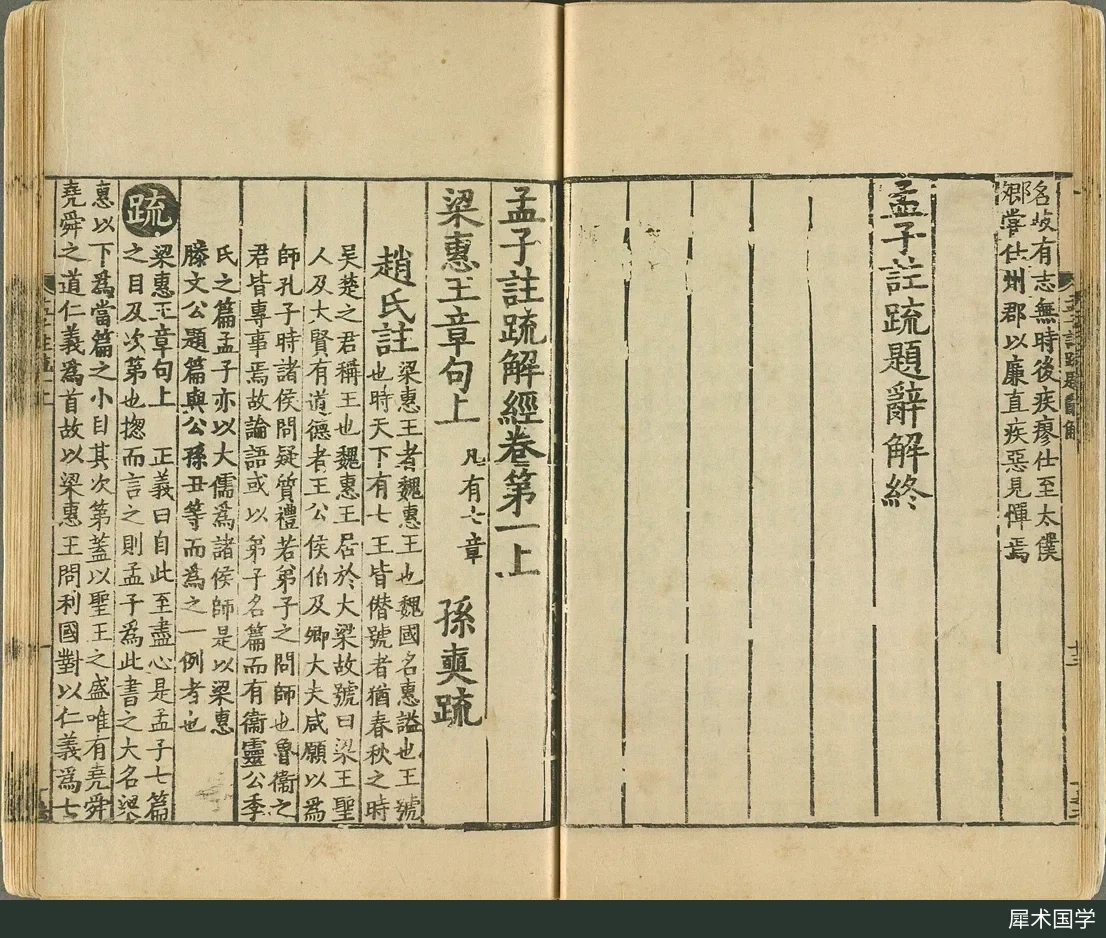
Figure: Leaf from Mengzi zhushu jiejing. Per Wikimedia Commons, a Southern Song Jiatai-era (1201–1204) imprint with Yuan–Ming successive repairs; image originally from a National Palace Museum, Taipei, exhibition page. Source: Wikimedia Commons[12]; license: public domain (PD-scan).

Study can begin in three steps:
- First prepare a reliable text. Readings repeatedly listed on course pages are Zhu Xi’s Mengzi jizhu, Yang Bojun’s Mengzi yizhu, and Jiao Xun’s Mengzi zhengyi, chiefly Zhonghua Book Company editions (years under each course above). Commentators do not always agree on the same chapter, and lectures follow their base texts; when readings diverge, return to the commentaries side by side.
- Open the course page and confirm current status. China University MOOC and Coursera both require registration and login; term dates and free access follow the enrollment page. NTU OCW can be watched on the web without enrollment.
- Advance in the order “text first, then interpretation, then topics.” Use Peking University’s close-reading course to get through the Mencius original and Zhu’s notes; then hear Huang Chun-chieh on how Xunzi, Zhu Xi, Wang Yangming, Dai Zhen, and others each read Mencius; finally, by interest, take South China Normal’s education topics or Puett’s course to place Mencius among pre-Qin thinkers.
References
-
Peking University: Mencius Close Reading, China University MOOC, course page, accessed 21 October 2026.
-
Peking University Office of Academic Affairs: “56 Peking University courses selected for the second batch of National First-Class Undergraduate Courses,” Peking University News, 7 June 2023, original.
-
School of Humanities and Social Sciences, Beijing University of Civil Engineering and Architecture: “General Education Lecture 28 and Humanities Lecture 32: Mencius’s temperament and the spiritual character of the Chinese nation,” 23 November 2023, original.
-
South China Normal University: Mencius: Educational Wisdom Appreciated, China University MOOC, course page, accessed 21 October 2026.
-
School of Education Science, South China Normal University: Huang Mingxi faculty page, new, old, accessed 21 October 2026.
-
China University MOOC: China University MOOC Platform Service Agreement, original, accessed 21 October 2026.
-
National Taiwan University: Modern Explorations of Mencius’s Thought, NTU OpenCourseWare, course page, accessed 21 October 2026.
-
National Taiwan University: East Asian Confucianism: Mencius I, Coursera, course page, accessed 21 October 2026.
-
National Taiwan University: East Asian Confucianism: Mencius II, Coursera, course page, accessed 21 October 2026.
-
Harvard University: The Path to Happiness: What Chinese Philosophy Teaches Us about the Good Life, Harvard course page, Harvard Online page, edX page, accessed 21 October 2026.
-
Class Central: Introduction to the Four Books and Five Classics (XuetangX), page, third-party transcription, accessed 21 October 2026.
-
Wikimedia Commons: Half Portraits of the Great Sage and Virtuous Men of Old - Meng Ke (孟軻).jpg; Jiatai Era Mencius title page.jpg, accessed 21 October 2026.
-
Information compiled and published by Scholay academic one-stop platform; report infringement for takedown.
-
Also published on EnterScholar, a scholars’ community for the intelligent age