The Guodian Chu slips excavated in 1993 let people see a Laozi that looks different from the received Wang Bi text: it is divided into groups A, B, and C, shorter in length, differently ordered, and the wording that corresponds to “discarding the sage and abandoning wisdom” is usually read as “discarding wisdom and abandoning disputation.” These differences supply physical clues to early textual transmission, but they cannot by themselves prove which copy is the original Laozi. Comparing versions first requires separating the bamboo slips, the editors’ transcriptions, and later interpretations.
Excavation and editorial editions
In October 1993, the Jingmen Municipal Museum excavated Guodian Tomb 1 at Jingmen, Hubei; the slips came from the head compartment of the tomb. On the basis of tomb form and artifact features, the excavators placed the burial in the later middle Warring States. That judgment comes from archaeological typological comparison; the slips themselves do not bear an exact year. Burial date, copying date, and the date when particular sayings took shape must also be discussed separately. Preface to Guodian Chu mu zhushu
Publication of the materials came in stages: Jingmen Municipal Museum’s “Jingmen Guodian yihao Chu mu” appeared in Wenwu 1997 no. 7; the museum’s Guodian Chu mu zhujian, published by Cultural Relics Press in May 1998, issued photographs with transcriptions and notes by Peng Hao and Liu Zuxin, plus remarks by Qiu Xigui. In 2011 came Guodian Chu mu zhushu, edited by the Wuhan University Center for Bamboo and Silk Manuscripts and the Jingmen Municipal Museum. Research must state which editorial round is used; later re-readings must not be backdated to the 1998 original transcription.
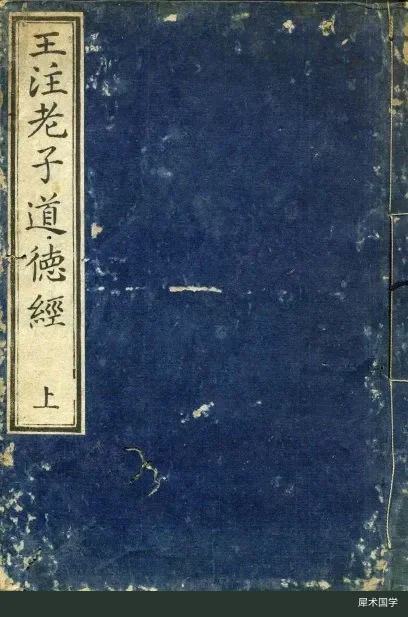
Hero caption: a transmitted leaf of Wang Bi’s annotated Laozi; the Commons file description marks it as a Japanese 1770 edition; the digital image’s original provider and present holding institution are unclear; uploaded by Miuki; public domain. It illustrates the look of an annotated edition, not a Guodian slip photograph. Source and license.

Length and order of the three groups
A, B, and C are first editorial groupings, not the upper, middle, and lower sections of the received text. Physical data record A as 39 slips, 32.3 cm long; B as 18 slips, 30.6 cm; C as 14 slips, 26.5 cm—71 slips in all; Taiyi shengshui is listed separately as 14 slips and is not mixed into this total. Chinese Association for Excavated Texts physical table
Following the correspondences in the Stanford Encyclopedia of Philosophy entry “Laozi,” the arrangement against received chapter numbers is listed below; the numbers are search coordinates, and some match only part of a chapter—they are not chapter numbers original to the slip text.
| Group | Arrangement corresponding to received chapters |
|---|---|
| A | 19, 66, 46, 30, 15, 64, 37, 63, 2, 32, 25, 5, 16, 64, 56, 57, 55, 44, 40, 9 |
| B | 59, 48, 20, 13, 41, 52, 45, 54 |
| C | 17, 18, 35, 31, 64 |
The three groups run to about two thousand characters. Group A begins from the passage corresponding to received chapter 19 and does not open with received chapter 1; material related to chapter 64 also appears in both A and C. Thus what is compared includes length, paragraph combination, and order—not only individual variant characters. Chapter correspondences and discussion
This table is a correspondence from institutional surveys already read; the 1998 original plates have not been rechecked slip by slip, and it is not used to give an exact total character count or to claim restoration of the slips’ original binding order.
Layers of variants and readings
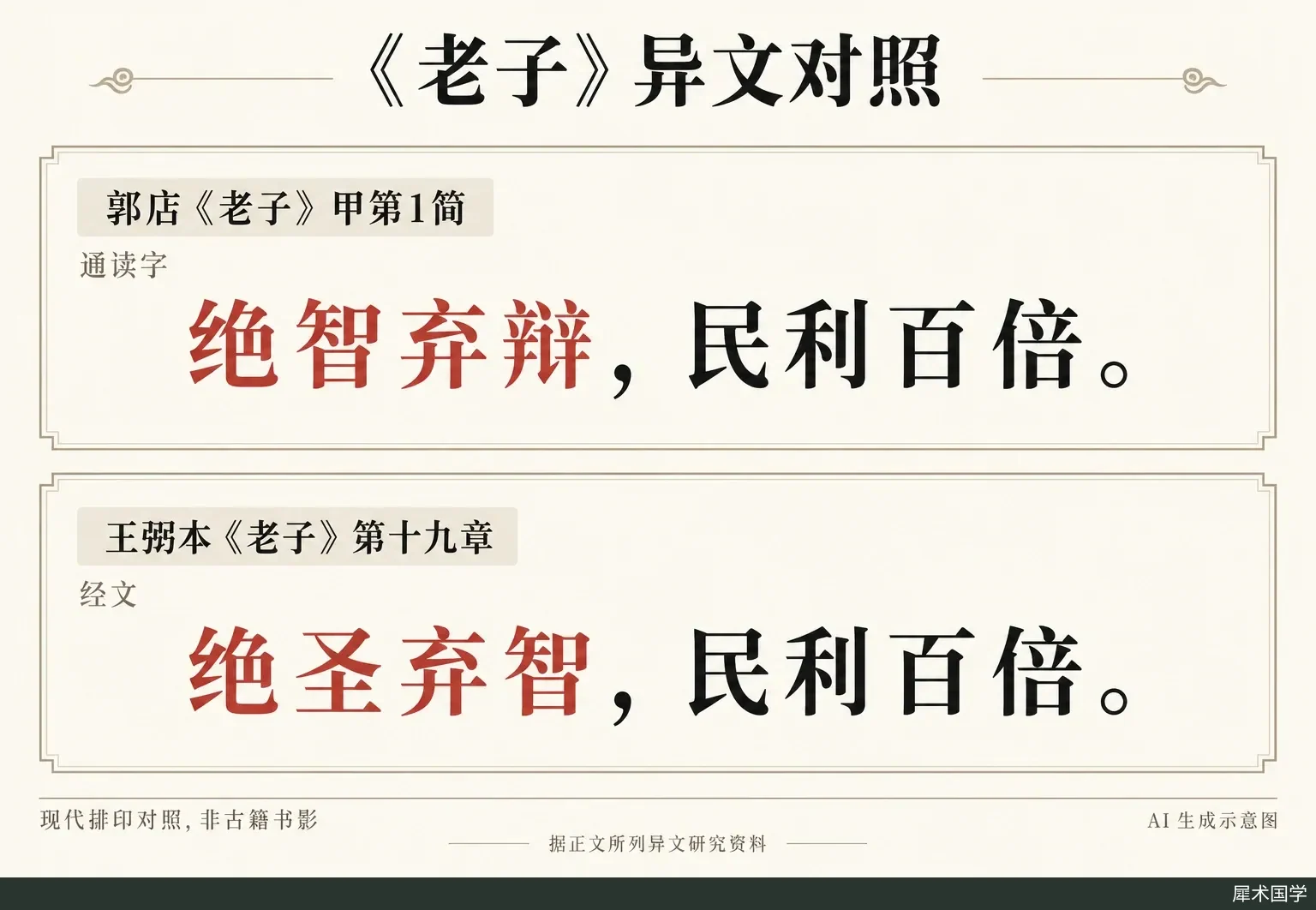
The best-known difference is between A slip 1 and received chapter 19. The slip wording is usually read through as “discard wisdom and abandon disputation, and the people will benefit a hundredfold”; the corresponding Wang Bi classic line is “discard the sage and abandon wisdom, and the people will benefit a hundredfold.” What is quoted here is the classic wording, not Wang Bi’s commentary; spellings such as zhi/zhi (“wisdom/know”) and bian/bian (“disputation/distinguish”) also involve transcription, reading-through, and editorial practice—modern typeset text must not be passed off as the slip graphs. Peng Yushang’s comparative essay lists the slip wording and the corresponding received wording directly; the Wang Bi corresponding line is also cited in a journal article quoting Peng Hao’s collated Guodian Chujian “Laozi” jiaodu (Hubei People’s Publishing House, 2000), p. 131. Peng Yushang original, PDF pp. 1–2, Journal citation of the Wang Bi corresponding line, p. 196
That “sage” does not appear among the objects discarded in this sentence does change how readers understand what is being criticized. Even so, one cannot generalize that the slip text entirely refuses Confucian ideas, still less press later Confucian–Daoist relations onto a single character. What first stands is a textual difference; intellectual-historical interpretation still needs context and other chapters as evidence.
Another set of variants in the same stretch especially shows the layers of reading: popular introductions often write “discard artifice and abandon deceit” (jue wei qi zha); Peng Yushang’s essay instead lists “discard artifice and abandon calculation” (jue wei qi lü); the 2011 editorial preface also notes that Qiu Xigui already supported reading the corresponding graph as lü. The table of contents of Laozi jinyan (Zhongxi Book Company, 2021) lists “Correcting an Error in My Reading of the Guodian Laozi Slips—On ‘Discard Artifice and Abandon Deceit’” beginning at p. 53. An early transcription must not be repeatedly cited as uncontested original slip wording. Editorial note, Qiu Xigui bibliography
This piece has not obtained the designated Wang Bi critical edition’s original leaf for chapter 19; the Wang Bi classic wording above rests on papers already read and does not for now unfold a line-by-line reading of Wang Bi’s notes.
Evidence and limits on the formation question
The Guodian materials split the “book formation” question more finely: some sayings later gathered into the Laozi were already written on slips then; whether those sayings already formed a book matching the received text in scale and order is another question. Finding corresponding passages by today’s chapter numbers does not mean the eighty-one-chapter structure already existed then.
There are at least two main directions of explanation: one takes them as selections copied from a more complete text; the other takes them as separately circulating textual sets before later compilation and expansion. That A and C preserve different forms of material related to chapter 64 is a clue for discussing source relations. Both directions must explain grouping, overlap, and missing text; the absence of a stretch from the tomb cannot alone prove that stretch had not yet taken shape. Differing explanations and overlapping material
This article’s judgment is that the Guodian slips are enough to remind us that the history of copy transmission and the history of compiling the whole book should be studied separately; they cannot alone settle the entire dating of the Laozi’s composition, still less decide authorship for us. That the slip text is earlier does not mean every character is necessarily closer to an original; that the received text is later does not mean every difference is a later deliberate rewrite.
For further reading, return to the 1998 photographs and transcription, then compare Li Ling’s Guodian Chujian jiaodu ji (Peking University Press, 2002) and Qiu Xigui’s specialized essays. Author, title, publisher, and year of Li Ling’s book have been verified from a Peking University Chinese Department notice; specific interpretations not read in the original book are not summarized here on its behalf.
References and pending checks
Materials already read and used in writing:
- Wuhan University Center for Bamboo and Silk Manuscripts and Jingmen Municipal Museum, eds.; Chen Wei and Peng Hao, chief eds.; Li Tianhong et al.: Guodian Chu mu zhushu, Cultural Relics Press, 2011. Preface, editorial principles, foreword, and table of contents from the institutional web page were read; the full book was not obtained; Laozi begins at p. 1, Taiyi shengshui at p. 21. Fudan University Center for Excavated Texts and Paleography, 4 January 2012 notice and book excerpts.
- Chinese Association for Excavated Texts: “Guodian Chujian,” page “physical overview.” Release date unmarked; slip counts and lengths for the three groups checked. Data page.
- Peng Yushang: “Notes on Reading the Guodian Laozi Slips against the Received Text (I)”; PDF pp. 1–3 on the Tsinghua institutional site read, p. 2 printed as 177; publication year and volume/issue shown in that file still need checking. Its received text mainly follows Chen Guying, not this piece’s designated Wang Bi base. Full essay.
- Alan K. L. Chan: “Laozi,” Stanford Encyclopedia of Philosophy, §2; first published 15 December 2001, substantially revised 22 October 2025. Used for chapter correspondences and a survey of the formation question. Entry.
- Qiu Xigui: Laozi jinyan, Zhongxi Book Company, 2021. Only the institutional book notice and table of contents were verified: “A Preliminary Exploration of the Guodian Laozi Slips” from p. 12; “Correcting an Error in My Reading of the Guodian Laozi Slips—On ‘Discard Artifice and Abandon Deceit’” from p. 53; “On the Laozi’s ‘Discarding Benevolence and Abandoning Righteousness’ and ‘Discarding the Sage’” from p. 65; the table of contents does not replace the body’s argument. Fudan University notice, 2 April 2021.
- Wang Chunhong: “The Question-and-Answer Form: A New Perspective on the Composition Structure and Speculative Mode of the Zhuangzi,” Journal of South China Normal University (Social Sciences) 2021 no. 4 (July), pp. 190–204; the Wang Bi chapter 19 corresponding line is at p. 196 n. ③, citing Peng Hao, ed., Guodian Chujian “Laozi” jiaodu, Hubei People’s Publishing House, 2000, p. 131; Peng Hao’s original book was not read and is not independently verified. Journal PDF.
Still lacking original-book checks: Jingmen Municipal Museum, ed., Guodian Chu mu zhujian (Cultural Relics Press, 1998), Laozi plates, transcription, and related note pages; Li Ling, Guodian Chujian jiaodu ji (Peking University Press, 2002), related pages; the designated Wang Bi critical edition’s original pages for chapter 19 classic and notes. Original books not obtained; the materials above are listed by actual consultation range; secondary citation, institutional notices, and table-of-contents checks are not the same as page-by-page reading of the original, and unverified page numbers and volume/issue data are not supplied.
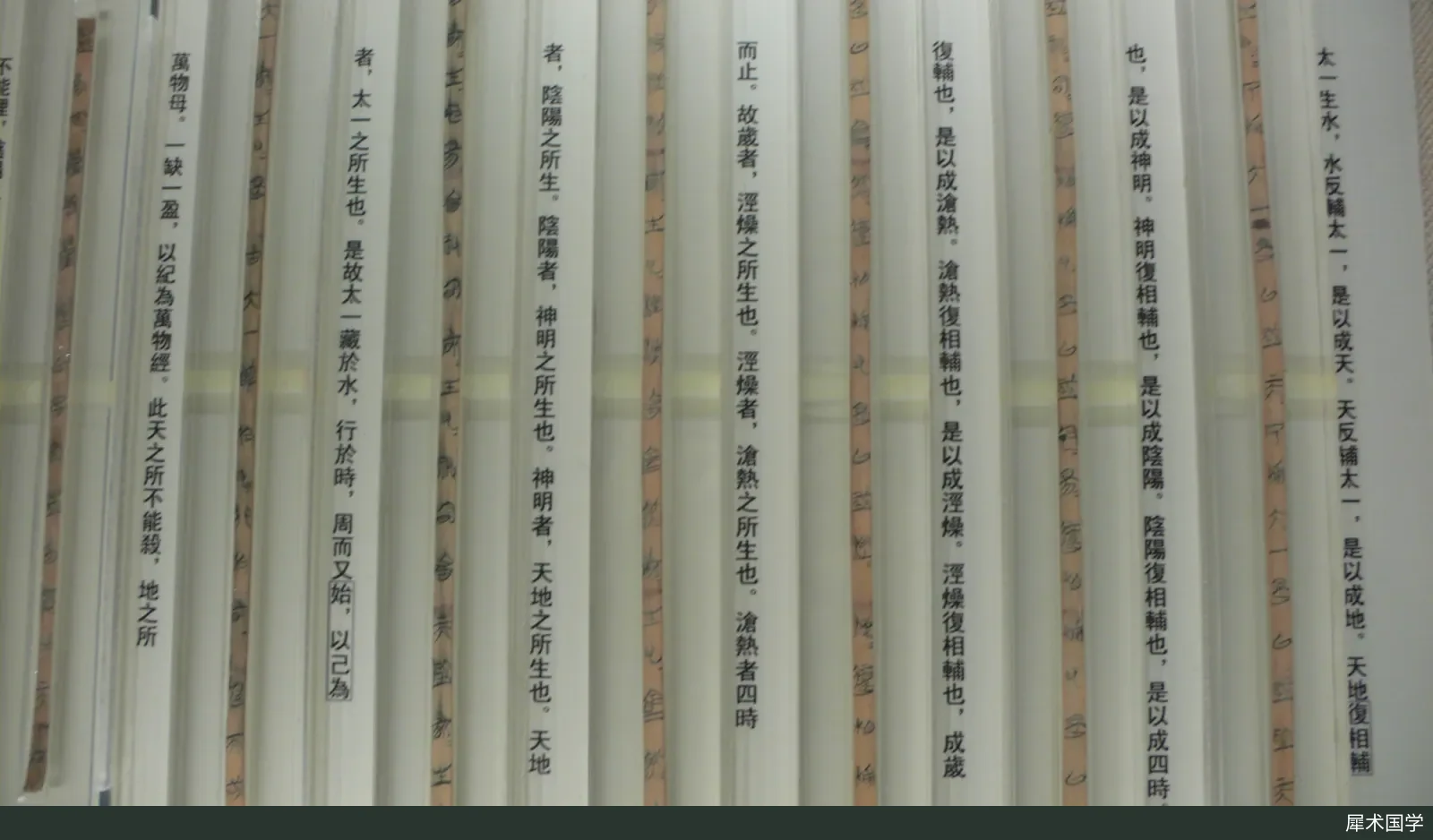
Body slip photograph caption: Hubei Provincial Museum display of a Taiyi shengshui detail, photographed by Sharkman on 19 March 2009, CC BY-SA 3.0, no content alteration; this is a Guodian co-tomb text, not any of Laozi groups A, B, or C. Photo page, license.

Variant comparison figure caption: AI-generated schematic, produced during the writing of this piece; modern typesetting compares the reading-through of Guodian Laozi A slip 1 with the Wang Bi chapter 19 classic wording, based on research materials listed in the body—not a rare-book leaf or slip facsimile. No third-party image license is attached to the generation record; it is not marked as a CC-licensed original image.
Hero source and license index: Wang Bi annotated Laozi leaf; Commons file description marks Japanese 1770 edition; uploaded by Miuki; digital image’s original provider and present holding unclear; public domain. File description, Public Domain Mark.
References
-
Information compiled and published by the Scholay academic one-stop platform; report infringement for takedown.
-
Also published on Enter Scholar, a scholars’ community for the intelligent age